
Why Does No-Added-Sugar Yogurt Still List Sugar?
Milk naturally contains lactose. Read a yogurt's ingredient list, compare two tubs by weight, and calculate the amount of sugar in the portion you actually eat.
You pick up a tub of yogurt marked “no added sugar” and turn it around. The nutrition label says 5.7 grams of sugar. The tub next to it says “plain” and gives a number for a different serving size. Before putting either back, look at the amount of yogurt printed above the numbers.
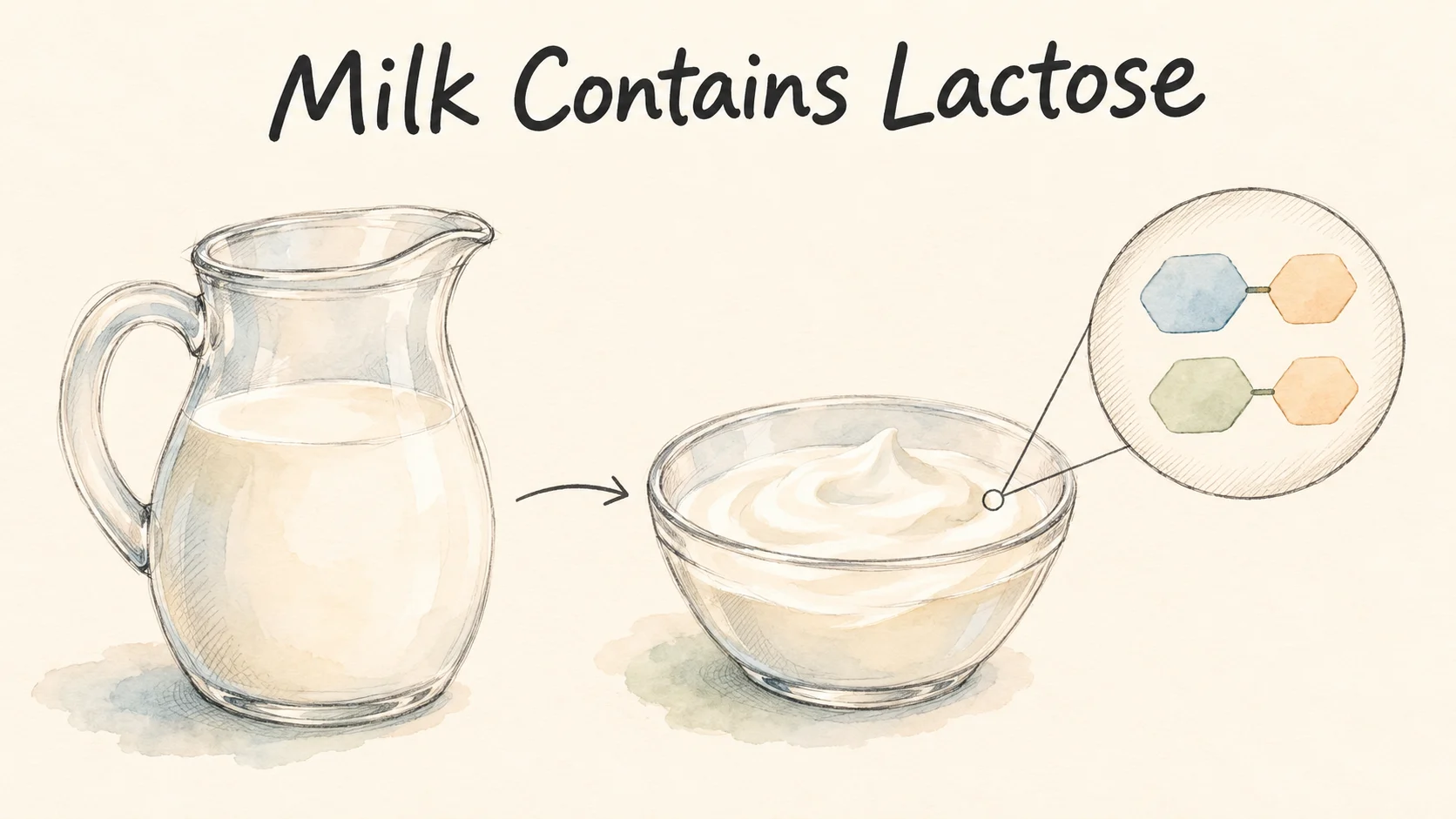
Milk naturally contains a sugar called lactose, and any lactose left in yogurt counts toward its total sugar. A claim about adding sugar describes how the food was made. The sugar figure tells you how much is in the finished yogurt. Compare the two tubs by the same weight, then calculate the amount in the portion you plan to eat [1][2].
How milk sugar gets into yogurt
Yogurt cultures use some of the lactose in milk and make lactic acid. As the milk gets more acidic, its proteins form the soft structure you recognize as yogurt. Some lactose typically remains. Researchers who measured sugars during yogurt production found that the sugar composition changed during fermentation. In one manufacturing study, lactose fell from an average of 8.50% in the mix to 5.75% after fermentation. Those figures describe the recipe the researchers tested, and you can see both parts of the result at once. The amount fell, and a measurable amount remained [4].
On a Taiwanese nutrition label, the line for sugar adds up the individual sugars, including single sugars and pairs of sugars. Lactose is one of those pairs, as is the sucrose in table sugar. The total can include more than one kind. The label gives you their combined weight [1].
A spoonful can taste tart and contain a few grams of sugar at the same time. The taste comes from what is in the yogurt after fermentation, including the acid. The sugar line gives you a number you can use to compare it with another tub.
The ingredient list and the nutrition panel
Take the 200-gram tub of Uni-President AB+ No Added Sugar Yogurt sold in Taiwan. The ingredients include milk powder and fresh milk. The nutrition information lists 5.7 grams of sugar and 5.6 grams of protein per 100 grams [2]. The dairy ingredients give you a clue about the source of the sugar. The nutrition panel gives you the amount in a specified weight of yogurt.
If another tub lists sugar, syrup, or honey, you can see that those ingredients went into the recipe. For a fruit preparation, check the ingredients in parentheses when the package lists them. A flavor name like “plain” helps you find a product on the shelf. The ingredients tell you what went into it. A sugar total alone gives no breakdown of the individual ingredients' contributions.
In the United States, a Nutrition Facts label can help you separate those questions. Total Sugars includes Added Sugars. When you see “Includes 4g Added Sugars” below a Total Sugars figure of 10 grams, the 4 grams are part of the 10. Keep those two lines separate when deciding what to compare. On a Taiwanese label, use the sugar line and the ingredient list together [1][5].
Compare equal weights before comparing tubs
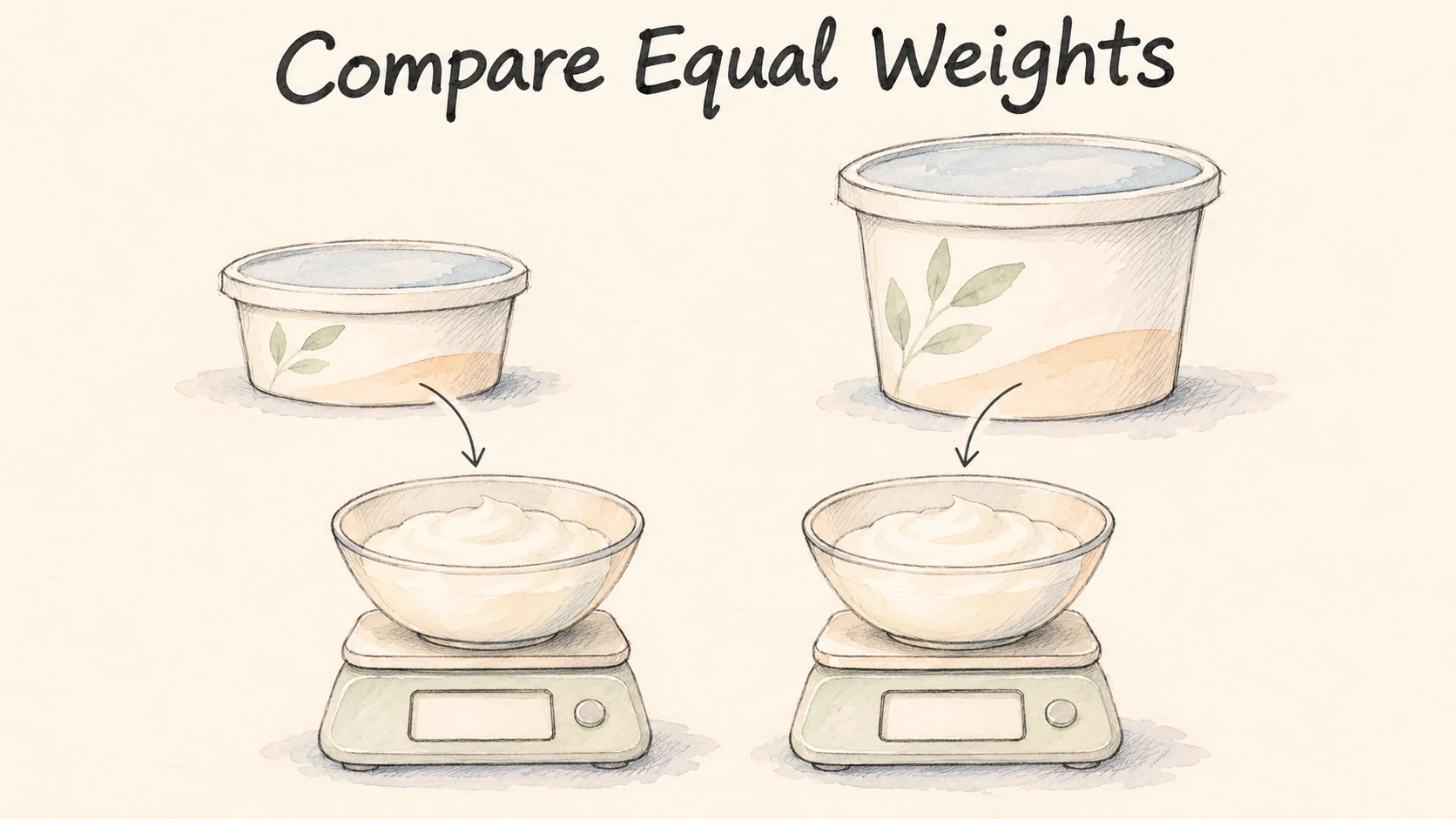
Imagine two single-serve yogurts. Yogurt A lists 5 grams of sugar per 100-gram serving. Yogurt B lists 6 grams per 150-gram serving. If you eat one serving of each, A gives you 5 grams and B gives you 6.
Now set an equal weight of each yogurt on the kitchen counter. In 100 grams, A still gives you 5 grams of sugar. B gives you 4 grams, because 6 ÷ 150 × 100 = 4. In this made-up example, B has the lower sugar concentration and its larger serving still gives you the higher total. Both comparisons tell you something, depending on how you plan to serve it.
If the label already gives numbers per 100 grams, use that column. For a number per serving, divide by the serving weight in grams and multiply by 100. The same calculation works for protein. A drinkable yogurt can be labelled by volume. Compare it with another product using the same volume, such as 100 milliliters [1].
What goes into your bowl?
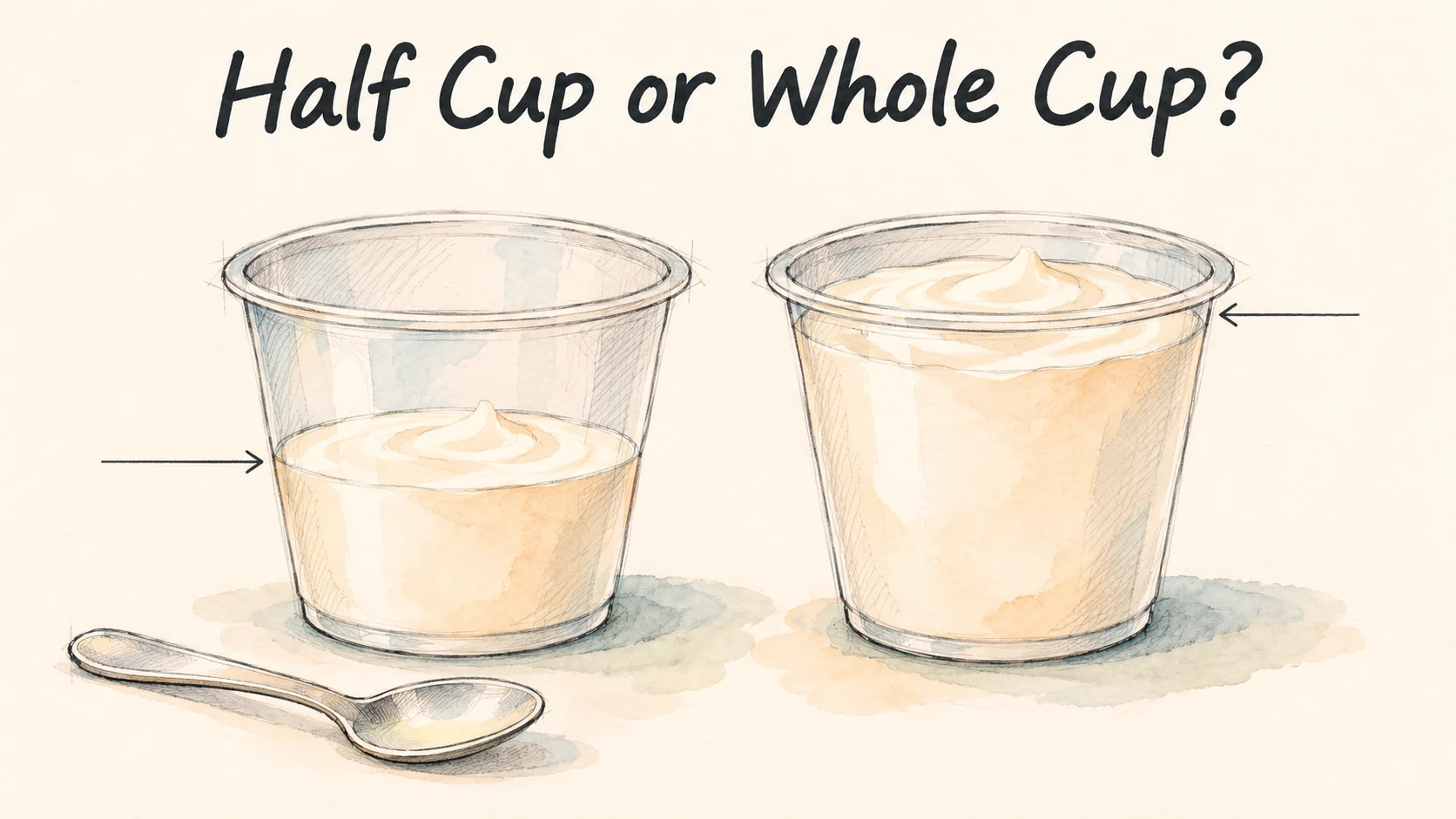
Return to that actual 200-gram tub. The reference amount on its label is 100 grams, which is half the tub. Eating the whole tub gives you twice the listed amounts [2].
- 100 grams, or half the tub: 5.7 grams of sugar and 5.6 grams of protein.
- 150 grams, or three-quarters of the tub: about 8.6 grams of sugar and 8.4 grams of protein.
- 200 grams, or the whole tub: 11.4 grams of sugar and 11.2 grams of protein.
For a large tub, you can put your usual bowl on a kitchen scale once, zero the display, and scoop the amount you normally eat. That gives you a reference for the next time you use the same bowl. If you're going by servings, multiply the amount on the panel by the number of servings you eat. A package can contain several servings even if it looks like something you could finish at once.
For a tub with fruit sauce or granola in a separate compartment, check whether the nutrition figures include the topping. Use the figures for the combination you actually eat. When the panel covers the yogurt and topping together, count that combined figure once.
Does the yogurt with more protein keep you full longer?
A Greek-style yogurt can contain more protein, and the label tells you how much is in the one you buy. How hungry you feel later is something researchers have to measure separately.
University of Missouri researchers recruited 32 healthy women, aged 27 on average. On separate days, each ate a standardized lunch and then had an afternoon yogurt snack three hours later. Both snacks contained 160 calories. One supplied 5 grams of protein and the Greek-style yogurt supplied 14 grams, nearly three times as much. The researchers tracked hunger and fullness, how long participants waited before requesting dinner, and how much they ate at dinner [3].
Participants requested dinner about 2 hours and 40 minutes after either snack. The researchers found no statistically significant difference in hunger, fullness, dinner timing, or dinner intake. The trial tracked the afternoon after each of the two snacks [3].
If you want more protein in a snack, the grams on the package help you choose. To find out how a snack fits into your afternoon, consider the portion, what you have with it, and when you tend to get hungry again.
Try it at the yogurt case
Pick up the tub you normally buy and a second one you want to compare. Read the ingredients to see which uses milk, fruit, or sweeteners. Put their sugar and protein on the same scale of 100 grams. Then calculate the amount in your own bowl or tub. If you usually finish the 200-gram tub from the opening, the number you're looking for is 11.4 grams of sugar. The 5.7 grams describe half the tub [2].
For individual dietary needs, consult a physician or dietitian.
Sources
[1] Taiwan Ministry of Health and Welfare. Nutrition labelling requirements for prepackaged food.
[2] Uni-Prosperity. Uni-President AB+ No Added Sugar Yogurt, 200 g, ingredients and nutrition information.
[3] Ortinau LC, et al. The effects of increased dietary protein yogurt snack in the afternoon on appetite control and eating initiation in healthy women. Nutr J. 2013;12:71.
[4] Goodenough ER, Kleyn DH. Qualitative and quantitative changes in carbohydrates during the manufacture of yogurt. J Dairy Sci. 1976;59(1):45–47.
[5] U.S. Food and Drug Administration. Added Sugars on the Nutrition Facts Label.