
The label says 120 calories per serving. What about the whole bag?
Start with serving weight and servings per package. A bag of roasted chickpeas shows how to calculate a bowl, a full bag, and a fair comparison between two foods.
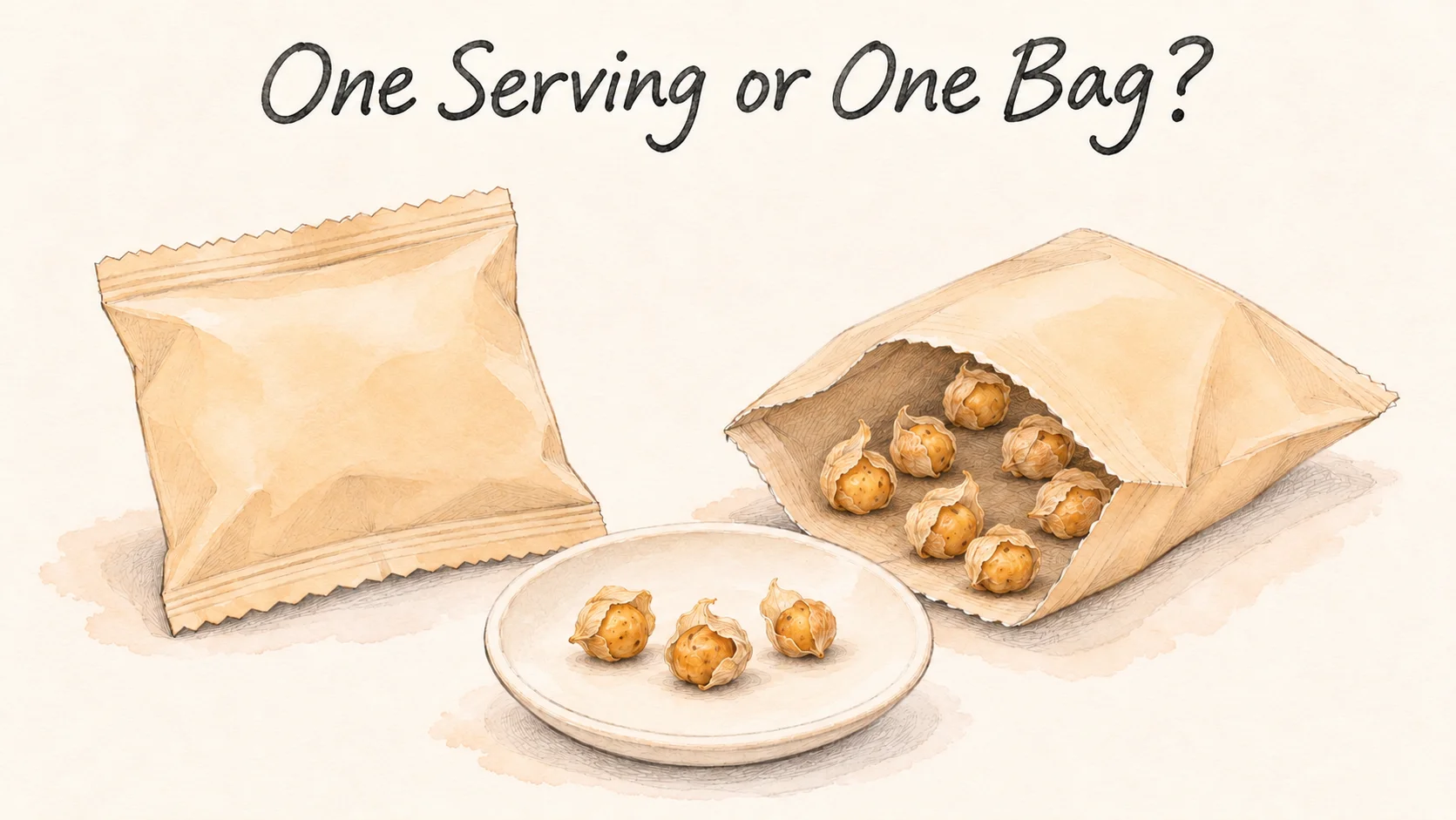
You pour a bag of roasted chickpeas into a bowl to eat during an afternoon meeting. As you shake the last few out of the bag, you spot 120 calories per serving. Does that number mean you've eaten 120 calories when the bag is empty?
Check how many servings the bag contains. Suppose the label says 120 calories in a 30-gram serving and there are 120 grams in the bag. That's four servings, so the whole bag contains about 480 calories. If you pour only 45 grams, that's one and a half servings, or about 180 calories. These numbers are an example. Use the actual label for your own snack [1][2].
Read the two lines that tell you what the rest means
Turn the bag over and look near the top of the nutrition panel. The serving size tells you the weight used for one serving. Servings per container tells you how many of those portions are in the bag. If calories, protein, or sodium appear in the per-serving column, they apply to the weight in the serving-size line. The U.S. Food and Drug Administration starts with these same two lines in its advice on reading labels [1][2].
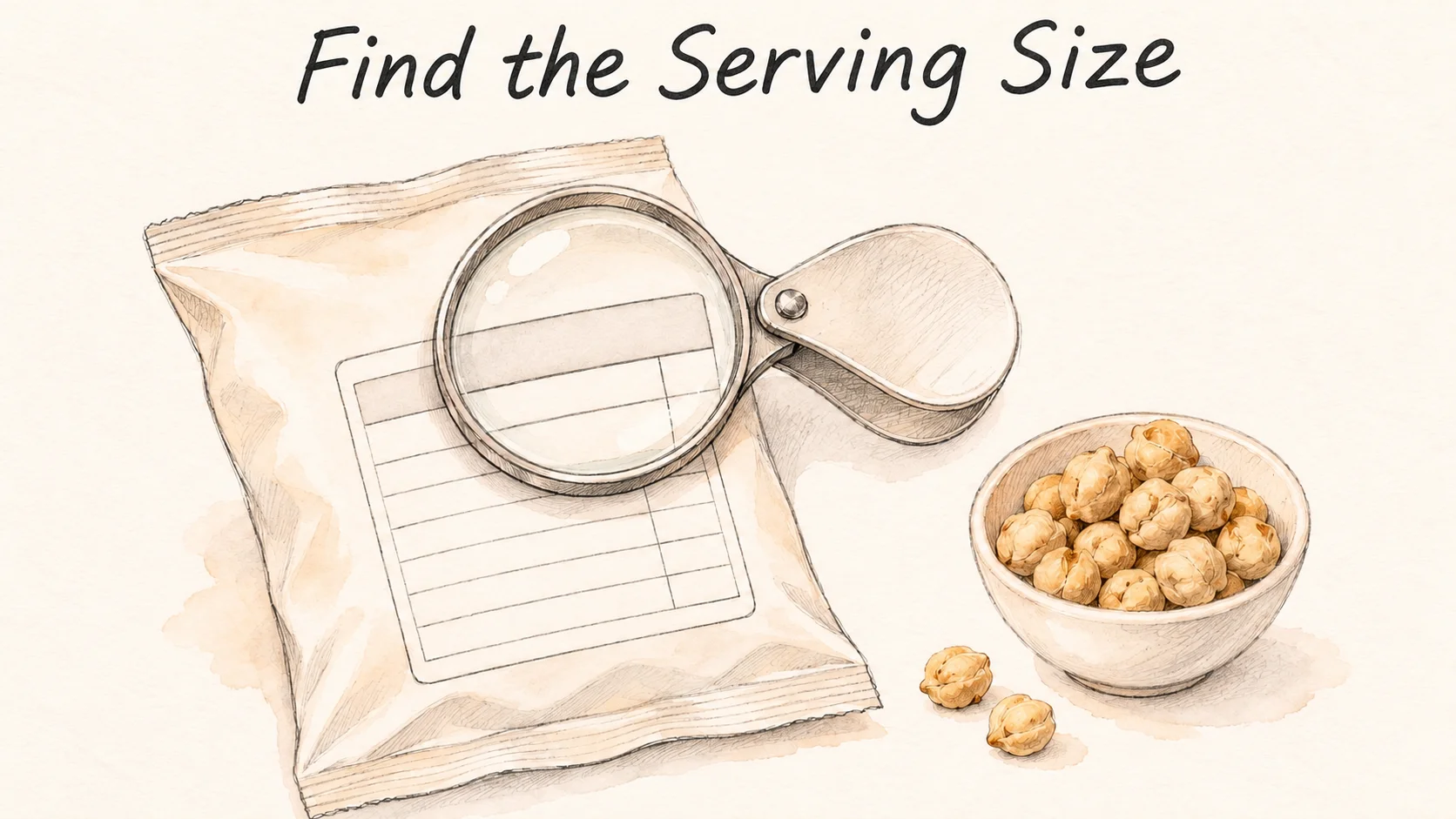
The serving on the label gives you a reference amount for the food. A resealable bag may contain several of those portions. A small snack pack might contain one. If you split the bag with a colleague or eat it over two afternoons, use what you ate each time. The serving size gives you the starting point for the calculation.
If there's already a per-package column and you eat the whole package, read it directly. Check the heading when you see two columns together. A column per 100 grams lets you compare equal weights. A column per package describes the whole container. A percent daily value sets a given nutrient amount against a reference for the day. The columns look similar, but their headings tell you which question each one answers [1][2].
Look for the unit next to that heading too. A serving of a solid snack is typically written in grams, while a carton of a drink may use milliliters. For the comparison here, weigh the chickpeas in grams because that's the unit on the label. The 120 in the weight line and the 120 in the calorie row describe different things even when the digits happen to match.
When a large bag holds smaller individual packets, check which layer the label describes. The serving might be one inner packet or a stated number of grams. If you only opened one packet, start with how much that packet holds before using the number printed on the large bag.
What if you eat 45 grams?
Take the hypothetical bag of roasted chickpeas. Each 30-gram serving contains 120 calories and 140 milligrams of sodium. Divide the 45 grams you ate by 30 grams. That's one and a half servings. Multiply the label numbers by 1.5. You get about 180 calories and 210 milligrams of sodium in the bowl.
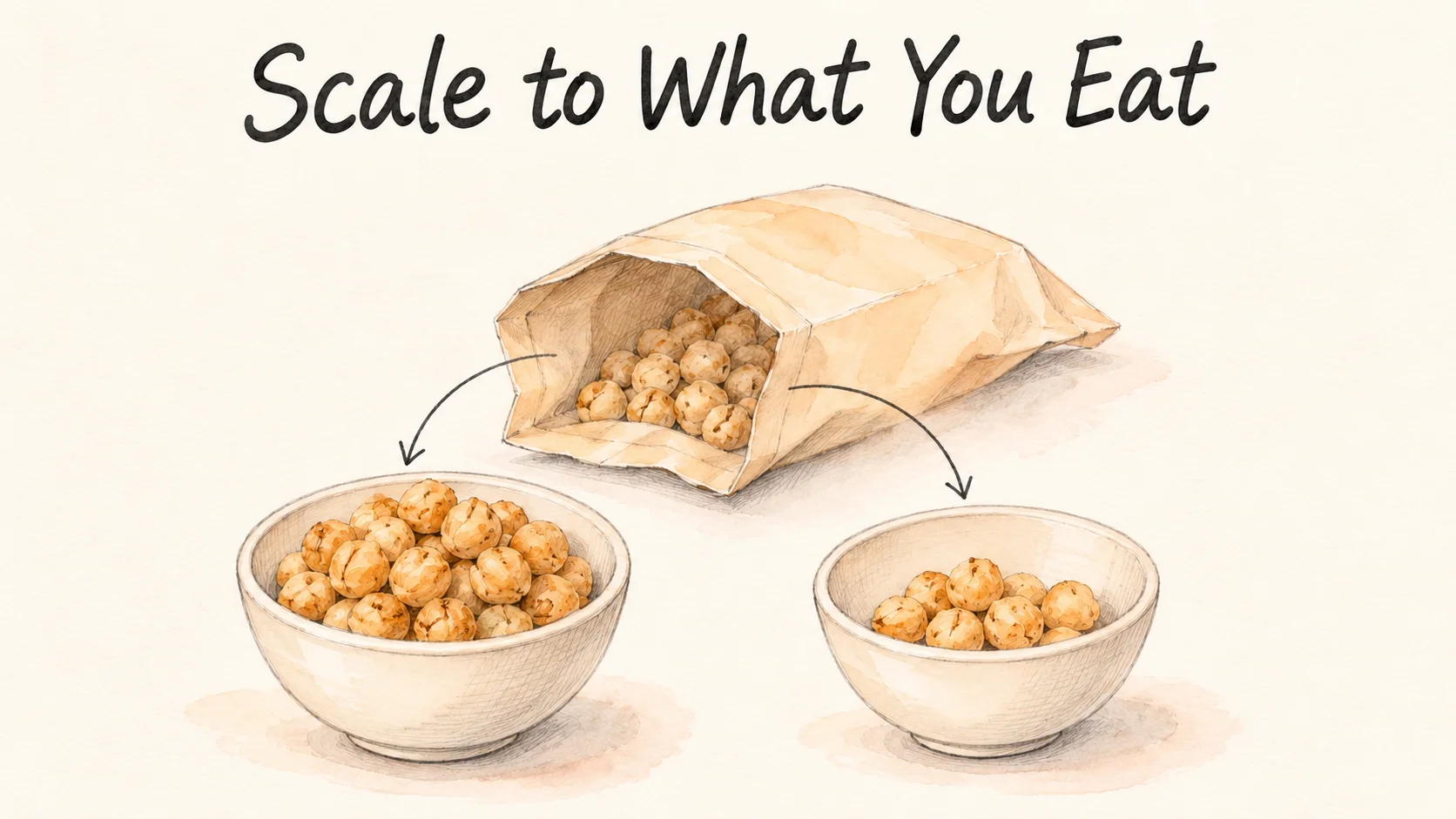
Suppose the 120-gram bag is split equally among three people. Each person gets 40 grams, or about one and a third servings. You could also use the per-100-gram figure, which is 400 calories in this example. Forty grams is 0.4 times 100 grams, so that's about 160 calories. The two routes work because you started with the same food and ended with the same portion.
You can try it once with a bowl you use for snacks. Put the empty bowl on the scale and press tare. Pour the amount you usually take and see what it weighs. Next time you use the same bowl and the same snack, you'll have a rough reference. When the food changes, the same level in the bowl could hold a different weight. A loose pile of larger pieces can take up more room than small chickpeas.
You can also weigh the same open bag before and after you pour. The bag itself weighs the same both times, so the difference is the weight of what came out. If you poured some for a friend too, that technique gives you the combined amount. Your own bowl is a better measure of your share.
Labels round some of their numbers. Multiplying the per-serving figure may give a slightly different total from the per-100-gram figure and the full package weight. Read the per-package number when it's present. Treat a calculated value as an estimate [1].
Which product has more sodium at the same weight?
Imagine choosing between two bags. In the first, a serving weighs 30 grams and has 140 milligrams of sodium. In the second, a serving weighs 40 grams and has 165 milligrams. If you only look at the serving column, the first number is lower. Convert both to 100 grams and the first is about 467 milligrams, while the second is about 413. In this example, the second serving was bigger. The comparison reverses when you use equal weights.
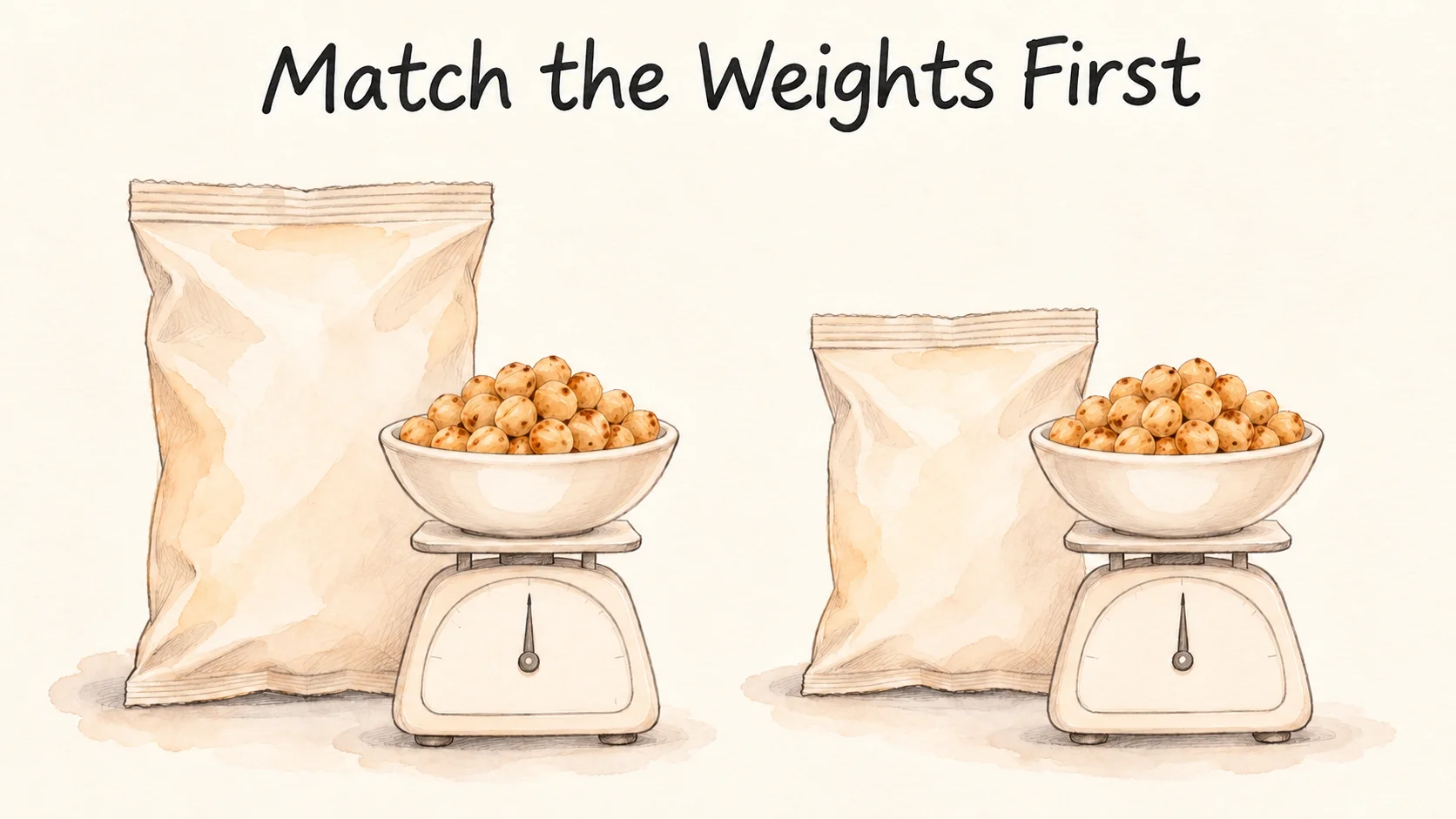
Getting the same concentration comparison doesn't settle how much you'd eat. If one bag is much larger and you finish it, the total can be greater even if there's less sodium in 100 grams. If you pour the same weight from either, the per-100-gram comparison tells you which bowl has more. You can decide which comparison you need before going back to the label.
A Japanese label may list salt equivalent instead of milligrams of sodium. Japan's Consumer Affairs Agency converts sodium in milligrams by multiplying by 2.54 and dividing by 1,000 to get grams of salt equivalent. The bowl's 210 milligrams of sodium is about 0.53 grams salt equivalent. Convert to the same nutrient unit as well as the same food weight [3].
For example, on a day you need a snack to share, think about the total in the bag and how many people will split it. On a day you take a small bowl from a larger bag at home, you can leave the bag size out of the calculation and use the weight in the bowl. The formula stays the same. What changes is the quantity you plan to eat.
Which number helps the next time you open the bag?
To estimate the bowl in front of you, look at the serving weight and work out what fraction or multiple of it you poured. When you've split a bag, use your share. When you're comparing two recipes before buying, look for values given at the same weight.
Next time you see 120 calories per serving, look just above it for the number of grams. Match that amount to what you're actually eating and the front of the label becomes much easier to use.
References
[1] Taiwan Food and Drug Administration. Regulations for nutrition labeling of prepackaged foods. Questions on serving size and servings per container.
[2] U.S. Food and Drug Administration. Serving Size on the Nutrition Facts Label.
[3] Consumer Affairs Agency, Japan. Consumer guide to food labelling. April 2025 edition. Converting sodium to salt equivalent.