
Fiber Reaches Your Colon Undigested. Does It Leave the Same Way?
Researchers followed what happened for 12 hours after a breakfast with 15 grams of inulin. Gut microbes made short-chain fatty acids, and a blood sample could only show part of the story.
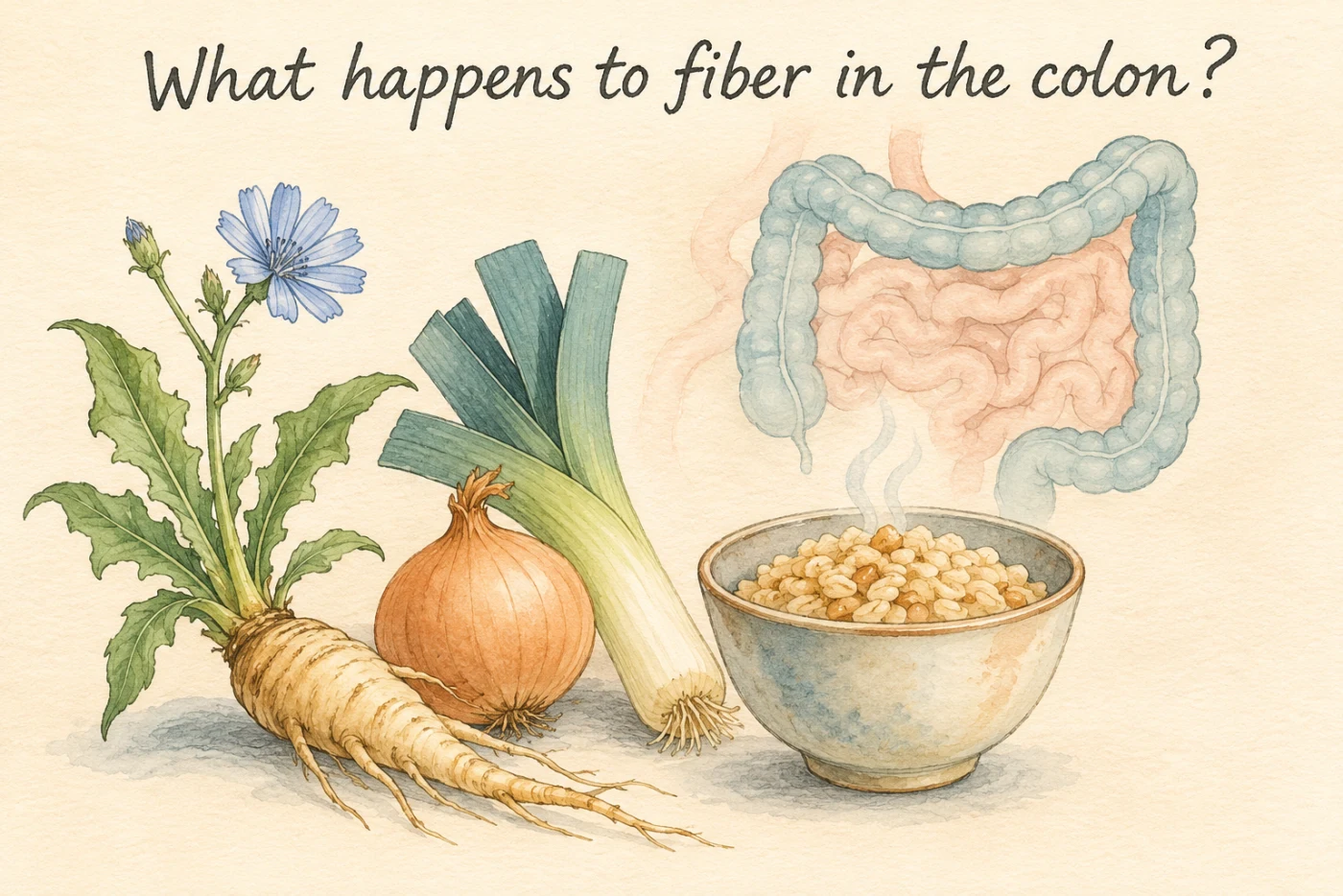
You have oats for breakfast and spoon some beans into dinner. When you hear that fiber isn't digested, you might picture it going through the gut and leaving exactly the way it came in. Something else can happen once it reaches the large intestine.
Microbes in your colon can ferment some of the fiber your small intestine didn't digest. As they use it, they can produce short-chain fatty acids such as acetate, propionate, and butyrate. In one experiment, researchers wanted to know how much was produced after people ate a fiber called inulin. A sample from an arm vein could only tell them about the part that made it into the wider bloodstream [1].
Who can use the food that reaches the colon?
Inulin is one way some plants store carbohydrates. It contains chains made largely of fructose and occurs in foods such as chicory root and onions. Human digestive enzymes cannot cut the links that join the fructose units in inulin, so it can reach the colon. Some of the microbes that live there can break them down and make use of them.
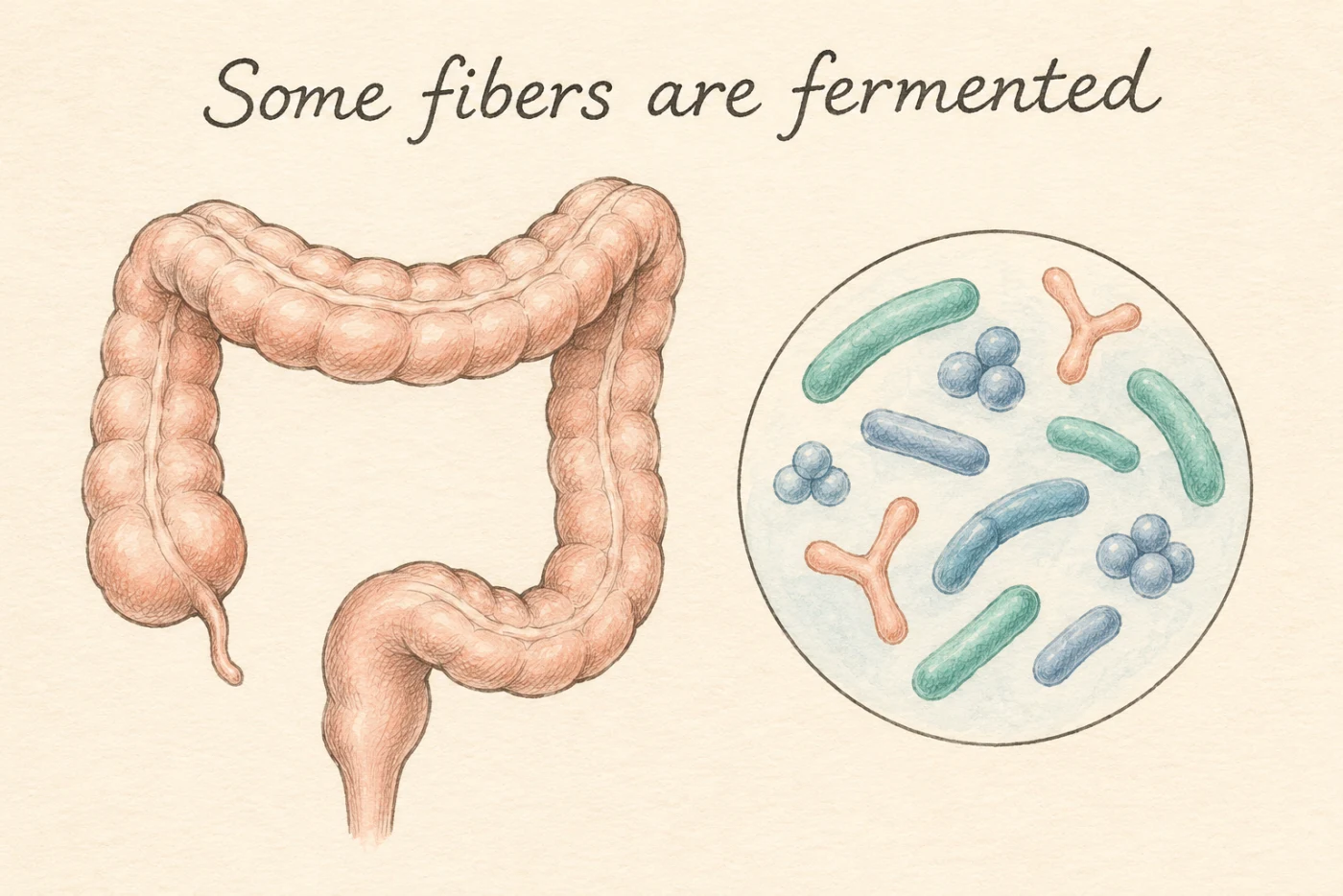
Fermentation can generate gas and molecules much smaller than the original plant fiber. Short-chain fatty acids are one group of those molecules. Despite the name, those fatty acids weren't sitting in the spoonful of fiber beforehand. Cells lining the colon can take them up. Some are used in the gut wall or the liver, while some reach the rest of the bloodstream. Cells in the colon can use a considerable share of the butyrate. If a test from an arm finds less butyrate than another acid, it doesn't follow that less butyrate was produced inside the colon [1].
Looking in stool runs into a different version of the same problem. The colon can absorb the acids while its contents are still moving through the gut. What remains at the end reflects what was produced and what was taken up along the way. If you want to know how much was produced in the colon, neither a stool concentration nor the concentration in a single tube of blood gives you that total [1].
How do you estimate what was made without collecting it in the gut?
Researchers in 2015 gave 12 healthy adults a standardized breakfast and 15 grams of inulin. They infused known amounts of the three short-chain fatty acids in forms tagged with stable isotopes. They took blood samples for 12 hours and breath samples for up to 10 hours. As more untagged forms of the same acids enter circulation, the tagged forms are diluted. The researchers used that change to estimate the appearance of the acids in the blood [1].
The fiber itself also needs time to reach the colon. The researchers tracked hydrogen in the breath as a sign of microbial fermentation. Breath hydrogen rose an average of five hours and 38 minutes after breakfast in this group. That is a timing marker from this breakfast and measurement setup. The team used the early readings to estimate how fast the fatty acids were already entering the blood, then calculated what appeared above that baseline. All 12 people had inulin with breakfast. The baseline came from earlier in the same session, without a separate breakfast-only comparison [1].
Over 12 hours, the researchers estimated that the colon produced an average of 137 millimoles of acetate, 11 of propionate, and 20 of butyrate. A millimole is a way to count an amount of molecules. By that measure, acetate was the most abundant of the three estimated products under the conditions of the experiment [1].
The same results table estimates an average cumulative appearance in the wider bloodstream of 55 millimoles of acetate, 1.1 of propionate, and 1.0 of butyrate. Notice how nearly equal propionate and butyrate look at this stage. Estimating the amount made in the colon changes their order because different shares are expected to reach the blood [1].
To get from the blood to those numbers, the team used previous evidence to assume that 40 percent of the acetate, 10 percent of the propionate, and 5 percent of the butyrate from the colon would appear in the wider bloodstream. Follow the calculation for butyrate. If 1.0 millimole represents 5% of the colonic amount, divide 1.0 by 0.05 to estimate 20 millimoles in the colon. Change the fraction and the estimate changes, too [1].
The numbers depend on the fiber, the amount, the measurement period, and the fractions used in the calculation. The team didn't collect and weigh all the acids made in the colon.
The group later asked a related question in another study. In 12 healthy adults, capsules released known amounts of the three tagged acids into the colon. About 36% of the acetate, 9% of the propionate, and 2% of the butyrate reached the wider circulation as the corresponding acid. This experiment traced the acids from their release in the colon. The breakfast experiment estimated how much was made after eating a particular fiber. The capsule study shows why so little of the butyrate can appear in the arm. It didn't repeat the 15-gram breakfast experiment or remeasure its production totals [1, 2].
Does a gram of fiber always do the same thing?
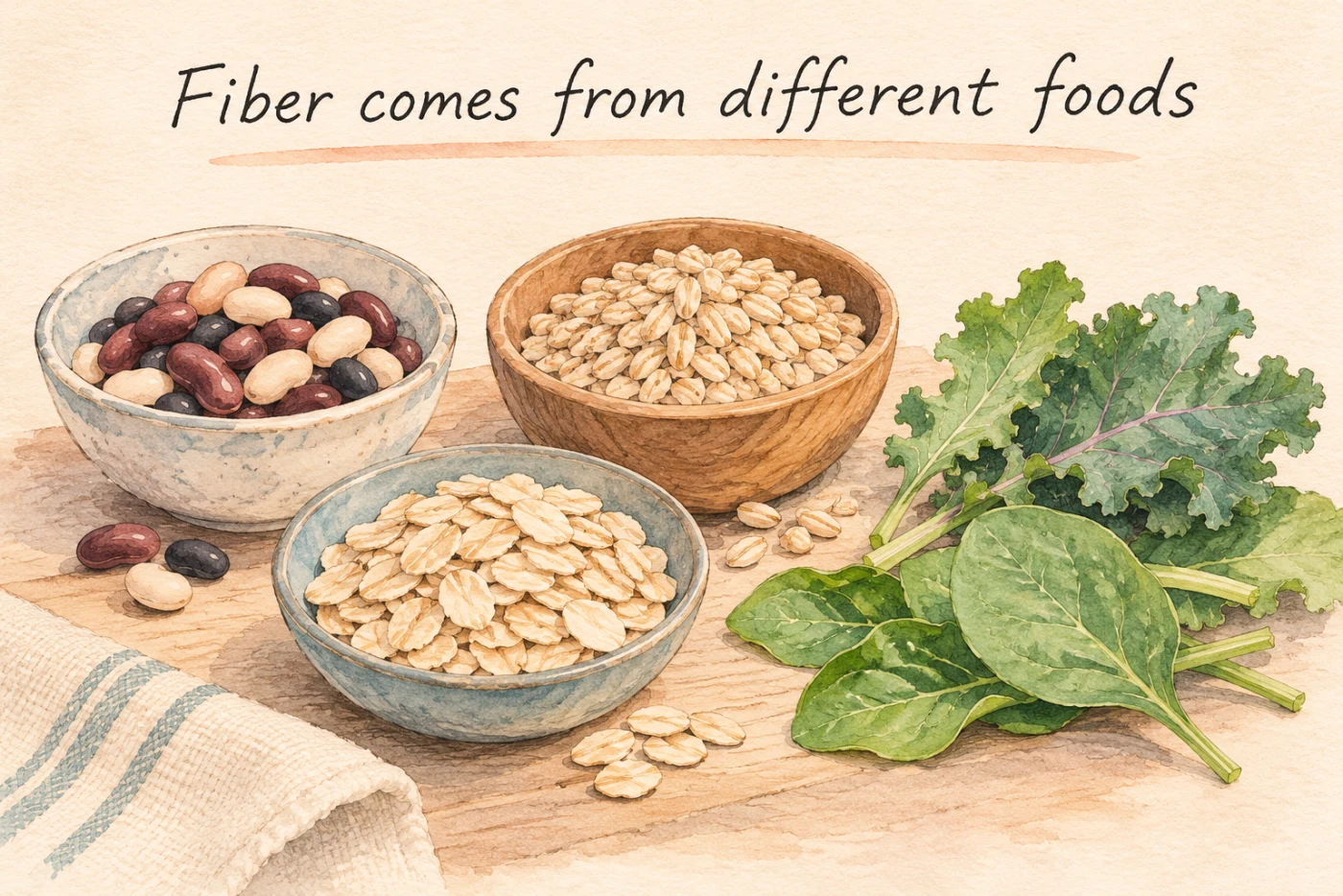
One food package may get most of its five grams of fiber from added inulin. Another might get five grams from a mixture of fibers in oats or beans. The label totals the grams, but it usually doesn't tell you how quickly the microbes can use each of those materials. Some fibers are more readily fermented than others. Some can hold water and contribute to the bulk or texture of food and stool. The same total doesn't tell you whether the microbiota will make the same mix of products.
A lab comparison gives one example of different patterns. Researchers incubated inulin, wheat dextrin, and partially hydrolyzed guar gum separately with microbes obtained from human stool. Inulin had produced the most gas by eight hours. At 24 hours, the guar gum condition had produced more propionate than inulin. Those are different outcomes, measured at different times in containers. They don't supply measurements of gas or blood propionate after a person eats those foods [3].
The nutrition panel and ingredients list can help with different questions. If a 250-gram portion contains two grams of fiber per 100 grams, the portion supplies five grams. If inulin is on the ingredients list, you know it is one of the materials the food contains. The list typically won't tell you how much of the five grams came from inulin. The two labels let you compare the portion and identify a source without turning either number into a forecast for your colon.
If you're trying a different breakfast, you can write down which grains, beans, fruits, or vegetables you had and how you felt afterward. Gas can be part of fermentation, but how much you notice also depends on how much you ate, what else you had, and how the rest of your gut is working. It isn't a way to measure your production of butyrate. The 15 grams was the amount researchers chose so they could compare measurements after one breakfast. It wasn't a target to hit yourself.
Think back to the oats and beans. Being hard for your own enzymes to digest can be exactly what lets some of their fiber reach the microbes that can use it. What happens next depends on the particular fiber and the amount that gets there.
References
- Boets E, et al. Quantification of in vivo colonic short chain fatty acid production from inulin. Nutrients. 2015;7(11):8916–8929.
- Boets E, et al. Systemic availability and metabolism of colonic-derived short-chain fatty acids in healthy subjects: a stable isotope study. J Physiol. 2017;595(2):541–555.
- Noack J, et al. Fermentation profiles of wheat dextrin, inulin and partially hydrolyzed guar gum. Nutrients. 2013;5(5):1500–1510.