
Sore on the stairs the next day. Was it a better workout?
Two human studies show what happens when soreness, short-term strength, and muscle growth are measured separately.
You try the leg press for the first time and feel fine on the way home. The next morning you reach the subway stairs, and your thighs ache the moment you lower yourself onto the first step. After a few more sessions, the stairs feel ordinary again. Did the exercise stop working? Next-day soreness tells you how the muscle feels. It can change alongside short-term strength, and the two can change by different amounts. To tell whether the muscle grew over several weeks, you need a longer comparison. [1, 2]
Why do you feel it on the stairs a day later?
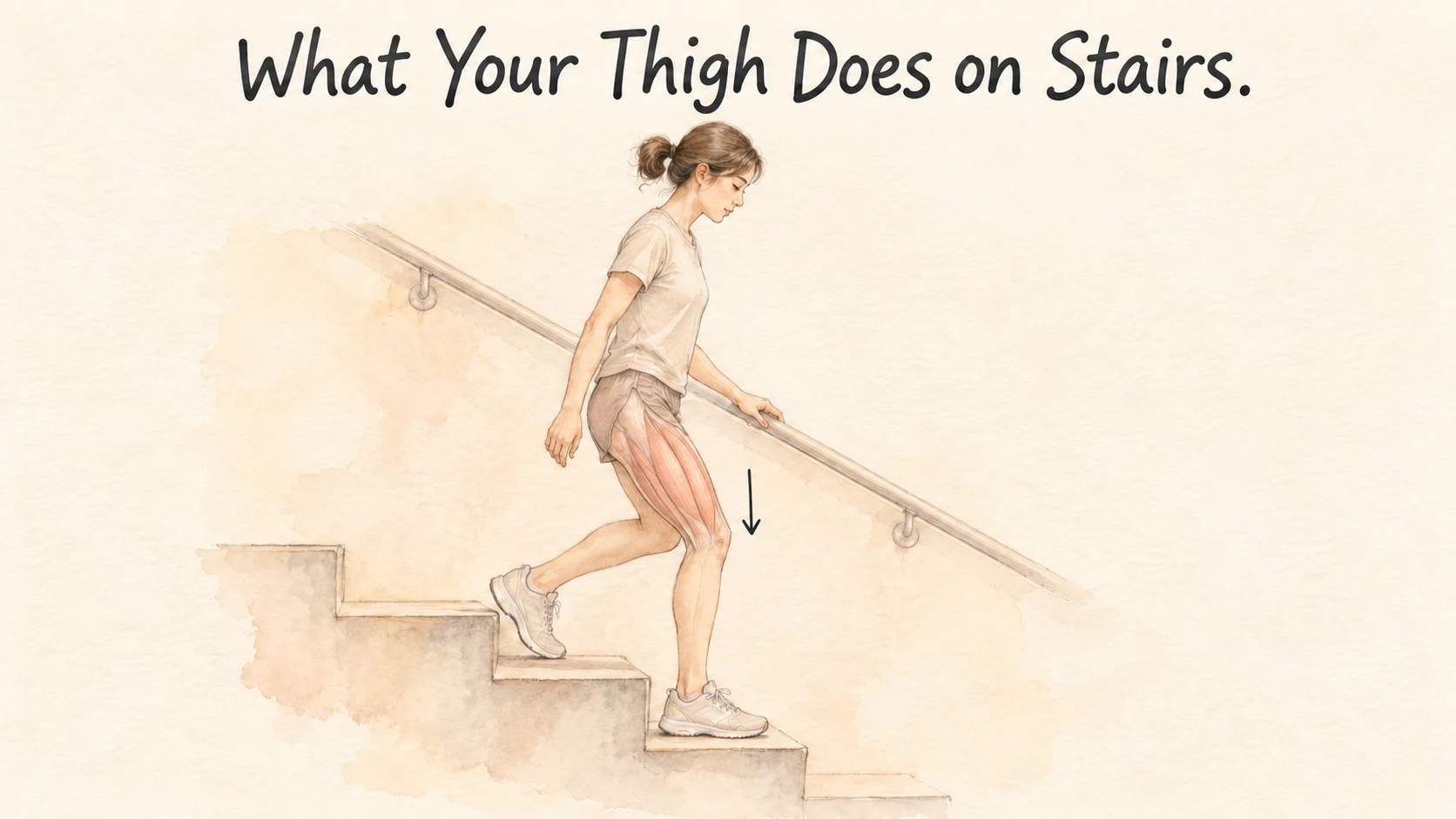
The dull ache that develops several hours after unfamiliar activity is called delayed-onset muscle soreness, or DOMS. You may notice it most when you move, get up from a chair, or press on the area that worked. The research literature describes soreness as often most pronounced over the next one to three days, with timing that can differ across activities and people [1].
Think about a leg press. On the way up, the front of the thigh shortens as it works to move the load. On the way back down, it keeps working while it lengthens to control the descent. That second action is called an eccentric contraction. Your thigh does something similar on the stairs: it works while allowing your body to lower to the next step. An unfamiliar bout of lengthening contractions can leave the muscles tender or stiff over the days that follow [1, 2].
Suppose you usually cycle but take a long downhill hike one weekend. Soreness may make the change in activity obvious in your day-to-day movements. To find out whether you can generate the same amount of force as before, a researcher would measure a contraction separately, in the same position and with the same equipment.
The rating also depends on when you ask. Sitting still and lowering yourself onto a step are two different situations. The studies specify how they brought out the sensation before asking for a rating. That lets them compare like with like. It also means a score obtained by pressing a muscle has to stay with that method when you read the results [1, 2].
Can two equally sore arms produce the same force?
Researchers combined data on 110 male students who had not taken part in a resistance training program. Fifty performed 12 maximal lengthening contractions of the muscles that bend the elbow, and 60 performed 24. To measure force, they asked participants to pull as hard as they could with the joint held at a fixed angle. For soreness, the examiner pressed on the muscle or moved the elbow into flexion or extension. The participant marked the feeling on a 50-millimeter line. The mark's distance from the left end gave the soreness score [1].
The group that did 24 contractions lost more force on average and recovered more slowly. Their soreness scores during pressing or bending were similar to those of the group that did 12. Straightening the elbow gave a different result: that test did register more soreness after 24 contractions. Across participants, soreness on pressing showed no statistically clear association with the other measures, while associations for the other ways of testing soreness were weak [1].
The paper gives two examples that make the contrast easy to see. Two participants recorded peak soreness on pressing of 46 and 45 millimeters. Four days after the exercise, their measured maximum muscle forces were 89.2% and 46.7% of their respective starting values. This pair illustrates individual variation after a specific elbow exercise. It does not tell you how much strength a person with a given soreness score usually loses [1].
What changed from the first week to the tenth?
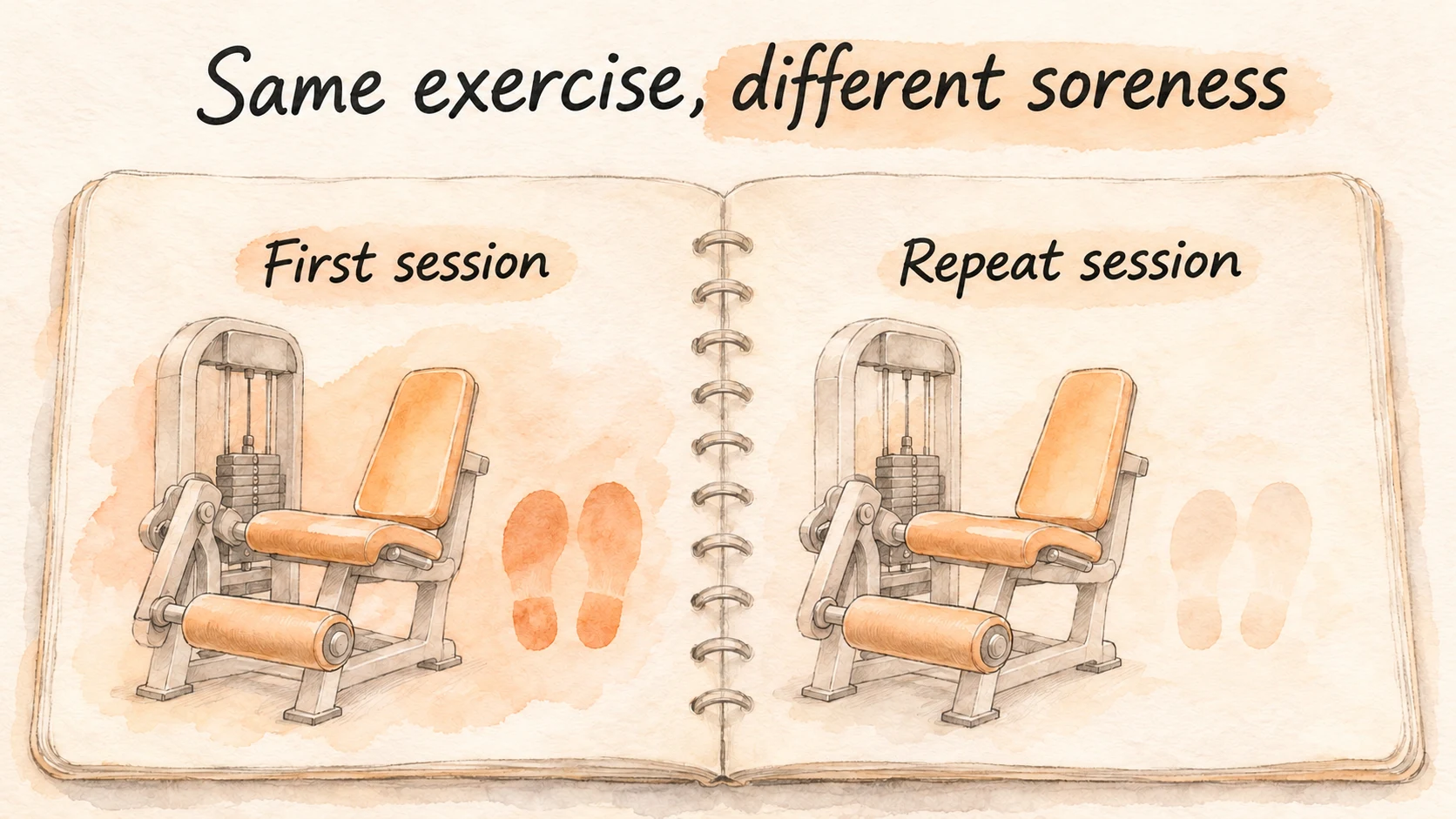
Damas and colleagues followed 10 young men who had done lower-body resistance training before but had not done it for at least six months. Over 10 weeks they completed 19 sessions of leg presses and leg extensions. In weeks 1, 3, and 10, the team measured soreness and strength before and after one session. It also collected muscle samples from the outer thigh to estimate how large individual muscle fibers were in cross-section [2].
For the soreness score, participants sat down and got up from a chair twice without using their hands and then marked a 100-millimeter line. At 48 hours, their average score was 61 millimeters after the first session and eight after both the week-three and week-ten sessions. At the same points, maximum knee extension torque with the joint held still was about 78%, 98%, and 98% of the corresponding pre-session level. Each test used that day's starting torque as 100%. These percentages describe how much force-producing capacity remained two days after the workout. To see how strength changed over ten weeks, compare the original starting tests [2].
By week ten, the average fiber cross-sectional area was larger than at the earlier two measurements. The researchers did not find a statistically clear link between soreness and later gains in fiber size in these ten men. They also estimated how fast muscle made proteins that form the contractile structures inside a fiber. That response was greatest over the 48 hours after the first workout, without a clear relationship to growth at ten weeks. The authors suggest some of the early response may have supported repair. Their measurements did not trace how much of the new protein ended up in repair or growth [2].
The team also examined the arrangement of structures inside muscle fibers under a microscope. By week three, soreness and the short-term strength response had already become much smaller. That did not tell the researchers exactly when the microscopic changes had diminished. They had sampled tissue at only three stages of training. An easier trip down the stairs cannot establish the timing of a change that was measured in a different way [2].
Once the same men were used to the exercises, the score from standing up from a chair went down. Their muscle fibers still grew over the training period. Both results can sit on the same page because they describe responses measured at different times and by different methods.
What to put in your training log
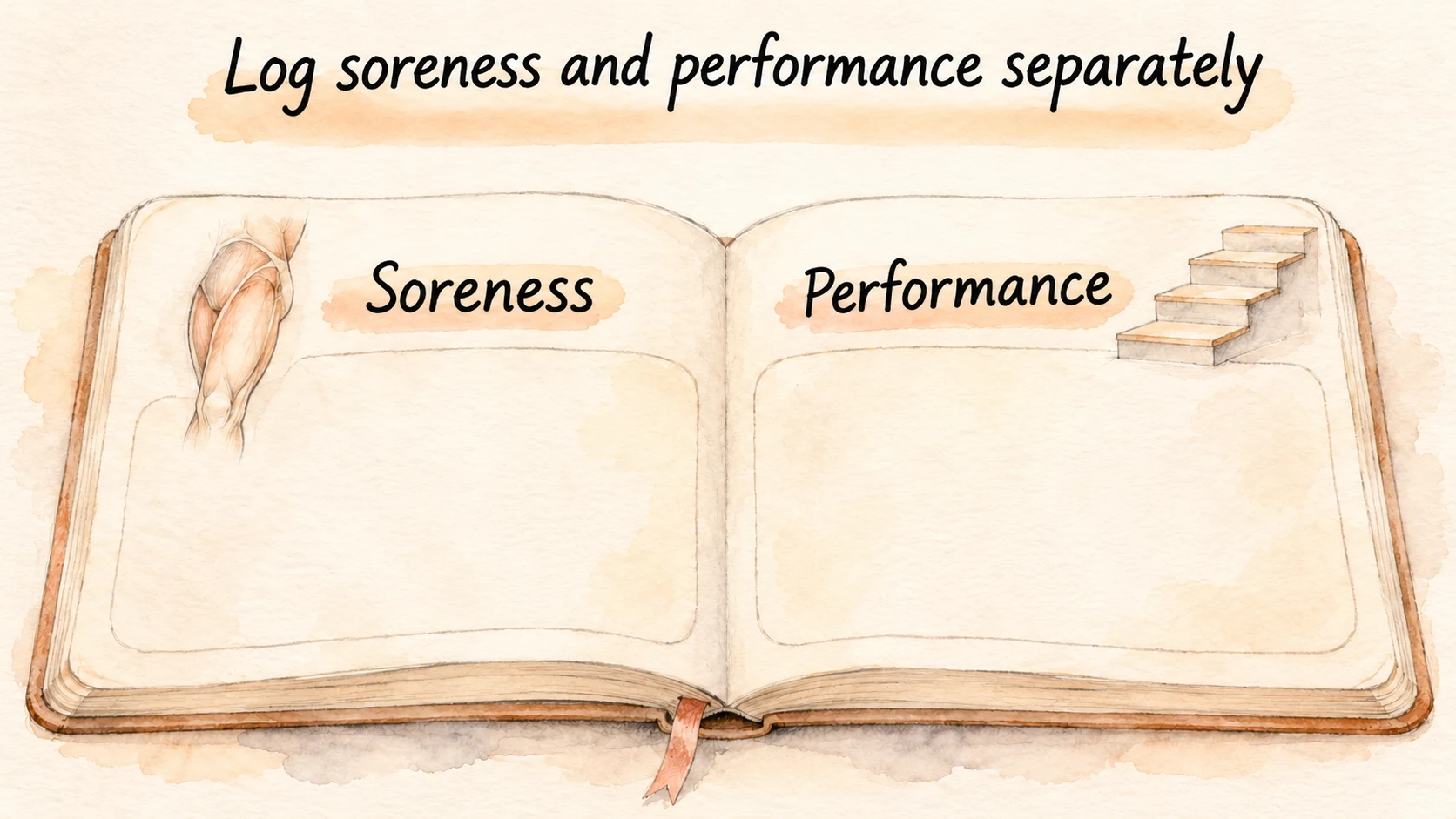
Keep the weight and repetitions for each set of a familiar exercise on one line. If you want to keep track of soreness, write it beside the specific movement that brought it out. For example: “Leg press, 60 kg, three sets of eight; front of thigh sore going downstairs the next morning.” A few weeks later, if you can do more repetitions with the same load and a similar range of motion, your performance on that exercise has changed. If your question is muscle size, give that measurement a separate place in the log and compare the same area under similar conditions.
The next time the subway stairs feel ordinary, that is something you can write down. Then look at the last entry for the same exercise to answer the question you had at the top of the stairs: how has the workout gone since you first tried it?
References
[1] Nosaka K, Newton M, Sacco P. Delayed-onset muscle soreness does not reflect the magnitude of eccentric exercise-induced muscle damage. Scand J Med Sci Sports. 2002;12(6):337–346.
[2] Damas F, et al. Resistance training-induced changes in integrated myofibrillar protein synthesis are related to hypertrophy only after attenuation of muscle damage. J Physiol. 2016;594(18):5209–5222.