
Cardio or Weights First When You Do Both on the Same Day?
The order affects how you feel starting the second part of a workout. Compare a same-day experiment with longer studies to see what to put first.
You've got one window to get to the gym after work. You want to train legs and get a run in. Last time you did intervals first and came up a few reps short on the leg press. If you lift first today, will you still be able to run at your usual pace?
When you do both in one session, you can start with the part you most want to do well. If it's a leg day, do your main lifts before the run. If it's a day to see what pace you can hold, do the run first. The order changes how much fatigue you carry into the second activity. Whether there's a difference after several weeks depends on how hard you trained and what the study measured.
What does the first part leave behind?
Imagine a session with a run and leg presses. If you start on the leg press, your legs haven't done the fast running yet. Run hard first and your breathing may have settled by the time you sit down at the machine, but the legs still have that work behind them. Switching equipment doesn't undo what they just did.
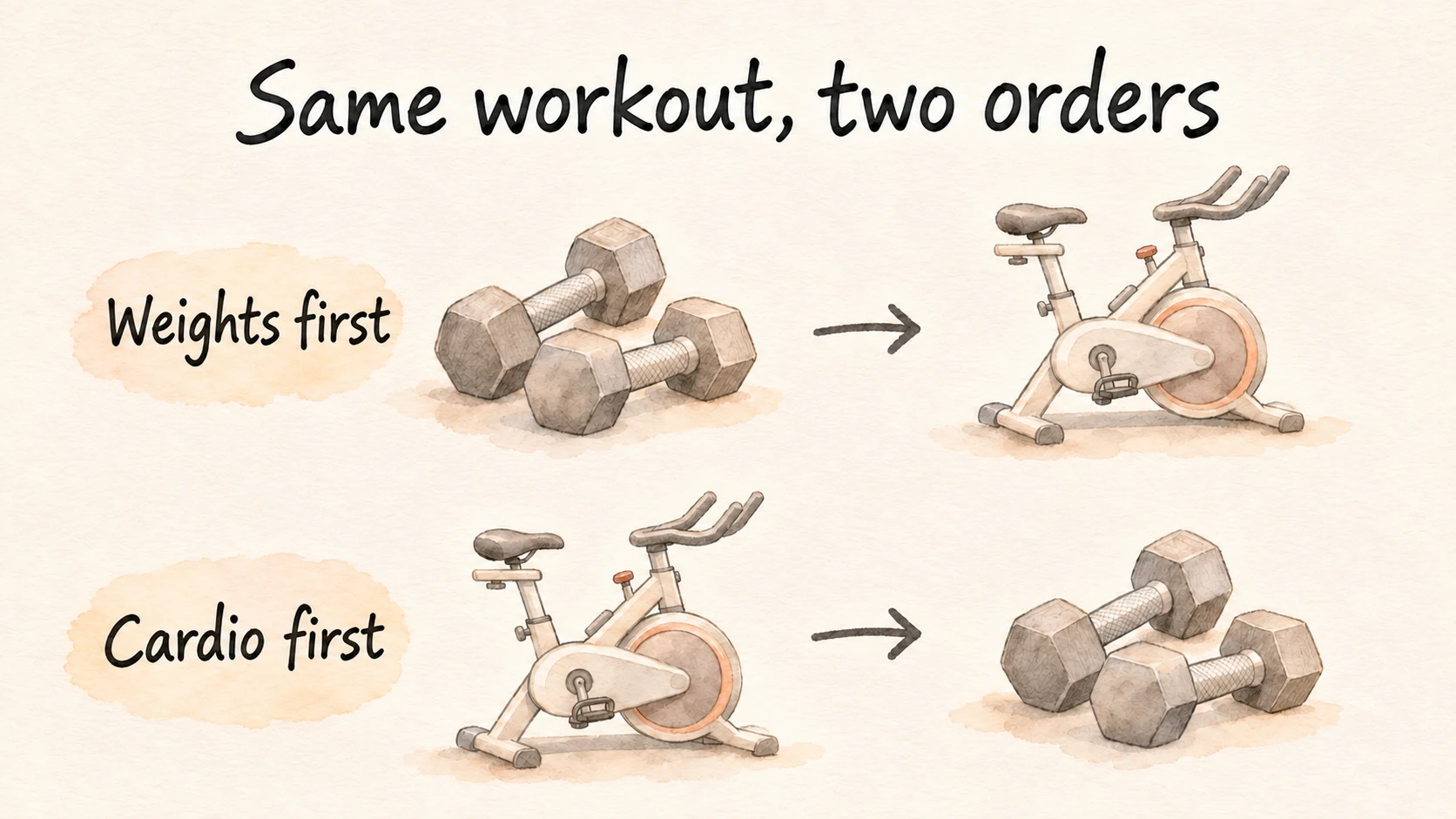
A few minutes of easy walking to warm up and a full running interval session are different amounts of work. Both can happen before a lift. If the second half of your session goes differently, note how long the first part was, how hard you went and how long you took before starting the next exercise.
After a run, do you lose reps or lose the ability to lift a heavy single?
In a 2007 experiment, eight physically active men did strength tests on separate days. Sometimes they tested when rested. Other times they did a continuous five-kilometer treadmill run or a five-kilometer interval run and tested ten minutes later. Researchers measured how much the men could leg press or bench press once, as well as the number of reps they could complete at 80% of that maximum [1].
The maximum weight the men could lift once did not change significantly after either type of run. On the leg press, the average at the set weight dropped from 10.8 reps when rested to 8.1 reps after the interval run. Bench-press reps didn't show the same difference [1].
Say your best single on the leg press is 60 kilograms. Eighty percent is 48 kilograms. If you usually do nine reps with 48 and manage seven today, you know you did fewer reps at that load. It takes a separate test to see what happened to your heaviest single. The researchers asked those two questions separately. In your own log, you can check what you ran beforehand and how long you rested before comparing with a similar day.
What if you lift first? The same research team later had 11 physically active men run five kilometers at prescribed speeds after doing leg presses. At the first and fifth kilometer, measures including heart rate, oxygen uptake and perceived effort showed no statistically significant effect of lifting first. The researchers set the treadmill speed, so the experiment tells us about running at that speed. It doesn't tell us how fast the men would have run a self-paced five-kilometer test [5].
What about after twelve weeks?
Researchers in Brazil divided 26 healthy men, around 65 years old on average, into two groups. They trained three times a week for twelve weeks. Both groups lifted and cycled in the same sessions. One lifted first, the other cycled first. At the beginning and end, researchers measured the maximum amount each person could lift once on a knee extension [2][3].
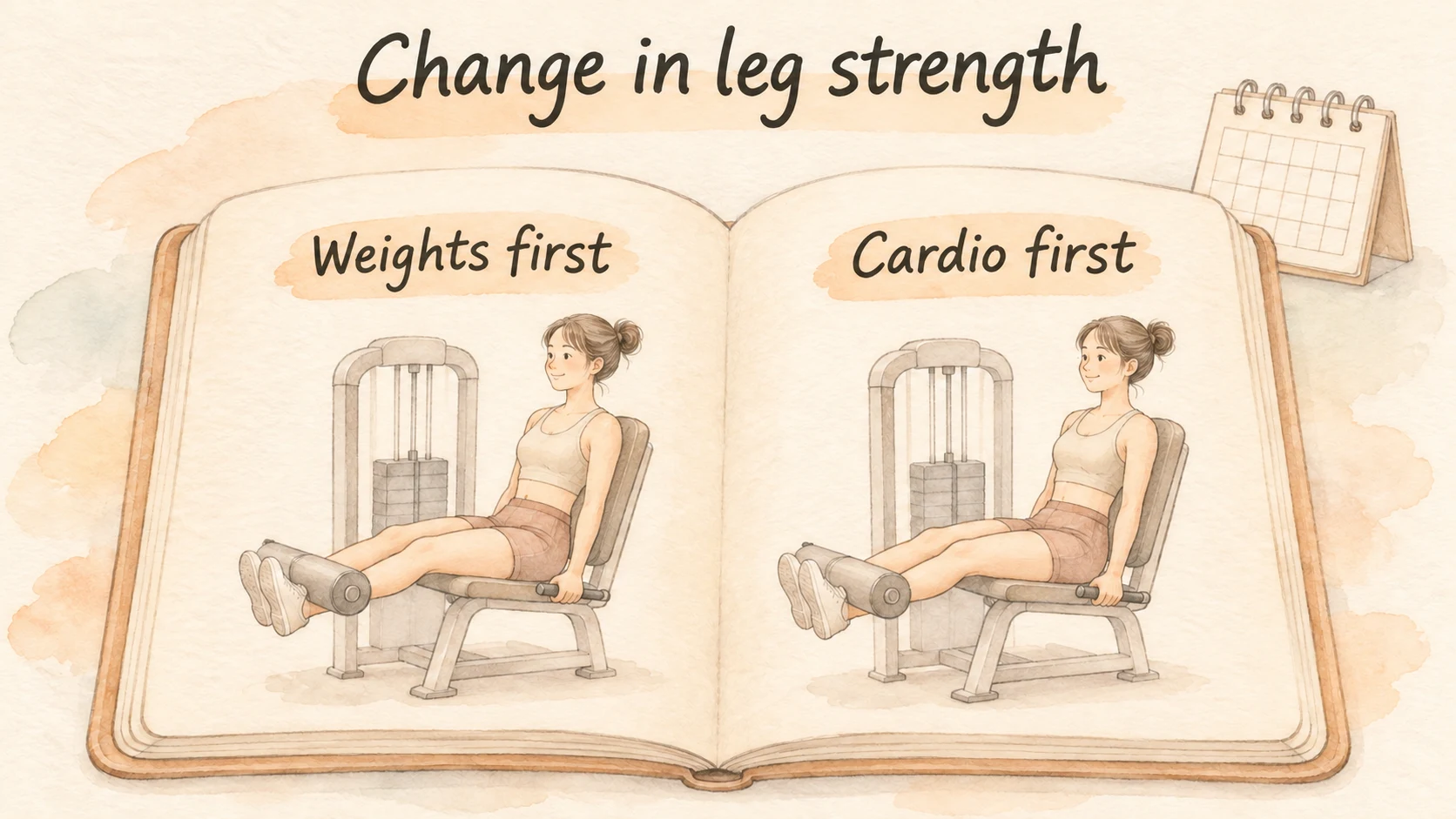
Twelve weeks later, the weights-first group improved its knee-extension maximum by 35.1% on average. The cycling-first group improved by 21.9%. The difference in gains was statistically significant. Upper-body strength also rose in both groups, with no statistically significant difference between the groups there [2].
Read the gain as a percentage of the original lift. For example, if a person's maximum was 50 kilograms, a 20% increase would be another ten kilograms. That's a calculation, and the study percentages don't let you predict your own increase. They describe specific tests, training sessions and participants [2].
The researchers also tested the two groups' peak oxygen uptake on a bike. Both groups improved, and there was no statistically significant difference between them on that measure. The strength test and the cycling test can tell different stories about the same training schedule [3].
Decide what progress will look like for you. Getting two more reps with the same load tracks one kind of change. Putting more weight on for a single after several weeks, when you're rested, tracks another. If you care about your run, keep a running measure of its own. For instance, how long could you hold your target pace on the same route? A leg-press log can't answer that.
If you have two training days, could you split the sessions?
A 24-week experiment compared cardio before lifting, lifting before cardio, and alternating the two on separate days. In the separate-days group, peak oxygen uptake on a bike rose by an average of 18% in men and 25% in women. In the two same-session groups, it increased by about 7% in men in either order and by about 12% and 10% in women, respectively. The two same-session orders had no statistically significant difference in this measure [4].
Look at the weekly calendar. For the first twelve weeks, people who did both in one session came in twice a week and switched activities after five to ten minutes. People on the split schedule did the same volume of training across four visits. Starting fitness measures also differed between groups. The study compared whole schedules, so it can't tell us how much of the difference came from the hours between activities [4].
If you have two evenings and want to start both activities feeling fresh, putting them on different days is one workable option. If you have a single evening, choose which activity you're using the session to practice and compare the second part with other times you did it in the same order.
Which part of today's session matters most?
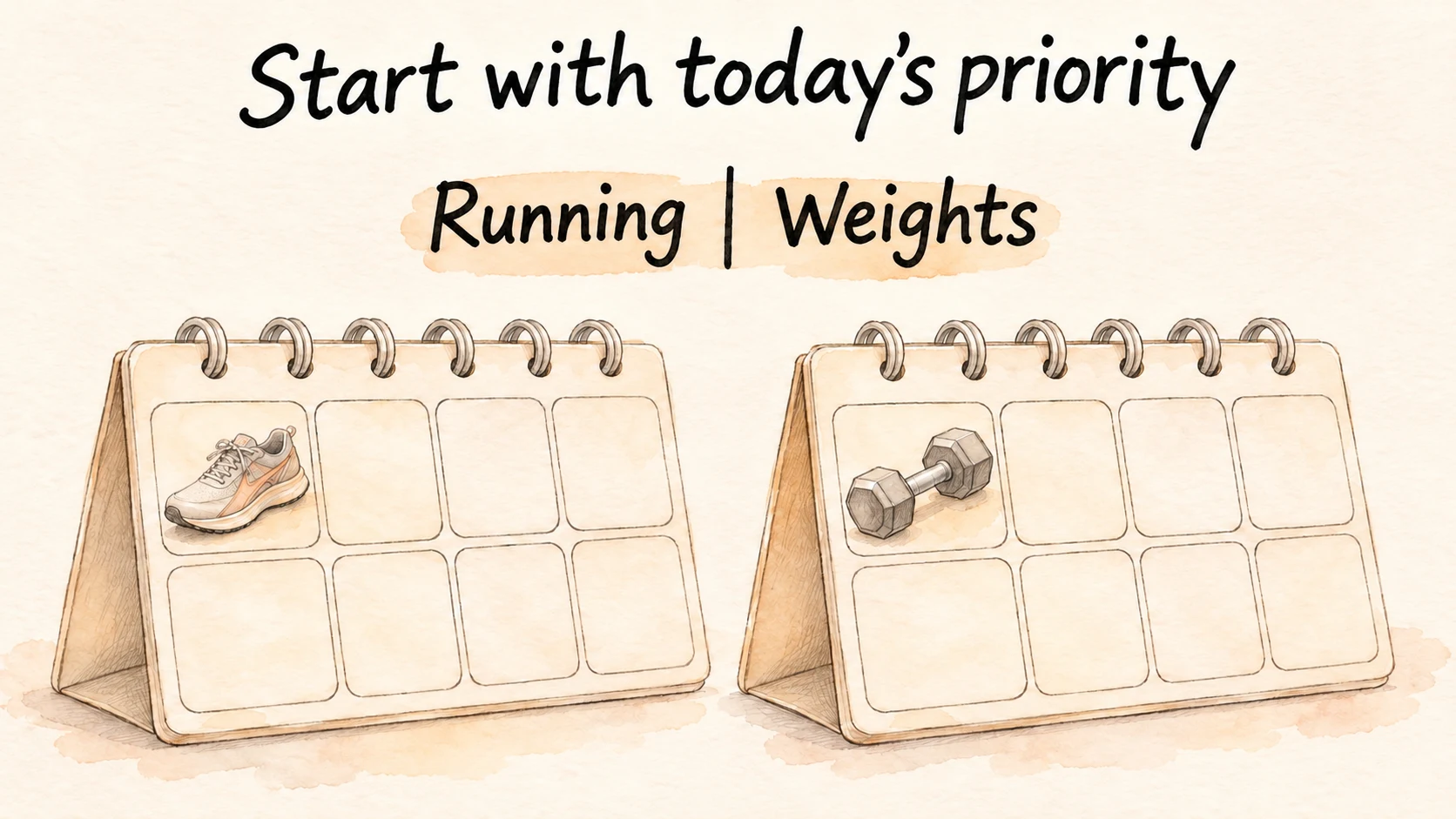
- It's your main leg workout. Warm up, do your main leg exercise and record the weight and reps. Then do the cardio you'd planned.
- You're checking your running pace. Start with the run. If you lift afterwards, make a note of the first exercise where you notice a difference.
- You want to practice both. If you can't split days, pick one to start with. When you try the reverse order, keep the running session and lifting weights roughly comparable. You can see what changed without also swapping half the workout.
Next time both machines are free, think back to what you most wanted to get done before you walked in. Finish that first and record what you actually do in the second part. A few such workouts will tell you more about your after-work schedule than one day when your legs felt heavy.
References
[1] de Souza EO, et al. Acute effect of two aerobic exercise modes on maximum strength and strength endurance. J Strength Cond Res. 2007;21(4):1286–1290.
[2] Cadore EL, et al. Neuromuscular adaptations to concurrent training in the elderly: effects of intrasession exercise sequence. Age. 2013;35(3):891–903.
[3] Cadore EL, et al. Strength prior to endurance intra-session exercise sequence optimizes neuromuscular and cardiovascular gains in elderly men. Exp Gerontol. 2012;47(2):164–169.
[4] Schumann M, et al. Cardiorespiratory adaptations during concurrent aerobic and strength training in men and women. PLoS One. 2015;10(9):e0139279.
[5] de Souza EO, et al. The acute effects of varying strength exercises bouts on 5Km running. J Sports Sci Med. 2011;10(3):565–570.