
Add Weight or Add Reps? How to Progress From 8 to 12
When your usual dumbbell feels light but the next one feels heavy, use a rep range to decide when to move up.
You've finished three sets of dumbbell presses and your usual 10-kilogram weight feels easier than it used to. At the rack, the next dumbbell feels like a big step. Should you pick it up today, or keep the same weight and try a few more reps?
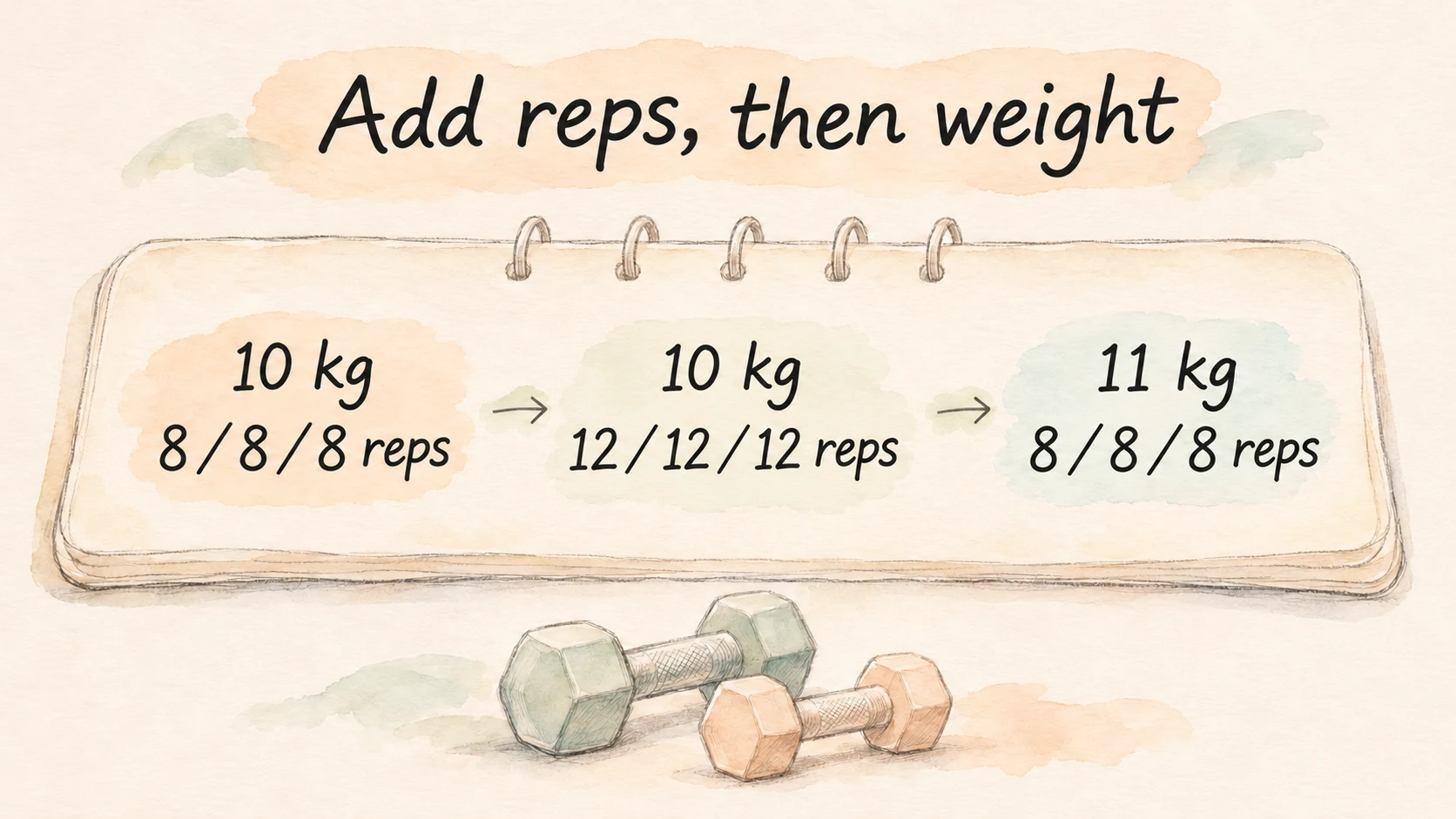
You can build up your reps at the current weight, then go heavier once all your sets reach the top of the range. For example, start with 10 kilograms for three sets of eight. Work toward twelve reps per set and try a small increase in weight once you get there. Reps go back toward eight. This is often called double progression because you have two numbers to move over time.
What changes when you add one rep or one kilogram?
Take the same movement through the same range. If your usual set is eight presses, a ninth means one more complete press and lowering of the weight. If you go heavier and keep the set at eight reps, every rep asks you to move a heavier dumbbell.
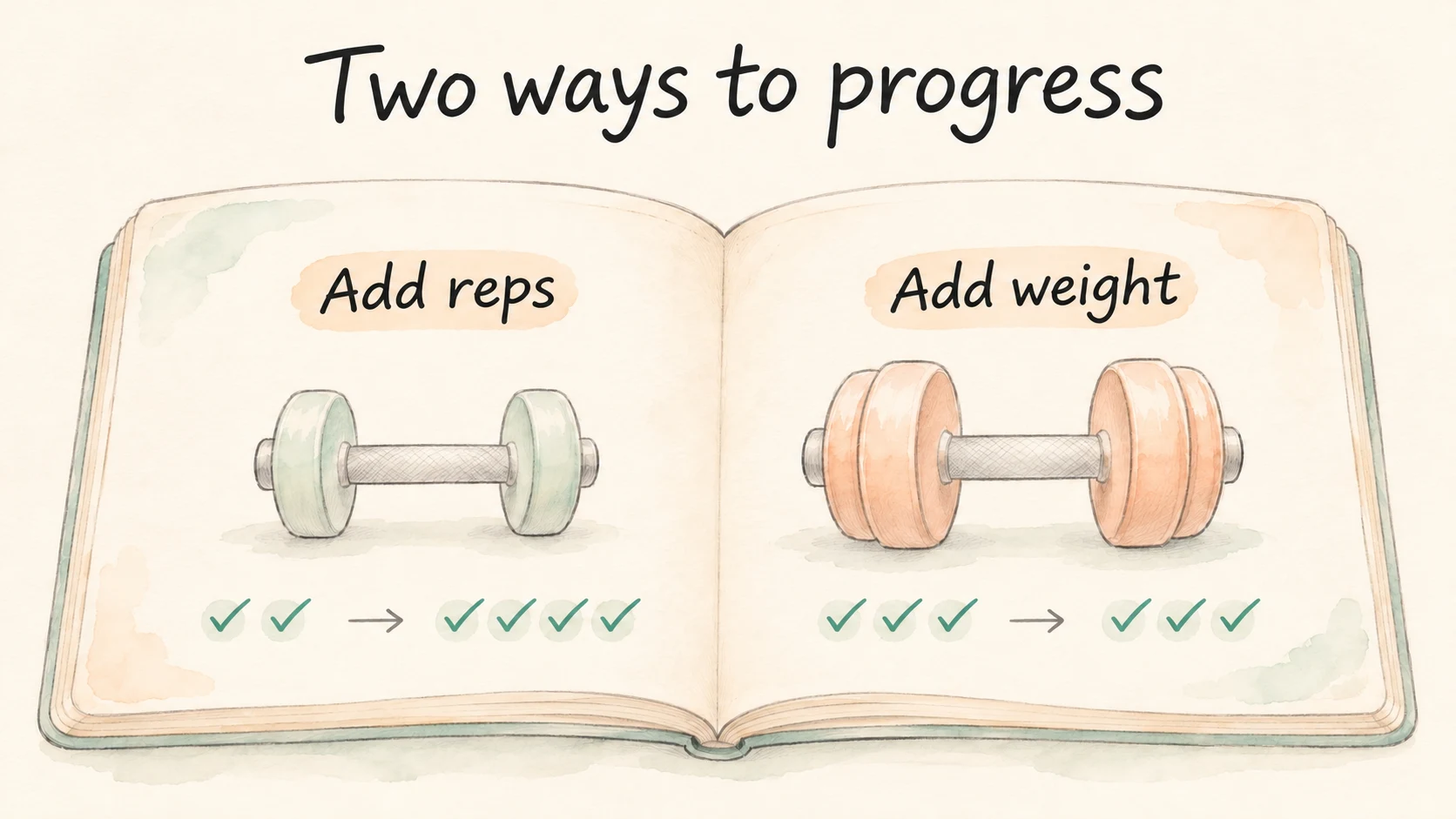
Weight and reps are worth keeping in separate columns. Twelve reps with 10 kilograms and ten reps with 12 kilograms both give you 120 when you multiply weight by reps. That's one simple way to tally training volume. The weight in your hand is different on every rep, and the number of reps in the set is different. If you record only the product, you lose the two details you need to plan the next workout.
It also helps to decide what counts as a rep. If you sit lower in the first squat or shorten the last few presses in the next set, the two sets are harder to compare. Record the change if you notice it. Next time, return to the usual range and see what you can do there.
Is one set of 12 enough to move up?
Imagine you have an adjustable dumbbell for your presses. Pick three sets of eight to twelve reps. These are example numbers to show how the weights and reps can take turns.
- 10 kg for 8, 8 and 8. Use your usual weight. If next time you get one extra rep in the first set and the same in the others, record 9, 8 and 8.
- 10 kg for 12, 12 and 12. You can complete all three sets using the same movement. Consider increasing to 11 kilograms. If the final reps are much shorter than the rest, try another session at the current weight.
- 11 kg for 8, 8 and 8. After the increase, you're back near the low end of your rep range. Now you can build from that starting point.
What if the gym goes straight from 10 to 12 kilograms? That's a 20% jump. If the movement breaks down quickly or you fall below the rep range after trying it, record the reps you actually did. You can return to the familiar weight for the rest of the workout. If smaller increments are available, try one when you're ready. The range of eight to twelve is an example that makes the adjustment manageable.
And if your latest three sets are 12, 10 and 9, you can leave the first set at 12 next time and see if one of the other sets comes up. A change to 12, 11 and 9 tells you which set changed. The total for the day would show you only one extra rep.
Can adding reps also help you lift more?
In an eight-week study, researchers enrolled 43 people who already trained their lower bodies. Thirty-eight finished. Both groups trained twice a week with squats, leg extensions and two kinds of calf raises. They started in a range of about eight to twelve reps per set. One group aimed to increase weight while staying in that range. The other kept the weight and tried to add reps. The researchers supervised the sets and encouraged participants to continue until they couldn't complete another rep with good form [1].
At the end of eight weeks, both groups increased their maximum Smith machine squat by about 20 kilograms on average. After accounting for baseline results and sex, the estimated improvement was two kilograms larger in the weight-progression group. The data were also compatible with a small advantage for the reps group [1].
Participants trained the free-weight back squat and tested on the Smith machine, which puts the bar on a fixed track. They also had prior training experience. The study compared two ways to progress and left the alternating routine in our dumbbell example untested. It does show that adding reps was a workable way to adjust this lower-body program [1].
A separate ten-week study had 39 young people new to resistance training do leg extensions with both legs trained separately. One leg was randomly assigned to weight progression and the other to rep progression. Both approaches improved the maximum weight participants could lift in a leg extension and increased outer thigh muscle cross-sectional area. The between-method differences weren't statistically significant. That's evidence for an exercise on a machine, with a different group of participants and a different setup [2].
The first study's 20 kilograms is an average change on a specific eight-week test. In each session participants did four sets of four exercises, resting two minutes between sets. An extra rep in one set at home isn't evidence that you'll add that much to a maximum lift. The part you can use is the idea of adjusting one part of the program and seeing how it changes over a series of workouts [1].
What if you did more last week?
Say last week's sets were 12, 11 and 10. Today they're 11, 10 and 10. Save the result as it happened. Then check whether you took a shorter break, did the movement later than usual or finished a few extra sets of something else first. A short note will help you set up a comparable session next time.
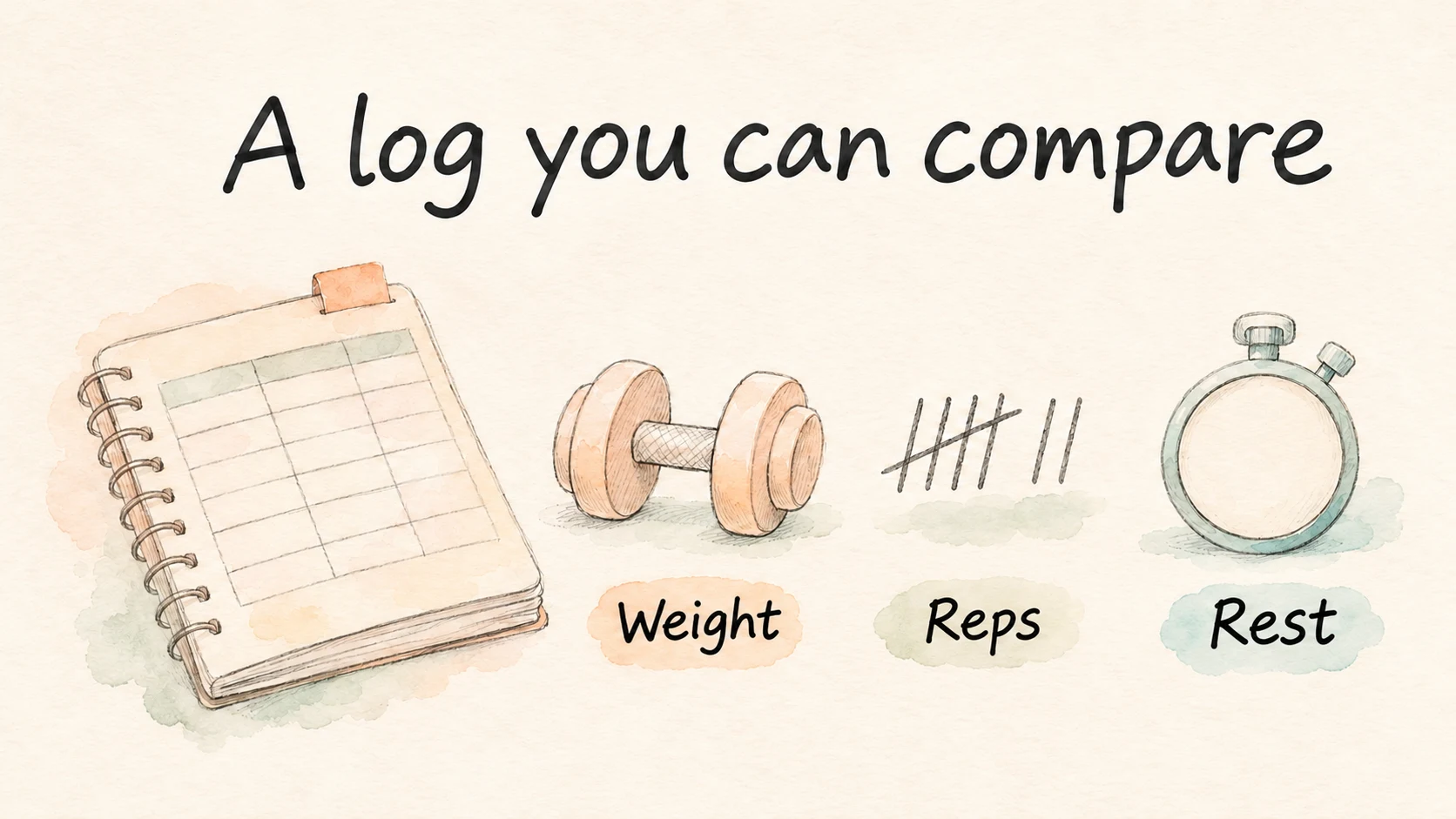
If you had half your usual rest because you were short on time, that entry still belongs in your log. Next time you can use the original rest period and see how the sets go before you change the weight or the range.
When you first move up in weight, keep the old entries. Eight reps at the new weight give you a starting point to compare with the next time you use it. Your twelve reps at the lighter weight are still part of the record.
Choose one movement you know and change one number next time. If you usually manage eight reps in your first set at 10 kilograms, see if you can complete a clean ninth when you feel ready. Keep the other two sets in the log, too. The next time you're at the rack, you'll know whether you're still building reps or ready to reach for the next dumbbell.
References
[1] Plotkin D, et al. Progressive overload without progressing load? The effects of load or repetition progression on muscular adaptations. PeerJ. 2022;10:e14142.
[2] Chaves TS, et al. Effects of resistance training overload progression protocols on strength and muscle mass. Int J Sports Med. 2024;45(7):504–510.