
One 30-Minute Walk or Three 10-Minute Walks?
Two groups were assigned the same weekly brisk-walking time across 10 weeks. Here’s what a fitness test showed when those minutes were divided differently.

You have ten minutes before breakfast, another ten at lunch, and a short break before you leave work. You could take a brisk walk in all three gaps. Or you could wait, go out after dinner, and do a full half hour at once. Would the two kinds of walking lead to different results?
In one ten-week trial, three ten-minute brisk walks a day and one thirty-minute brisk walk a day led to similar changes in maximal oxygen uptake. Both groups improved compared with a group assigned no walking program. The researchers planned the same weekly minutes and a comparable walking effort. On your own calendar, it's worth asking whether all three breaks actually come through [1].
Compare what you're doing during the minutes
The study enrolled 47 previously sedentary women, with an average age of 44. The researchers randomly assigned them to one of three groups. One walked briskly three times a day for ten minutes at a time. One walked briskly once a day for thirty minutes. The control group wasn't assigned a walking program. The two walking groups trained five days a week for ten weeks, aiming for about 70 to 80 percent of their individual maximal heart rates. Participants agreed not to change their diet [1].
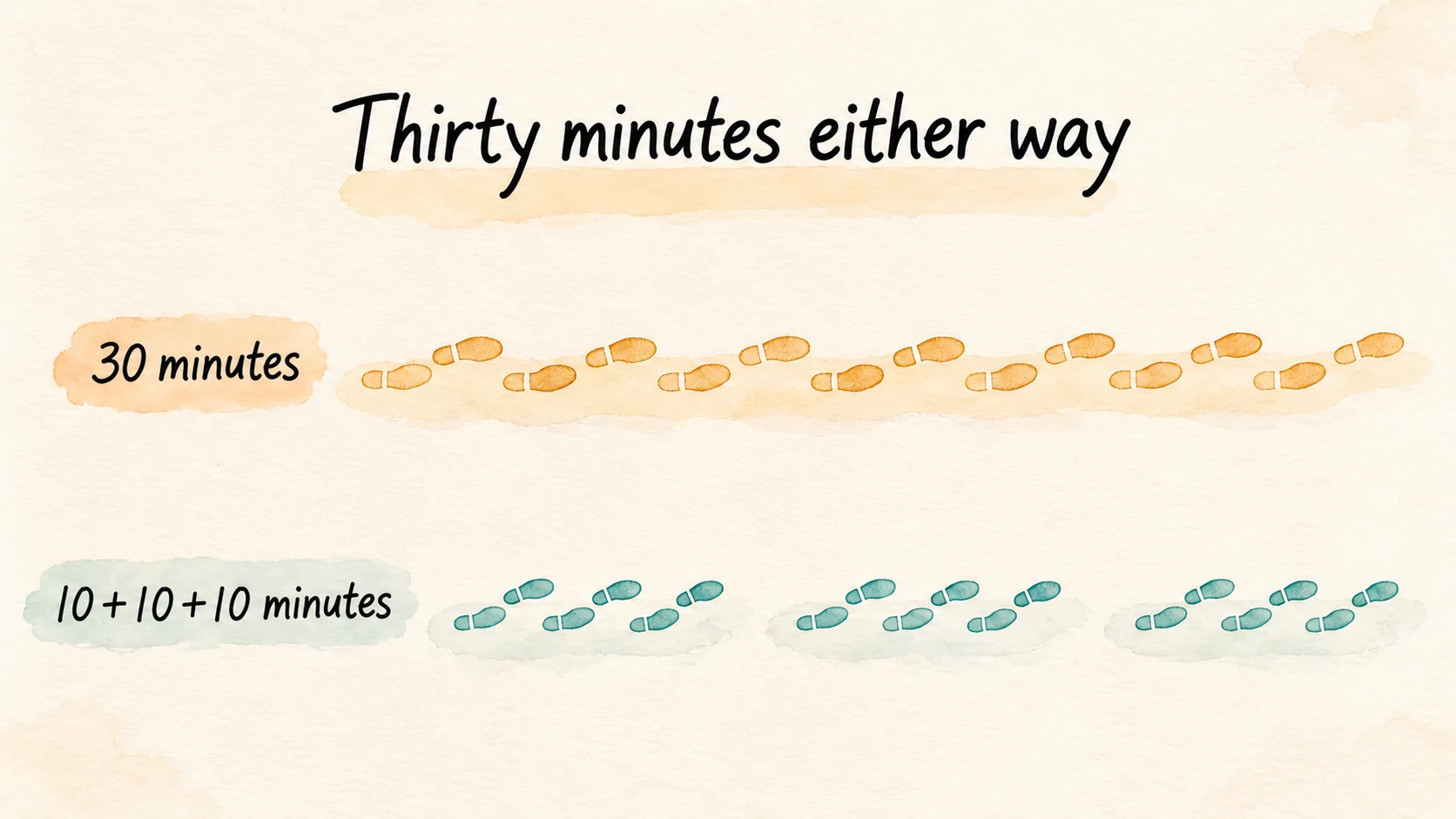
Both schedules called for 150 minutes a week. Three appointments don't necessarily mean a lower effort. People in the short-walk group were aiming at the same intensity range as people who went out once. A single appointment of thirty minutes also doesn't guarantee thirty uninterrupted minutes of brisk walking. If you stop at the store and wait at the lights, you may spend a substantial part of it standing. The researchers tried to keep the amount and effort comparable so the comparison could tell them something about how the time was divided.
The short walks were spread across the day by at least four hours. On supervised walks, average heart rate was 73% of maximum for the short-walk group and 75% for the long-walk group. Over the ten weeks, the groups that completed the study actually averaged about 1,298 and 1,316 minutes of walking. Both totals were below the planned 1,500 minutes and fairly similar to each other [1].
In everyday life, the amount of time around a walk varies. Some people walk right out an office door and onto a familiar route. Others have to change shoes, wait for an elevator, or walk through a crowded building before getting outside. The time you spend preparing isn't part of a fitness test, but it can change which plan you are able to repeat.
What was measured ten weeks later?
Twelve people in the short-walk group, twelve in the long-walk group, and ten in the control group completed the study. The researchers measured maximal oxygen uptake, or how much oxygen the body can use per minute for each kilogram of body weight as effort gets close to maximum. The two walking groups changed by an average of +2.3 and +2.4 mL/kg/min, respectively. The control group changed by −0.5. The researchers detected a difference for the walking groups compared with controls and didn't detect a clear difference between the two walking schedules [1].

Those two positive values are close. With only twelve people completing each walking plan, the study can't pin down just how similar the effects would be in a larger population. It also didn't test whether shorter bouts of two minutes would do the same thing, or whether either plan prepares you better for walking continuously on a steep trail. It measured particular outcomes after ten weeks of two specified plans [1].
The study tells us about two ways of accumulating thirty minutes in one day. It doesn't identify the shortest possible walk or compare every possible schedule.
If one of your goals is to get comfortable with staying on the move for a full half hour, you may also want opportunities to practice that skill. You can adjust your pace along the way and notice how you feel near the end. That's a different question from whether two plans of equal total time can change an aerobic test result.
Count the time that actually fits the week
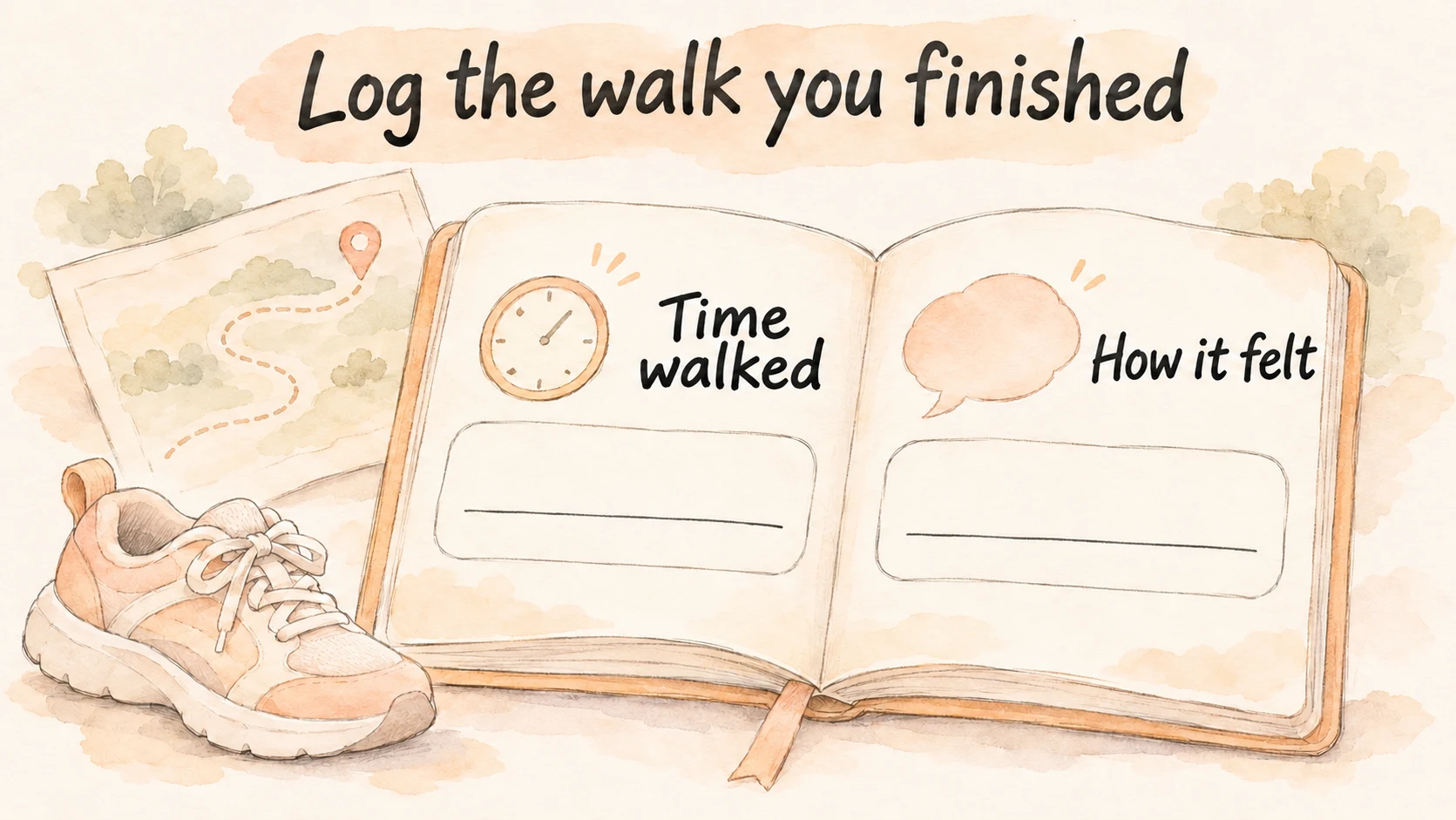
Say your plan calls for three ten-minute walks on five days, but twice a week the afternoon walk disappears into a meeting. Instead of the planned 150, you walk 130 minutes. If you make the full thirty minutes on two days and have all three shorter walks on the other three, you reach 150 minutes with a mixed plan. That's arithmetic for the calendar. It isn't a way to predict a personal change in maximal oxygen uptake.
You can pick a familiar route and see how many times you complete it in a week. Notice how fast you tend to walk when you're in a hurry versus when there aren't any meetings on either side. If a plan looks good on paper but the walks keep getting displaced, the new information is about your schedule. If a longer walk is pleasant but seldom happens, a few shorter ones may be easier to fit.
Back at breakfast, if there's a route you can take in those ten minutes, you can go in those ten minutes. Once you have a week's actual walks in front of you, let those records help you decide where a longer walk might fit.
References
- Murphy MH, Hardman AE. (1998). Training effects of short and long bouts of brisk walking in sedentary women. Medicine & Science in Sports & Exercise.