
Three Hours Into a Ride, What Are the Carbs You Drink Doing?
Seven trained cyclists rode an hour longer on average when they drank carbohydrates. Their stores of muscle glycogen had still fallen by the third hour.
You're more than two hours into a ride when a pace you've been holding all morning starts to feel harder. You have water and a carbohydrate drink in your bag. If you drink the carbs now, will your legs put them back into storage, or use them to keep going?
An experiment in trained cyclists saw no clear slowing in the use of stored carbohydrate in the thigh over the first three hours when riders took in carbohydrate. Later in the ride, though, they maintained their blood glucose and their use of carbohydrate for energy, and lasted about an hour longer on average [1]. Both things can happen once you know where the legs get their fuel.
There's carbohydrate in the muscle and in the blood
Muscle connects glucose molecules to make glycogen, a stored form of carbohydrate. When you pedal, the muscle can break it apart and use it. Glucose also arrives through the bloodstream. The liver can release it, and the intestine can absorb carbohydrate you eat or drink. Your muscles can use both the fuel they already have and the fuel the blood delivers.
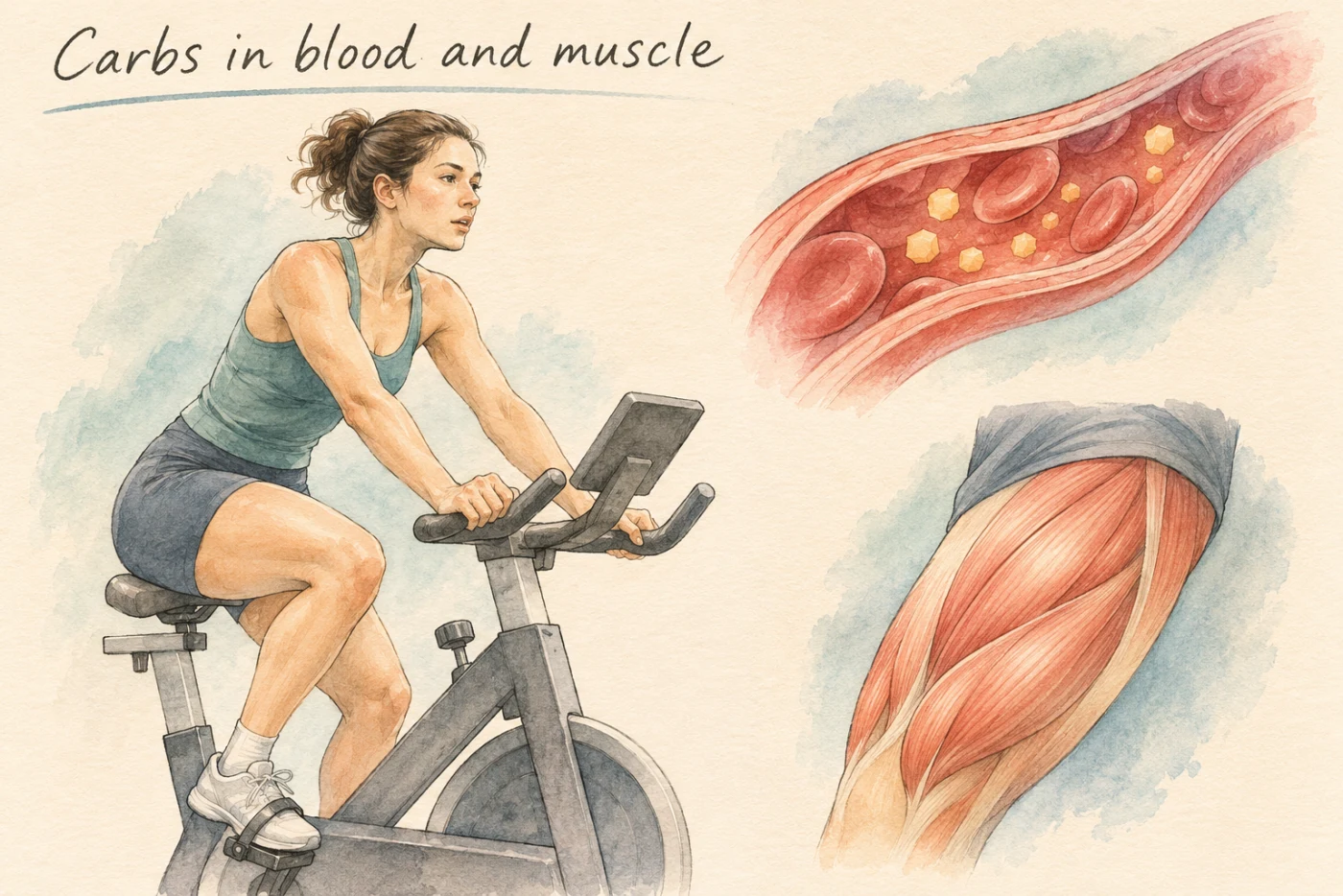
A sip of a carbohydrate drink doesn't go directly into your thigh. It passes through digestion and absorption first. Working muscles can take up glucose as it arrives in the blood and use it for energy. Putting it away as glycogen to use later is a separate process. If the drink helps sustain the supply of glucose toward the end of a ride, you don't have to see an increase in the thigh's glycogen for it to make a difference.
The same cyclists came back for a second drink
In 1986, Edward Coyle and colleagues studied seven endurance-trained cyclists. Each rider did two lab tests, cycling at about 71 percent of their maximal oxygen uptake until they couldn't keep up the required workload. In one test they drank flavored water as a placebo. In the other they drank a solution containing chains of glucose. The researchers measured glucose in the blood and gases from breathing. They also sampled tissue from a muscle at the outer thigh to estimate how much glycogen was left [1].
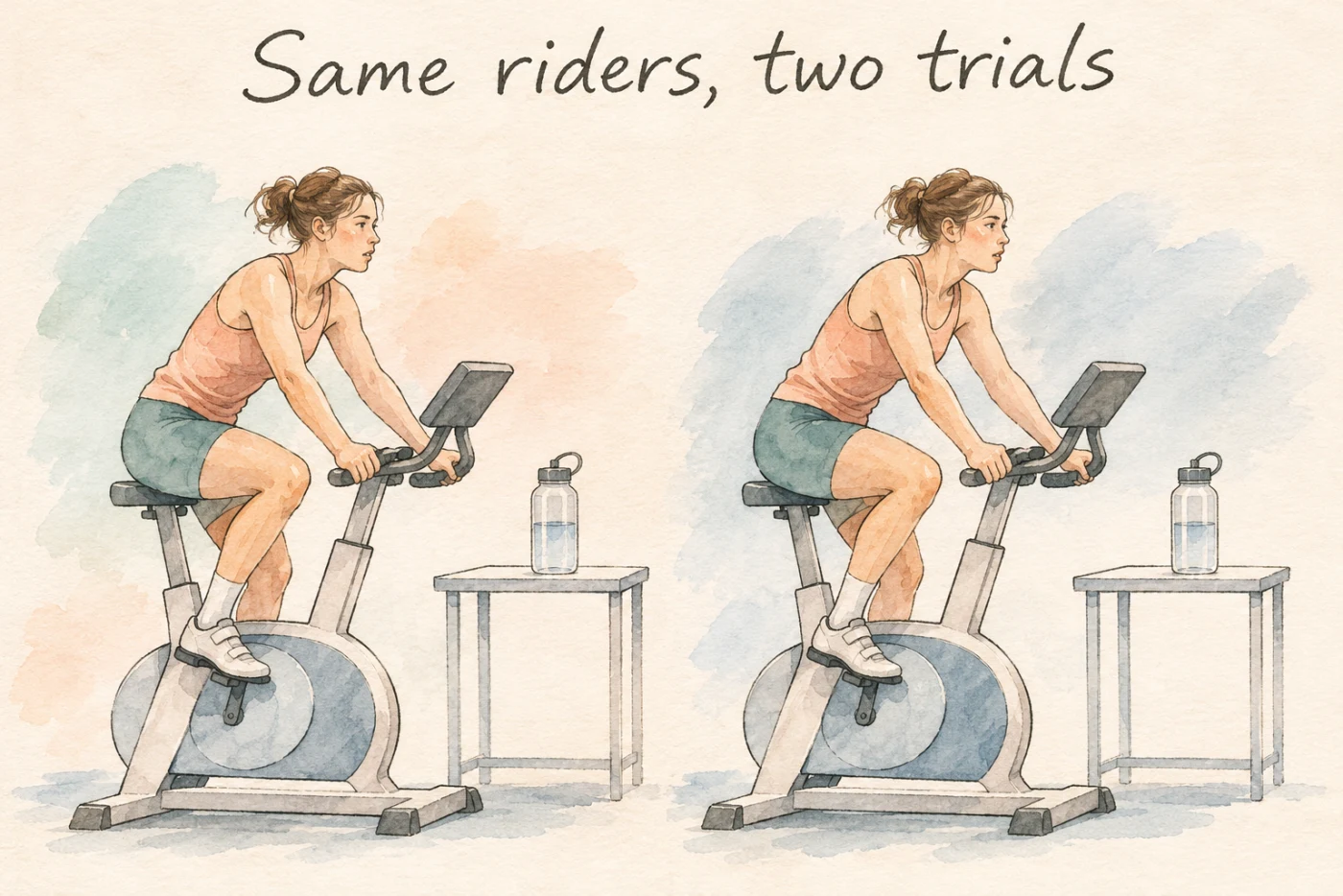
With the placebo, the cyclists lasted about 3.02 hours on average. With the carbohydrates, it was about 4.02 hours. At about the three-hour mark, when they had completed the same amount of work, thigh glycogen had clearly dropped from its starting level in both tests. The researchers didn't find a clear difference between the drinks at that point. Over the additional hour on the carbohydrate drink, they didn't detect another clear drop in glycogen in the sampled muscle [1].
The data from breathing tell another part of the story. Riders still used carbohydrate for energy at a relatively high rate during the latter part of the carbohydrate test. With the placebo, blood glucose and estimated carbohydrate oxidation dropped later in the ride. The readings fit an explanation where the riders could use carbohydrate from outside the muscle's own stores to keep putting out the same work, even though the stores in the sampled muscle were relatively low [1].
The researchers took samples from one thigh muscle. Blood, breathing, and tissue tell you about different parts of the same process. Together they point to a source beyond local glycogen. They don't give you a count of every gram that came from the drink, the liver, or a different muscle [1].
A blood reading can't tell you what's left in the thigh
Near the end of the placebo test, blood glucose had dropped to around 2.5 mmol/L. With the carbohydrate drink, it stayed mostly between 4.2 and 5.2 mmol/L. Glycogen in the muscle samples moved down in both tests. If the researchers had taken only blood, they could have seen the difference in circulating glucose without knowing whether the thigh was conserving its stores. If they had sampled the thigh alone, they could have seen the stores fall without knowing how much glucose was circulating. The fact that they measured both helps explain why a drink could contribute to continued effort without preserving the initial glycogen [1].
You can also express the extra hour as roughly a third more time than the average of 3.02 hours. That calculation is for time until fatigue at the lab's prescribed workload. It doesn't mean someone who needs three hours to finish a route will finish it a third faster. A route asks you to cover a distance, while the lab asked how long you could keep the same workload going.
An extra hour on the lab bike is a particular kind of result
The hour was a group average, not a promise that every rider lasted precisely that much longer. They were trained cyclists working for hours at a prescribed workload. The measurement was how long they could keep it up. It wasn't how fast a casual rider could get home, how comfortably someone could roll on a path for half an hour, or how many grams per bottle a person would tolerate. The test set the drink doses in advance and didn't compare a range of options [1].
Think about the trip you're planning before you worry about what goes in the pocket. How long will you be out? Which parts will you ride hard? Where would you be able to stop and eat or drink? A long training day that ends far from home presents a different problem from a short loop that brings you back before breakfast or lunch.
If you're already practicing for a long ride, keep notes on one familiar route. Record roughly when you ate or drank, how your stomach felt, and whether the later sections went the way you expected. That helps you work out what fits the effort you're actually doing. The very end of a demanding lab test tells you something useful about reaching that point. You don't have to recreate the test to see what works in your own routine.
Two hours on a bike and four hours on a bike present different fueling questions. On the long day, the place to start isn't a rule about what belongs in every bottle. It's the stretch of road you still need to cover near the end.
References
- Coyle EF, Coggan AR, Hemmert MK, Ivy JL. (1986). Muscle glycogen utilization during prolonged strenuous exercise when fed carbohydrate. Journal of Applied Physiology.