
What Does VO₂ Max Measure? How to Read Your Watch's Estimate
What a breathing test measures, why VO₂ max is often divided by body weight, and where a watch's estimate comes from.
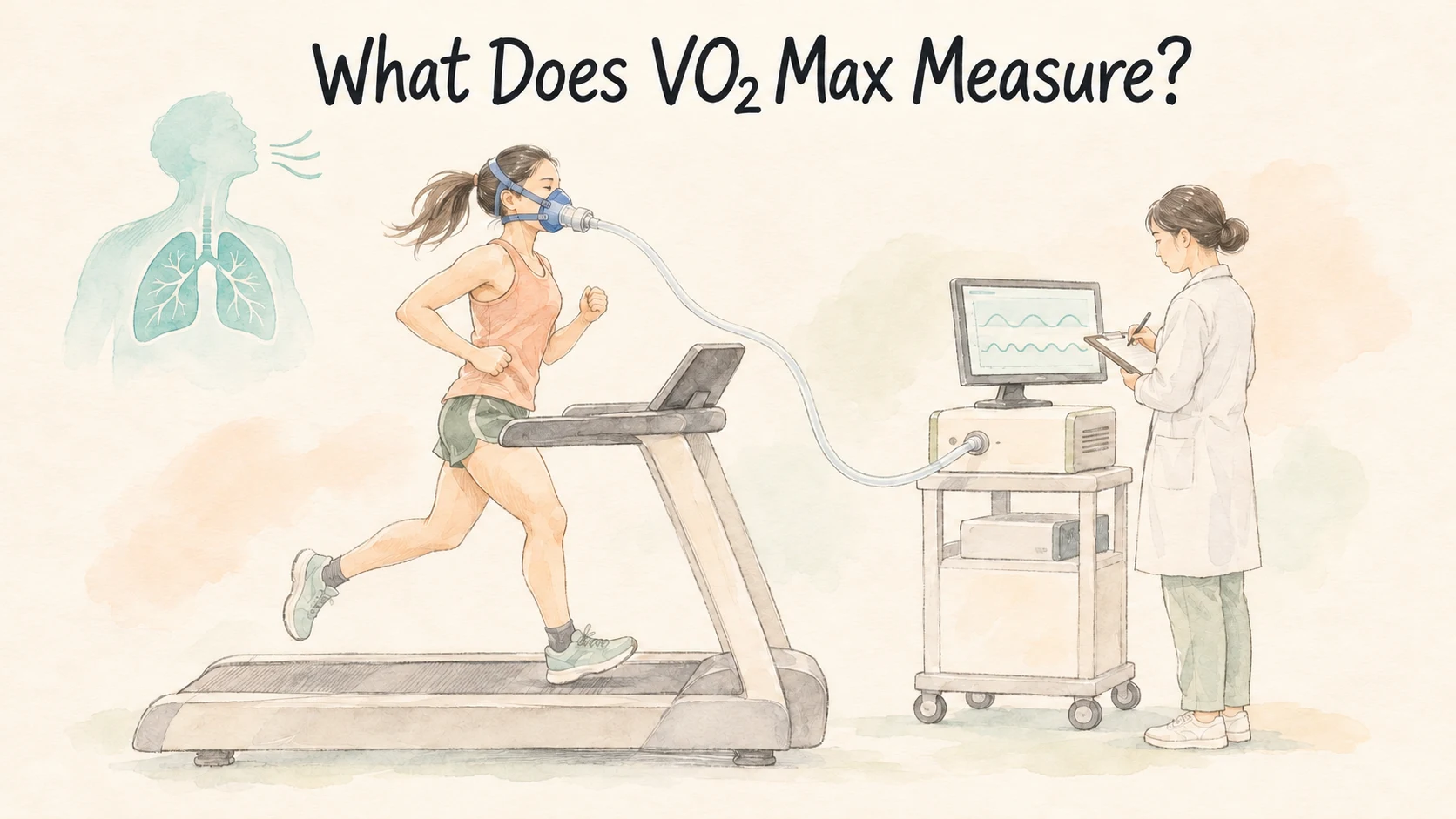
You get back from your usual run by the river and check your health app. Your cardio fitness readout has gone from 40 to 38. It didn't feel like a particularly hard run. Then you look up VO₂ max testing and see people running in masks. How can your watch give you the same kind of number after a loop on the river path?
VO₂ max is the highest rate at which your body can use oxygen during hard exercise. In a lab, researchers use the gases you breathe to measure that rate. A watch estimates it from signals such as your heart rate and how you move. You start with two kinds of information and get results in the same units. When you compare numbers, look at where they came from first.
How does the oxygen you breathe get to your legs?
As you speed up, your leg muscles need energy more quickly. Oxygen goes from your lungs into your blood. Your heart pumps the blood around your body, and working muscle takes up oxygen from it. To see how quickly the whole body can use oxygen, you have to consider the lungs, circulation and muscles together [1].
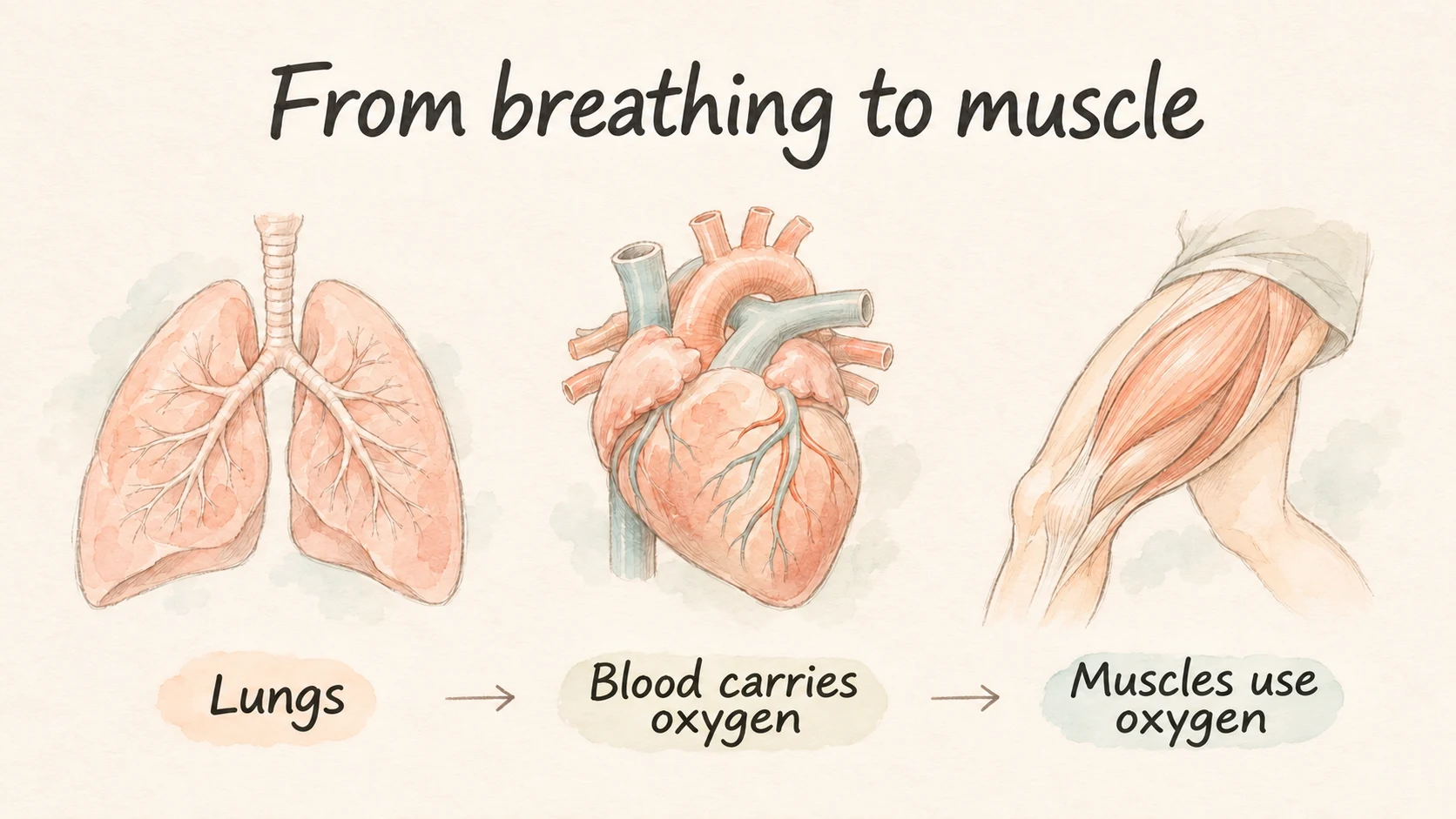
A big breath tells you air has moved. To find out how much oxygen you used, an analyzer measures the flow of air and what's in it. Researchers use the difference between the gases coming in and going out to calculate oxygen uptake. The rate generally rises as exercise gets harder. The lab wants to see how high it gets as the workload increases [1][2].
Does the treadmill have to get faster and faster?
Some tests increase speed in stages. Others keep the speed the same and make the incline steeper. In a 2025 study that compared an Apple Watch with a lab test, researchers selected a speed between 8 and 13 kilometers per hour for each person. That speed stayed the same throughout the test and the incline gradually increased. Researchers collected breathing data and monitored each participant [2].
If the workload goes up and oxygen uptake starts to level off, that plateau is one sign that the test has reached a maximum. When a clear plateau doesn't appear, a report may instead say VO₂ peak, the highest rate observed in that particular test. A lab may also consider several other exercise responses when deciding if a test meets its criteria for a maximum. Look for what the report calls the value and which exercise it used [2][3].
The treadmill researchers averaged the breathing data over 30 seconds and took the highest averaged value. One big breath doesn't automatically become the number on the report. The result depends on how the data were collected and summarized during the test [2].
The researchers also recorded how hard the test felt, heart rate, and the ratio of carbon dioxide breathed out to oxygen used. They required at least two indicators on their list before treating the result as a maximum. Two people who stop at the same incline can therefore leave with different labels on their reports [2].
How can 2.4 liters per minute turn into both 40 and 30?
First, check the units. L/min means liters per minute for the whole body. Many reports and watches show mL/kg/min. That divides the rate by body weight and expresses it as milliliters of oxygen used per kilogram per minute.
Take two people who each reach a rate of 2.4 liters per minute, or 2,400 milliliters. Here is how the arithmetic works.
- At 60 kilograms, 2,400 ÷ 60 gives 40 mL/kg/min.
- At 80 kilograms, 2,400 ÷ 80 gives 30 mL/kg/min.
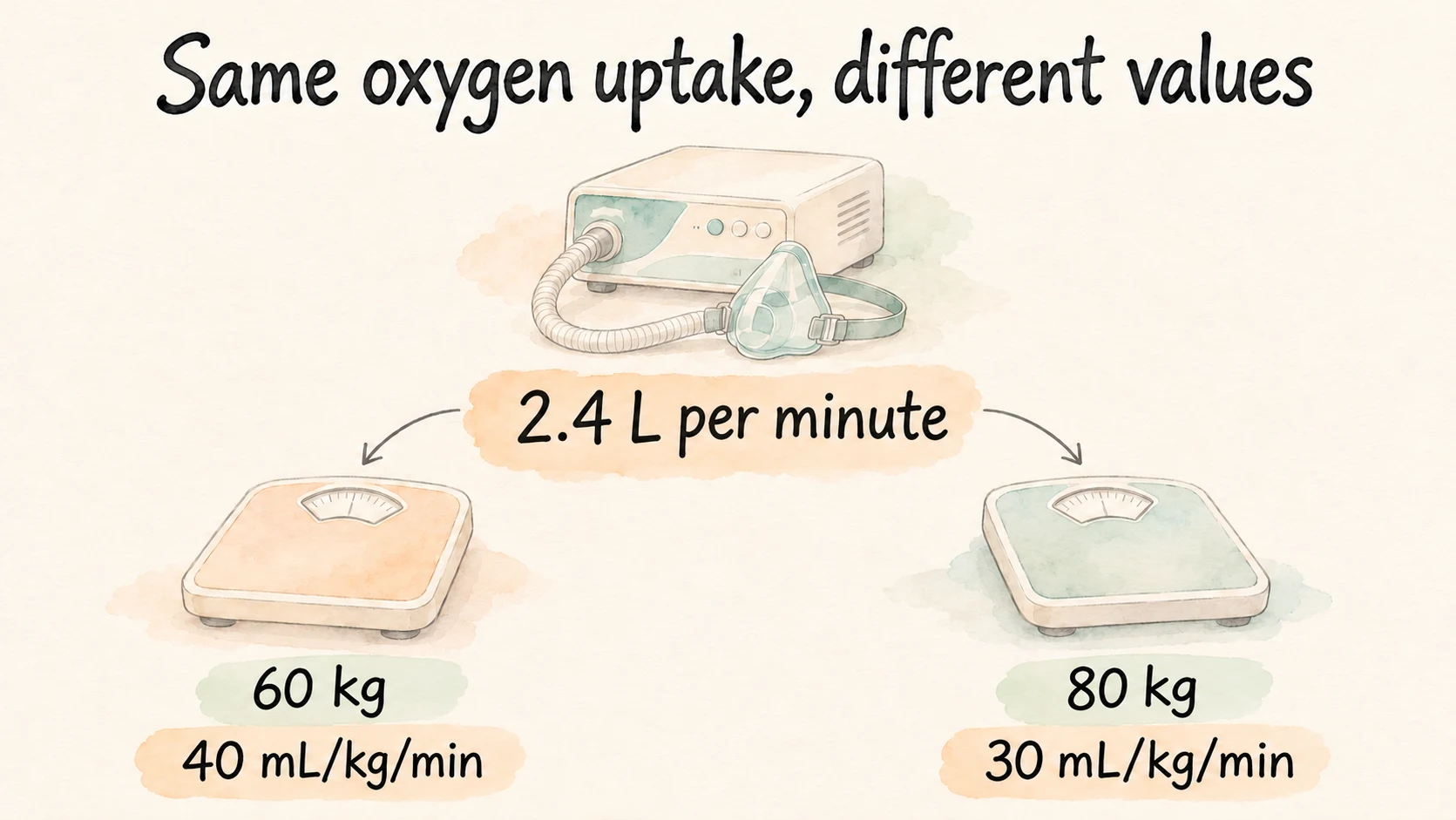
Their whole-body oxygen uptake is the same. The ten-point difference comes from the denominator. The same thing can happen when you compare two reports of your own. If your weight has changed, check the whole-body rate where it is available. That tells you how much of the shift in the ratio may come from the denominator.
For a second example, keep the weight at 60 kilograms. If whole-body uptake goes from 2.4 to 2.52 liters per minute, the relative number goes from 40 to 42. This time the change comes from the numerator. It's an arithmetic example, so it tells you how the units work without giving you a cutoff for meaningful change.
How close does a watch get to the lab?
Some watches estimate VO₂ max from heart rate and movement during qualifying outdoor walks, runs or hikes. The model uses information such as your pace and how your pulse responds. A headwind, a climb or a poor heart-rate signal can make two outdoor sessions harder to compare [2].
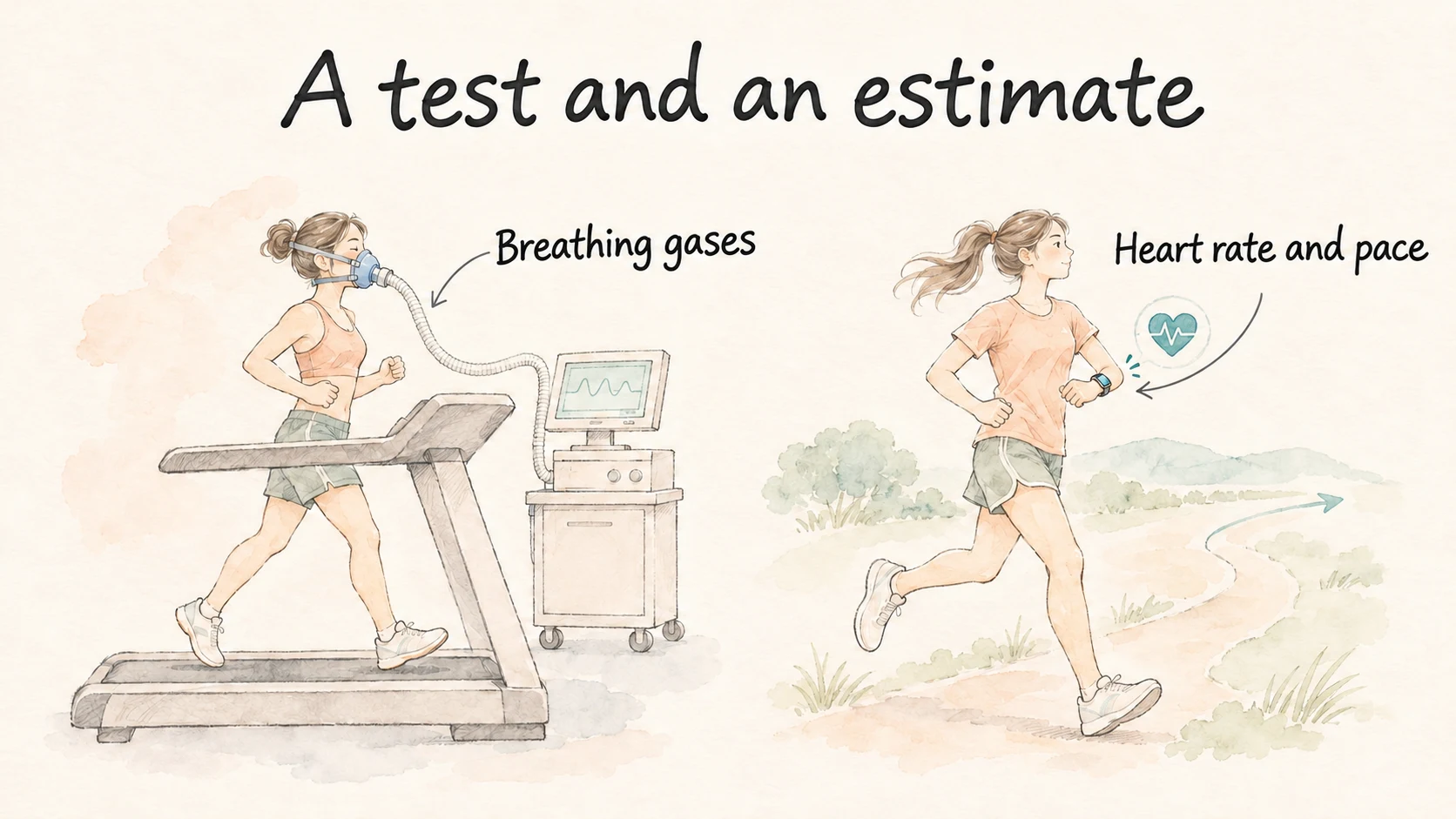
A watch and treadmill comparison — Thirty healthy adults wore Apple Watches for five to ten days before doing a treadmill breathing test. Twenty-eight met the test criteria and were included in the analysis. The watch estimate averaged 6.07 mL/kg/min lower than the breathing test, with substantial variation between people [2].
Some watches gave higher numbers than the lab. The statistical limits of agreement in this study ran from about −6.1 to +18.3 when the team subtracted the watch result from the lab result. The spread gives you a sense of how far individual readings could differ. Adding six to a watch reading of 38 can't turn it into a reliable lab value of 44 [2].
Comparing outdoor running with a lab bike adds another difference. The movements and muscles are different, and familiarity with the test and how the load increases can affect the result. If you want to know whether your own numbers are moving over time, start with a set of readings from the same activity and the same measurement method [2].
In another study in 2024, 19 people completed a cycle test in the lab and an outdoor run for an Apple Watch Series 7 estimate. Average values were 45.88 in the lab and 41.37 on the watch, both in mL/kg/min. These were different people, devices and test conditions from the 2025 comparison. The two studies help explain why both the device and the lab protocol belong beside the number [4].
If the question is how your running is going, the watch's estimate is one detail to save. Another is how long you can hold the usual pace on the river path. A lab maximum and the way you settle into a steady run answer different questions.
What do you do with a 38 from the river path?
Save the 38 and look at a few readings from similar routes or outings. If you ran at a different time, hit a headwind or stopped more than usual, add a short note. You can also record how long a familiar stretch took and how it felt. That gives you something you observed directly next to the watch estimate.
If you've had a lab test, save the date, units and equipment with that report. When you have another report to compare, start with those details. For this run, leave the 38 in the record and look back after a few more comparable trips along the river. You'll be able to see whether it was one low reading or part of a longer change.
References
[1] Skattebo Ø, et al. Contribution of oxygen extraction fraction to maximal oxygen uptake in healthy young men. Acta Physiol. 2020;230(2):e13486.
[2] Lambe R, et al. Investigating the accuracy of Apple Watch VO₂ max measurements: A validation study. PLoS One. 2025;20(5):e0323741.
[3] Bruggisser F, et al. A verification phase adds little value to the determination of maximum oxygen uptake in well-trained adults. Eur J Appl Physiol. 2024;124(6):1669–1681.
[4] Caserman P, et al. Assessing the accuracy of smartwatch-based estimation of maximum oxygen uptake using the Apple Watch Series 7. JMIR Biomed Eng. 2024;9:e59459.