
Which Minutes of a Spin Class Are You Actually Riding Hard?
A 45-minute class can include warm-ups, climbs and recovery. Measurements from two rides explain what your bike, breathing and heart rate each tell you.
Your instructor calls for a climb and you turn up the resistance one notch. A song later, everyone is back in the saddle, spinning lightly. Your workout summary says 45 minutes. You remember gasping through the middle of that climb. How much of the class did you spend working that hard?
The 45 minutes include the warm-up, hard efforts and recovery. In one experiment that measured breathing, participants spent about 23 minutes above their individual ventilatory thresholds during a 45-minute class. Using heart rate to count time above the threshold gave about 16 minutes for the same ride. The answer depends on what you use to measure effort.
Why does a turn of the knob make the same beat harder?
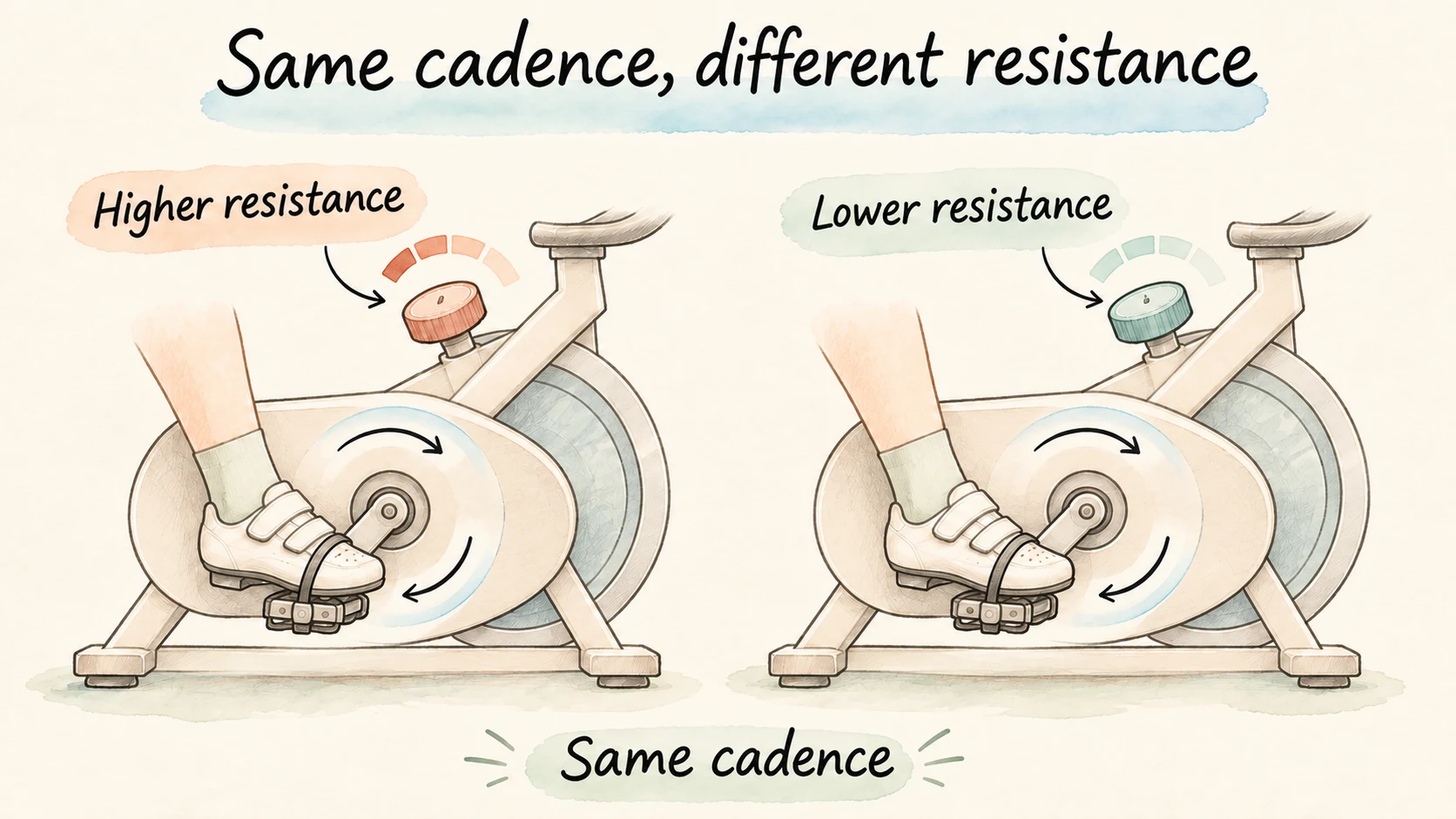
On a bike, one revolution means the pedals complete a full turn. The number of turns per minute is your cadence. Suppose you ride along at 80 revolutions per minute and the instructor asks you to turn up the resistance. If you stay with the beat, your feet move just as fast but you have to push harder to complete each turn.
Power is how quickly you do work at the pedals. It depends on how fast the cranks turn and how much turning force you apply. Watts are the unit. If you hold 80 watts for one minute and 120 watts for another, you do one and a half times as much mechanical work in the second minute. Those are example numbers. They describe the output at the bike. How hard that output is for you is something your breathing and how you feel can help answer.
Two rides can even average the same watts. Imagine holding 100 watts for two minutes in one ride. In the other, you spend a minute at 150 watts and a minute at 50. Both average 100 watts. The average alone gives you no way to tell if you held one pace or pushed hard for a minute and eased up.
On a bike without a watt display, you can use “one notch up” as a note about that particular bike. The knob on the bike next to you may feel different in the same position. Record how long you kept it there and how quickly you could pedal. Those details give you something to compare if you return to the same bike.
How did researchers count 23 minutes out of 45?
In 2008, researchers at the University of Wisconsin–La Crosse and other institutions tested 20 healthy female students and university staff who had experience with indoor cycling. First, the participants rode on a bike as the load gradually increased. The researchers analyzed the gas they breathed and found the point where breathing began to rise faster in relation to oxygen use. It's called the ventilatory threshold, and the test gave them a reference point for each person [1].
Each woman then rode two videotaped classes lasting 45 and 35 minutes. The team compared oxygen uptake in 30-second intervals with each participant's threshold [1].
- In the 45-minute class, an average of 52% of the time was above the threshold, or about 23 minutes.
- In the 35-minute class, an average of 35% was above the threshold, or about 12 minutes.
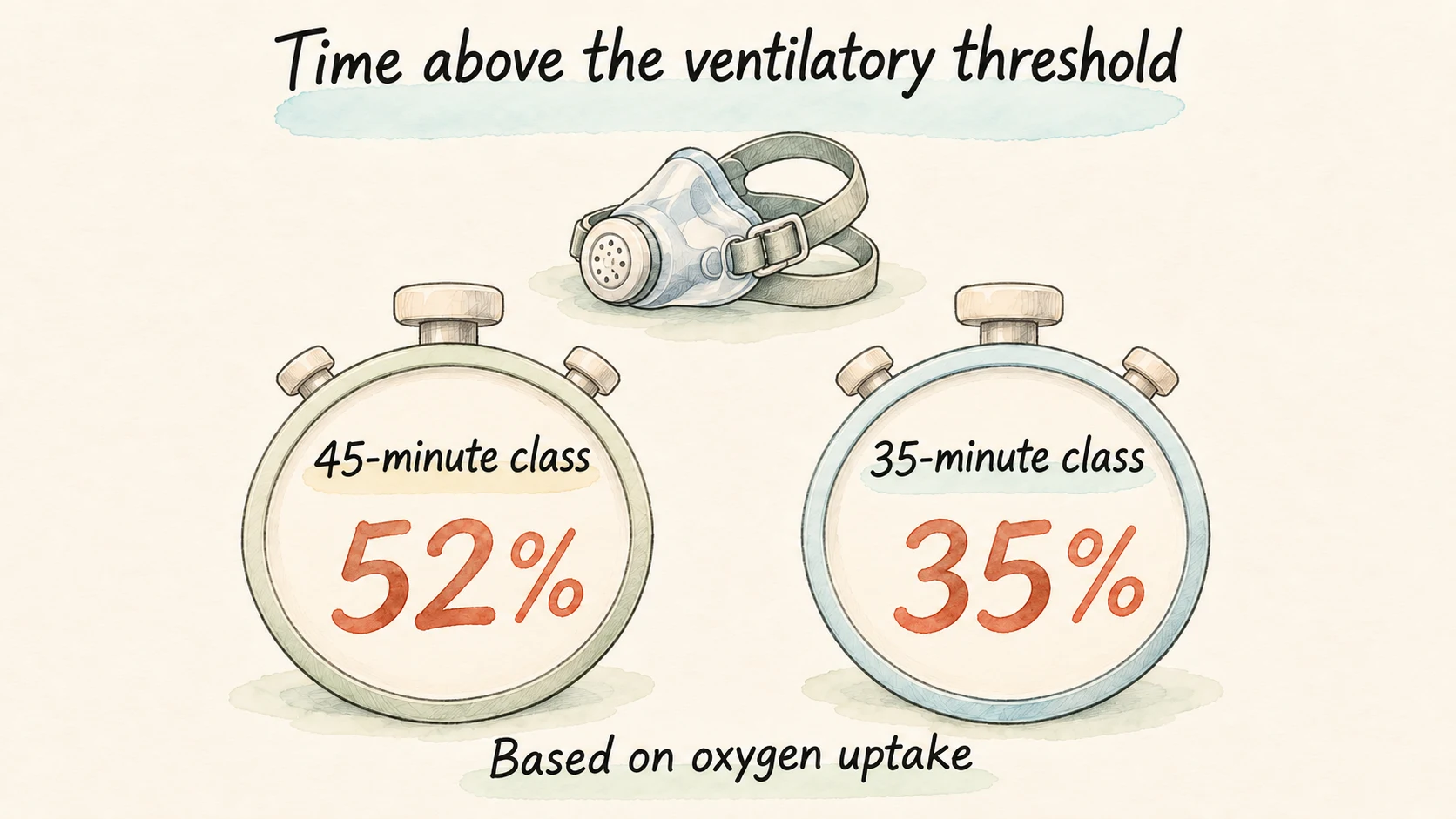
Where 23 minutes comes from — Multiply 45 by 52%, and 35 by 35% for the shorter class. The minutes are converted from average percentages. The two classes used different routines, and the shorter class came in multiple versions [1].
Time over the threshold can come in bits spread across songs. If you kept the hard parts as they were and added a longer cooldown, the class would get longer without adding time over the threshold. And those 23 minutes summarize the rides of these participants. How much time you spend at that level depends on your class and on the effort you choose.
Participants were about 24 years old on average and had already been taking indoor cycling classes at least twice a week for two months. Even these experienced riders exercised at a wide range of intensities while following the exact same 45-minute video [1].
Why do you get a different answer with heart rate?
Researchers also noted each person's heart rate at the ventilatory threshold during the initial test. When they used that heart rate as the cutoff, an average 35% of the 45-minute class was above it, about 16 minutes. The figure for the 35-minute class was 38%, about 13 minutes. That puts the shorter class higher as a share and lower as a number of minutes. The denominators are different [1].
Heart rate and oxygen uptake generally rise and fall as the demands of the ride change. In a short surge, power at the pedals can change before your body has fully responded. When you ease off, your breathing and pulse may still be on their way down. The experiment found different totals with the two measures and didn't pin the gap on one cause. On your own recording, if your pulse peaks after you ease off, you can check it against the moment you turned the knob [1].
The bike used in the classes did not measure power. During short water breaks in recovery, the researchers let participants remove the breathing valve. They estimated oxygen uptake for those gaps using each person's relationship between heart rate and oxygen use. The two totals are best read as results of this setup. Back at your studio, a note on when you added resistance may tell you more about which part of the ride you actually pushed [1].
The researchers also asked how hard the ride felt on a 0–10 scale. The 45-minute class averaged 6.3 at 10 minutes and 7.9 at 20 minutes. That gives you a description of how those two points felt during the class. It's another measurement you can make on an ordinary bike, even without a power display [1].
Does the person pushing more watts also have a faster pulse?
A separate study had 12 cycling instructors follow the same 50-minute class. The six men averaged 120 watts and 136 beats per minute. The six women averaged 73 watts and 143 beats per minute. These are averages from two small groups of instructors, with different bodies, fitness and ways of pacing. They aren't targets for women or men in class [2].
In this case the group doing more work on the pedals had a lower average heart rate. If you want to know how hard today's climb was for you, your breathing or your own record of a comparable ride will tell you more than a neighbor's watts.
What's one line worth saving after class?
Keep the 45 minutes in your log. Then pick a climb you still remember and add some detail. “One extra turn on climb two. Back in the saddle, I was still catching my breath into the next song.” If there's a screen, include the cadence or power. With no screen, record roughly how long the climb lasted and how it felt when you eased up.
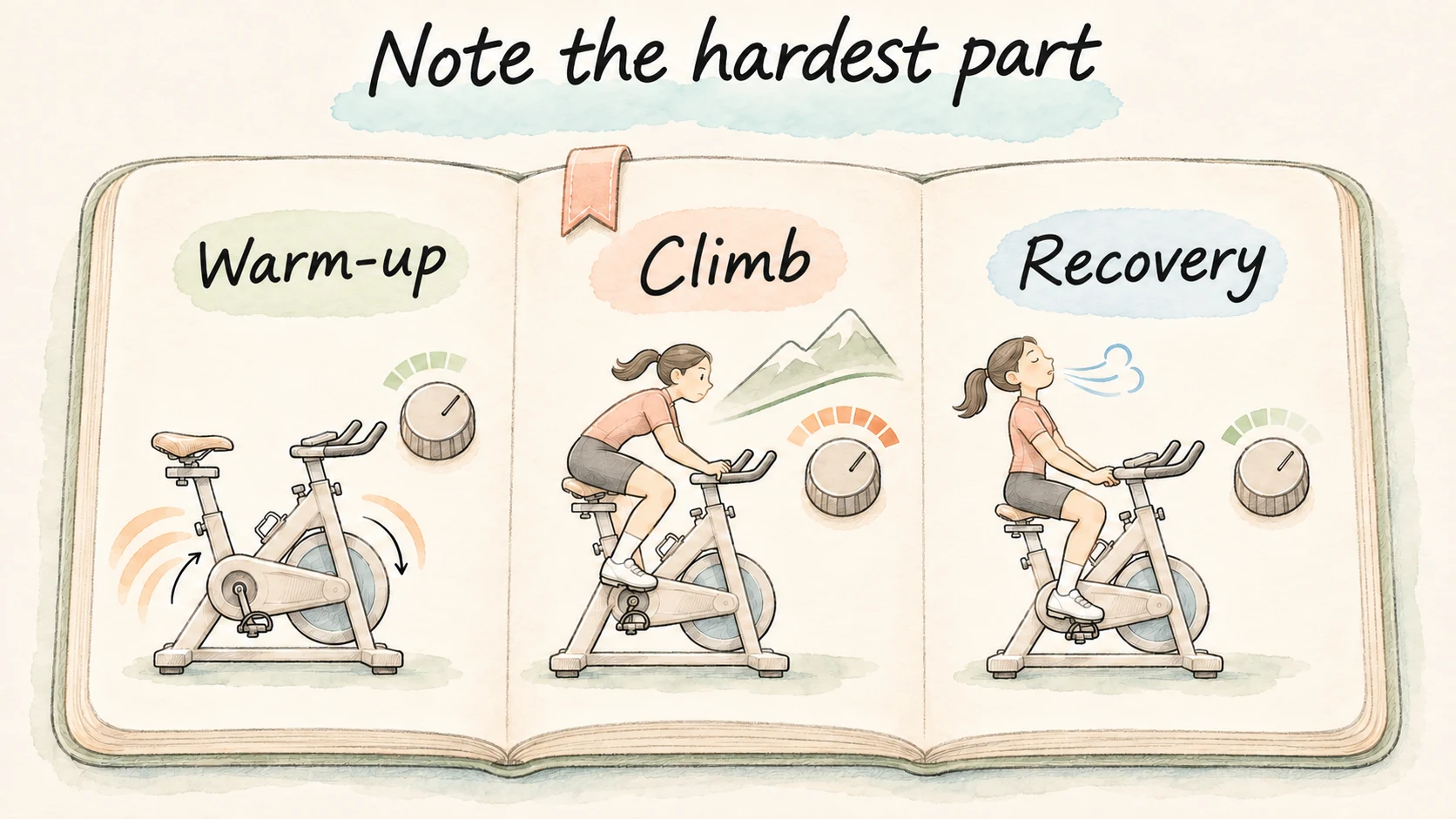
The next time you reach that climb, see if you can keep the beat at similar resistance and how quickly you feel ready to talk when you return to easy pedaling. Both entries can say 45 minutes, and the extra line tells you what changed.
References
[1] Battista RA, et al. Physiologic responses during indoor cycling. J Strength Cond Res. 2008;22(4):1236–1241.
[2] Caria MA, et al. Quantification of Spinning bike performance during a standard 50-minute class. J Sports Sci. 2007;25(4):421–429.