
You Lifted More on Your Fourth Test. How Much Stronger Are You?
Researchers asked men with and without lifting experience to repeat a strength test four times. Their numbers show why it helps to compare the same lift under similar conditions.

The first time you logged a bench press, you put down 40 kilograms. A few visits later you lifted 44. The bar really was heavier. Does that tell you that your chest and arms were exactly ten percent stronger?
How much you lift depends on both your strength and how familiar you are with the movement and the test. In one study, men who hadn't trained with weights lifted about ten percent more on their fourth bench press test than on their first. Researchers didn't find the same rise among men who had been training for years. Before judging how much changed, look at what you did on both days [1].
The number describes a particular kind of rep
Researchers often report a one-repetition maximum, or 1RM. It's the heaviest load you can lift once while meeting the requirements for a particular movement. In a bench press, that might include the position of your hands, how far you lower the bar, and whether you return it to the required end position. On a first attempt you might be working out how to keep the bar moving where you want. The next attempt can feel different once you know where to lie, how to grip, and how it feels to move a load over you.
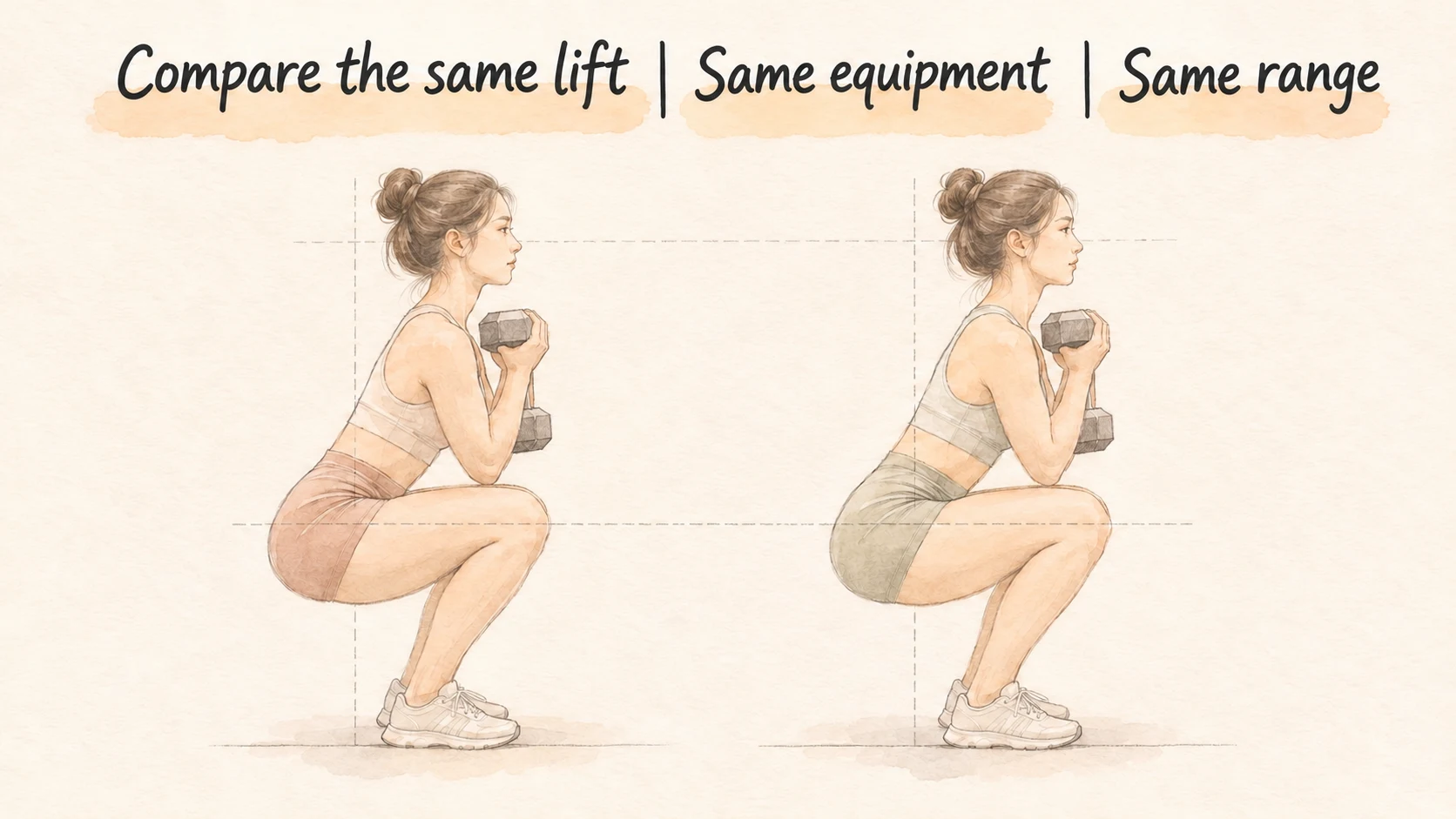
Suppose your first rep starts with a pause at the bottom, and on the second test you stop lowering several inches earlier. Both efforts move a load. They don't give you a clean side-by-side comparison of what you could lift through the same path. For a squat, the depth you reach has a similar effect on what you're testing. Before treating the weight on the bar as a measure of the change, ask whether the conditions and the movement matched.
Four visits for people with different levels of experience
A study led by Raphael Ritti-Dias included 30 men. One group had no previous resistance training experience. The other had been training for more than two years. They completed bench press and squat maximum tests on four separate days. The researchers grouped people by training experience they already had, so the test could show how the measurements changed over visits within those groups [1].
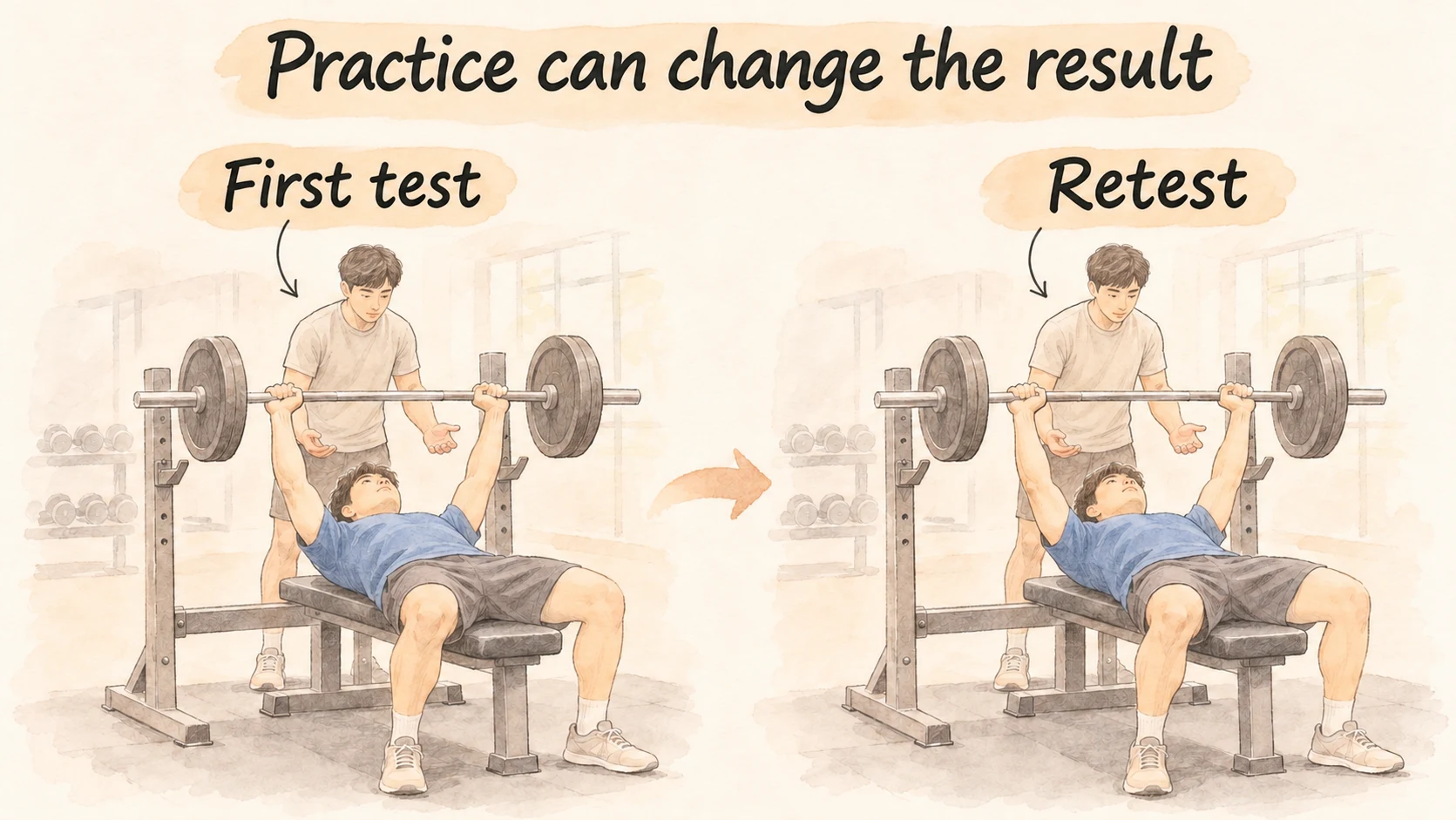
In the group without prior experience, average bench press scores were 3.8% higher on the second visit, 7.4% higher on the third, and 10.1% higher on the fourth, each compared with the first. By the fourth test, squat scores were 11.2% higher. The experienced group didn't show the same clear increase across tests [1].
There was a change in what the participants could complete under the test conditions. The experiment didn't measure how much new muscle they had grown or separate the exact contribution of practice, technique, and other short-term adaptations. It can't turn a ten percent higher score into ten percent more muscle. For someone new to a lift, it shows why a first attempt may not give a stable starting number.
The sample doesn't provide a percentage you can deduct from your own improvement. It shows that getting used to a test can be part of what the readings capture [1].
A separate study tested 21 men who had at least six months of weight training experience. They completed four tests separated by two or three days. The fourth bench press averaged 2.4% higher than the first, and the squat averaged 3.4% higher. Six months is a different entry requirement from the two years used to define the experienced group in the other study. Each experiment also used its own protocol. Taken together, the studies give you a reason to pay attention to how familiar people were with the specific test, even if they had lifted before [2].
If you've done chest presses for years on one machine, the first time you lie down under a bar can still be a new lift for you. A machine and a bar can both list weight in kilograms, while supporting the load differently and moving through different paths. Rather than try to match numbers across them, keep each exercise in its own line of the log. A few sessions with the same equipment will give you a clearer starting point for comparison.
You can compare ordinary sessions without testing a maximum
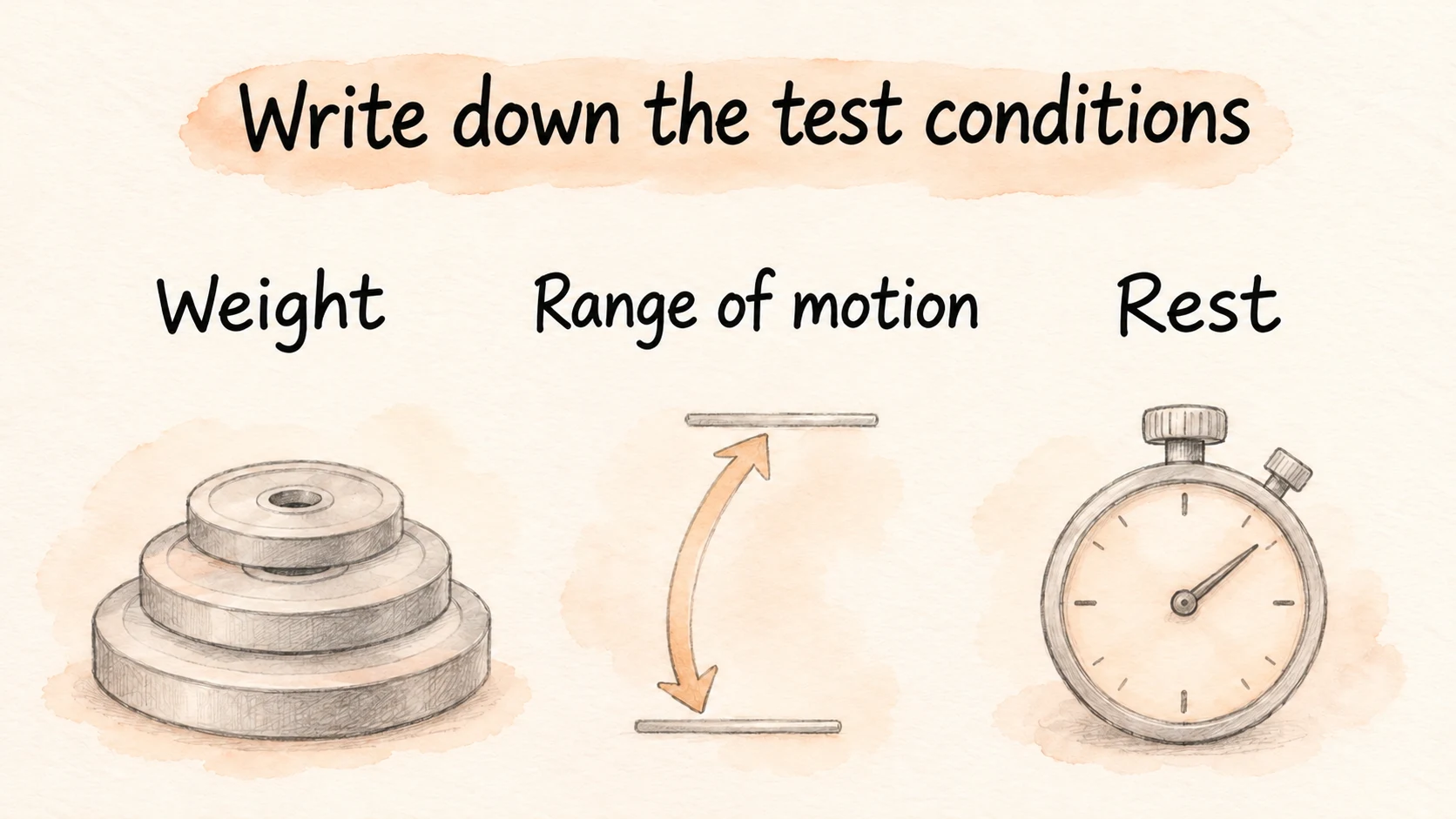
For an exercise you do regularly, start with the parts you can repeat. Use the same machine or barbell when possible, keep the range of motion comparable, and write down how many repetitions you actually completed. If one day you bench press after several other lifts, but the next week you do it first, add that note. A different seat setting or a longer rest can be worth recording, too. Later, you'll have a way to see what changed besides the number on the weight.
Say you use the same 40 kilograms and the same setup. You complete six controlled reps one week and eight another week, with a comparable range of motion. That tells you something about the lift without asking you to handle the heaviest possible load. After a few similar sessions you can compare them together. A great day can reflect a combination of practice, strength, rest, and how you feel. Several entries will tell you more than trying to assign every change to one of them.
Back at 40 and 44 kilograms, write down the new number. Then record the setup, the movement, and how you got it. The next time you open the log, you'll know what you'd need to repeat for the comparison to be meaningful.
References
-
Ritti-Dias RM, Avelar A, Salvador EP, Cyrino ES. (2011). Influence of previous resistance training experience on the reliability of a one-repetition maximum test. Journal of Strength and Conditioning Research.
-
Ritti Dias RM, et al. (2005). Influence of familiarization process on muscular strength assessment in 1RM tests. Revista Brasileira de Medicina do Esporte.