
How Long Should You Rest Between Sets? Watch What Happens in the Next One
Rest can change how many reps you manage later in a workout. See what two strength studies measured, then try a simple comparison in your own training.
You rack the bar after eight reps. The timer hits a minute, your breathing settles, and you get back under the same weight. This time the bar stalls on rep six. Was the bar too heavy, or did you come back too soon?
If you lose several reps after a hard first set, give yourself a little more time before the next one. The same lifter can complete a different number of reps with the same exercise depending on how long they wait. How many reps you can do today and how much you can eventually lift after weeks of practice are two separate measurements [1, 2].
Your breathing can settle before you're ready to repeat the set
Picture the last rep of a difficult bench press set. The bar takes a long time to move through the middle of the lift, and you are glad to put it back in the rack. As you sit, your breathing eases and the burning feeling in your arms might let up. The next set still asks the same muscles to move the bar from your chest to the same height again. Feeling more comfortable in the seat gives you one piece of information. How well you can press the bar gives you another.
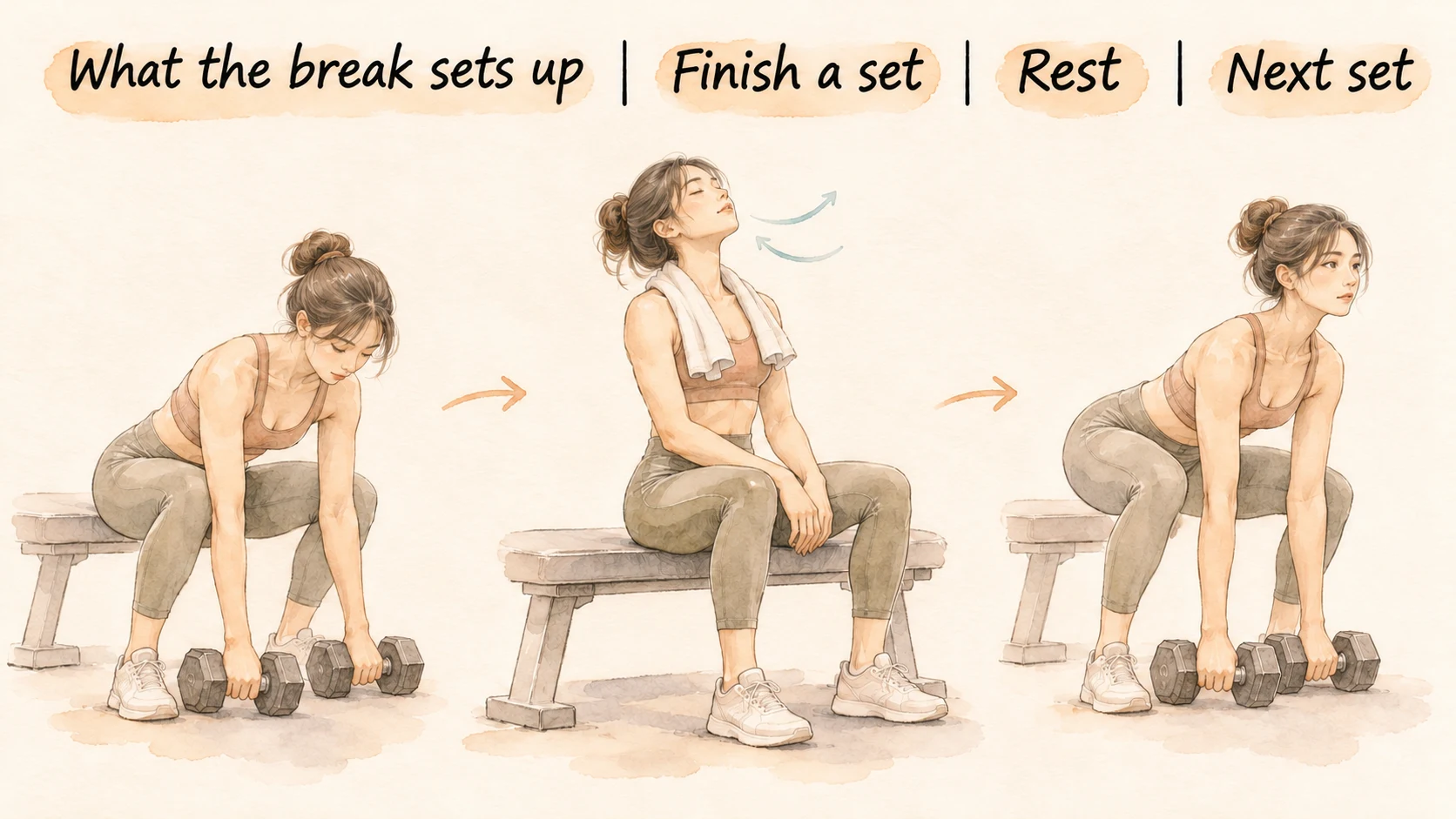
In one experiment, researchers Jeffrey Willardson and Lee Burkett brought in 15 college-age men who lifted regularly. Each came in for three test sessions and did four sets each of the squat and bench press at about the heaviest load he could lift eight times. The sets continued until the lifter chose to stop because he could no longer keep going. Between sets of the same lift, the rest was either one, two, or five minutes, decided in advance for that session. Each lifter tried all three rest schedules, so the researchers could compare the same person's performance across visits [1].
The first bench press set averaged between seven and eight reps on all three schedules. With a minute of rest, the fourth set averaged 2.4 reps and the four sets added up to about 17 reps. With two minutes, the total was about 22 reps. With five minutes, the fourth set averaged 5.6 and the total was about 26 reps. The fractions are averages across the 15 participants. Each lifter still logged whole reps [1].
Most of the gap opened up late in the exercise. Even with five minutes between sets, the average lifter still did fewer reps in set four than in set one. This was a demanding test with four hard sets and a weight chosen to make eight reps a serious effort. If you do only two sets or stop earlier, the difference between your first and last set could be smaller [1].
A minute on the timer can feel quite different depending on the set you just finished. After an easy warm-up, another rep may come easily. After a set whose last rep took everything you had, the next set starts from a different place. Reading the timer alongside the rep counts tells you more about how that break worked at the load you used.
What changed over eight weeks with one minute or three?
A few extra reps on the bench tonight tell you about the session you just did. Brad Schoenfeld's team asked a question on a longer timeline. They randomly assigned young men with lifting experience to rest one minute or three minutes between sets. Twenty-one completed eight weeks. Both groups did three full-body sessions a week with the same seven exercises and three sets per exercise. During training, the researchers adjusted weight as needed so that each participant reached the point where he could not do another rep with proper form at roughly eight to 12 reps [2].
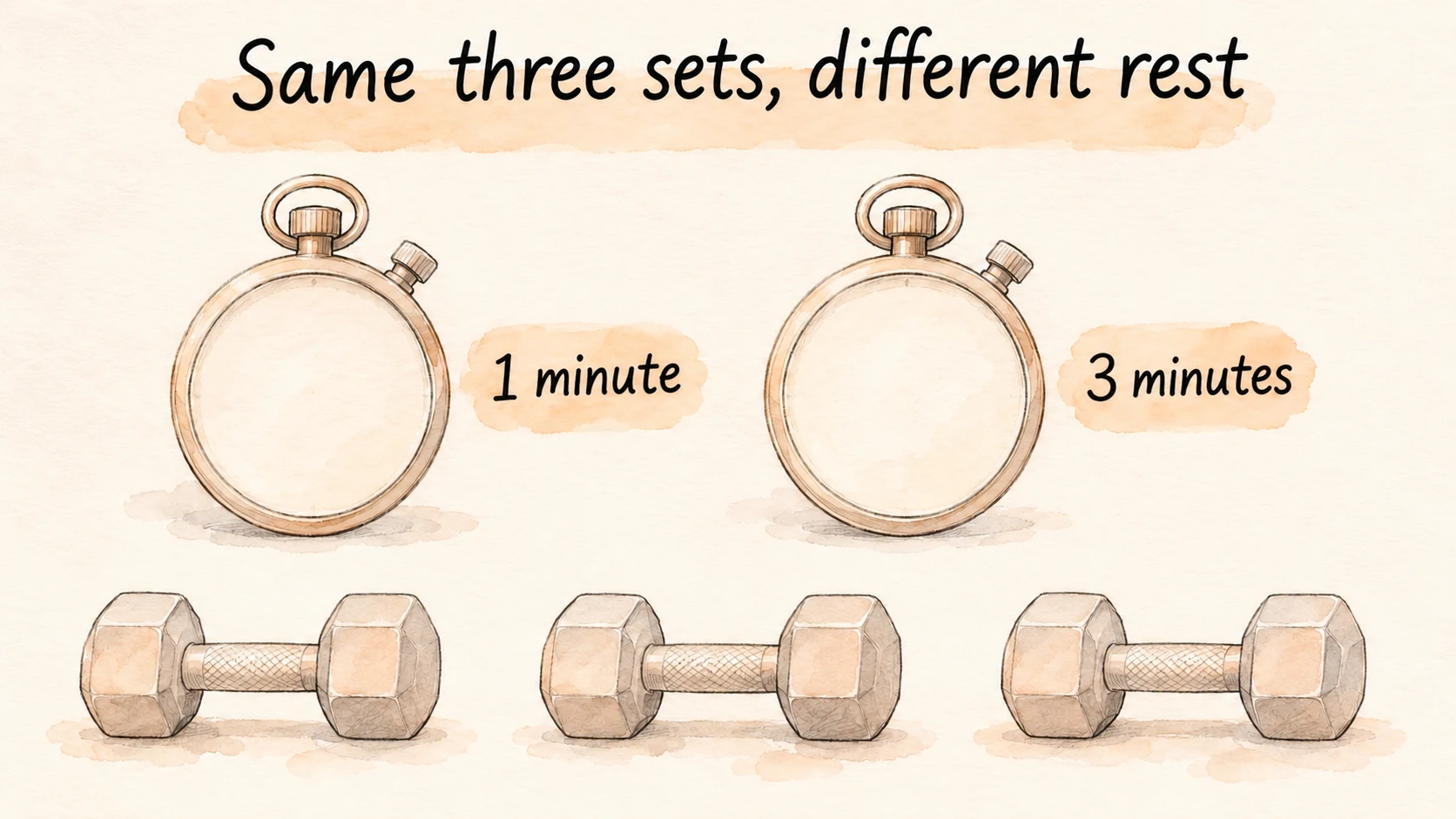
At the start and at the end, the researchers found the heaviest load each participant could lift once in the squat and bench press with the required form. That test is called a one-rep max, or 1RM. Here is how far each group moved from its own starting average [2].
| Change in one-rep max after eight weeks | One-minute rest | Three-minute rest | | --------------------------------------- | --------------: | ----------------: | | Squat | +7.6% | +15.2% | | Bench press | +4.1% | +12.7% |
In kilos, the three-minute group's average squat went from about 118 to 136 kg. The one-minute group's went from about 119 to 129 kg. Their starting weights were a little different, so each percentage tracks the change from that group's own baseline. The differences in gains between groups were statistically significant for both lifts. They describe a particular eight-week program in a small group of experienced lifters [2].
Finding out whether two minutes would have come close, or whether a fourth minute would have helped, would take a comparison with those rest intervals [2].
The same study also tested how many bench press reps participants could do in one go at half their starting one-rep max. Both groups did more reps at the end, and the researchers did not detect a clear difference in the amount of change between groups. Repeating a hard effort over four sets, doing one longer set with a lighter weight, and lifting your heaviest single can tell you different things about your training [1, 2].
Schoenfeld's team also tracked weight multiplied by reps for three barbell exercises in the last session of each week. They found no clear difference between groups in that measure over the eight weeks. In this trial, how much the ability to get more work done explained the strength gains remains an open question [2].
Time one exercise you already know
Pick a familiar exercise you already do for three sets, such as a machine chest press. Start by finding out how long you usually take. Hit the timer after the last rep, then check it when you actually begin the next set. Getting a drink, setting the seat, and waiting for someone else to finish can all add time. Use the same start and stop points on both days you want to compare.
Next time, use the same machine settings and load, at about the same point in your workout, and add one minute to each break. End each set where you usually would. If your usual signal is that you can no longer move the handles through the same distance smoothly, use it again. Record how many full reps you completed in all three sets and a short note about the last few. If you gain a rep, the note helps you remember how you did it.
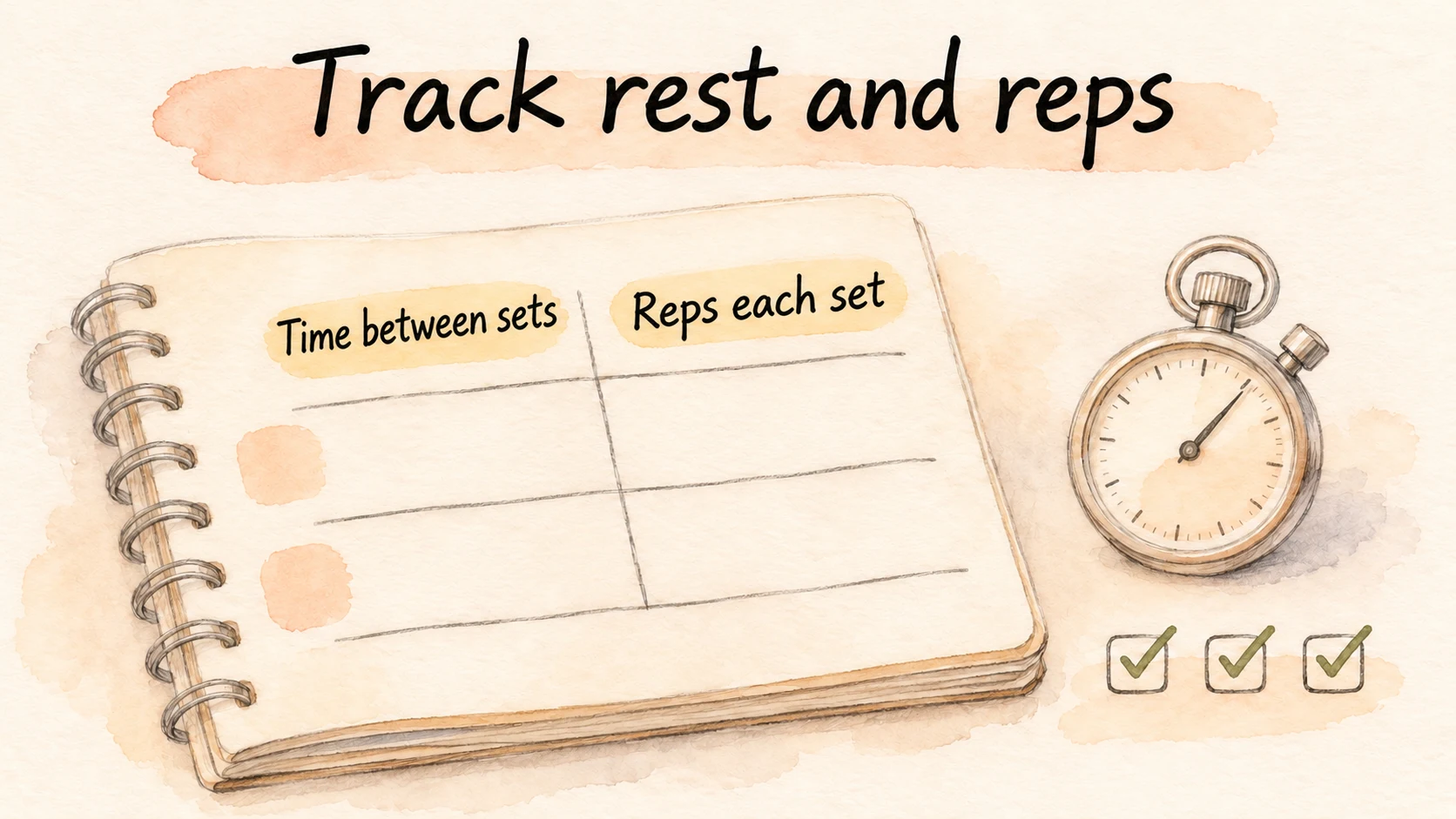
Say one log shows 10, 8, and 6 reps, and another shows 10, 9, and 8. That's 24 versus 27 reps at the same load for two extra minutes across the breaks. Those are sample log entries. If a gap like that shows up on several comparable days and you want to sustain more reps in later sets, you know where the extra time might pay off. If both sessions come in at 10, 10, and 9, you can keep your usual pace on that exercise and check a more demanding lift another day.
If your first set was 10 reps on one day and seven on the other, set those logs aside and compare again on a closer match. The first set came before the timed breaks, so the difference was there from the start. An unusually hard exercise just before the press or a last-minute change of machine is worth jotting down as well.
Adding a minute to every break in three exercises with three sets each makes a workout six minutes longer. If time is tight, try it on one exercise first. The next time your phone says a minute has passed, see whether waiting a bit longer lets you finish one more full rep in the set where you usually get stuck.
References
- Willardson JM, Burkett LN. 2005. A Comparison of 3 Different Rest Intervals on the Exercise Volume Completed During a Workout. Journal of Strength and Conditioning Research, 19(1), 23–26. Full paper and mean repetition counts
- Schoenfeld BJ, et al. 2016. Longer Interset Rest Periods Enhance Muscle Strength and Hypertrophy in Resistance-Trained Men. Journal of Strength and Conditioning Research, 30(7), 1805–1812. Full paper and before-and-after data