
How Do You Know How Many Reps You Have Left?
Two sets of eight can differ in effort. A bench-press experiment and a worked example show what a reps-in-reserve estimate means.
You've finished your eighth chest press and a friend asks, “Could you do two more?” Your chest and arms are tired, but the last rep still moved smoothly. You say yes and put “two left” in your workout log. How much can you trust that number?
Reps in reserve are how many more reps you think you could complete with the same movement right now. The abbreviation is RIR. It can help you tell which of two sets of eight was closer to the point where you couldn't do another rep. Experienced lifters can get quite close on a familiar bench press. Accuracy depends on the lift and when you make the estimate.
Which two reps count as “two left”?
Suppose you stop after eight reps and estimate that you have two left. You record “8 reps, estimated 2 left.” Now imagine that you'd kept going. Reps nine and ten would have been full presses, but you wouldn't have got through rep eleven. In this example, you had 10 − 8 = 2 additional reps available.
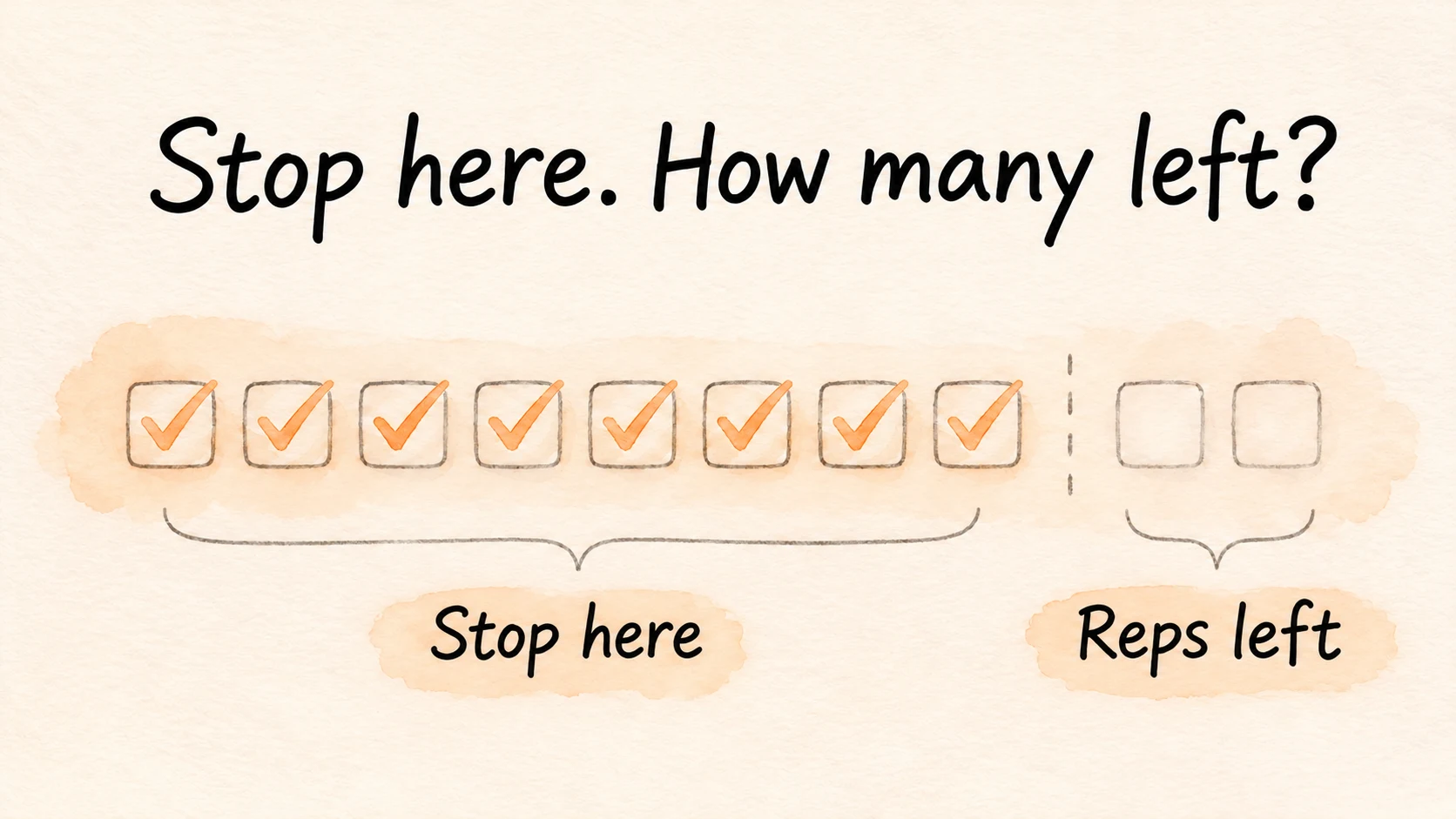
That number assumes the extra reps look like the ones you counted. If you have to arch much farther or shorten the movement, you're doing something different. The estimate also excludes what you could do after putting the weight down and taking a break. A minute of rest gives you another set of conditions.
Keep “eight reps” and “two left” in separate fields. One is what you finished and the other is a prediction. If you did eight reps on two occasions and estimated three left one time and one left the other, check the weight, range and rest first. You've got two observations, and you can look for a pattern before changing the plan.
If it burns more, do you have fewer reps left?
You may have done a dozen reps with a lighter load and felt your arms burn, yet still managed a few more clean presses. A heavier load can stop you after fewer reps, and you may feel less of that sustained burn. “Could I finish another rep?” and “How uncomfortable do I feel?” are two questions you can ask separately.
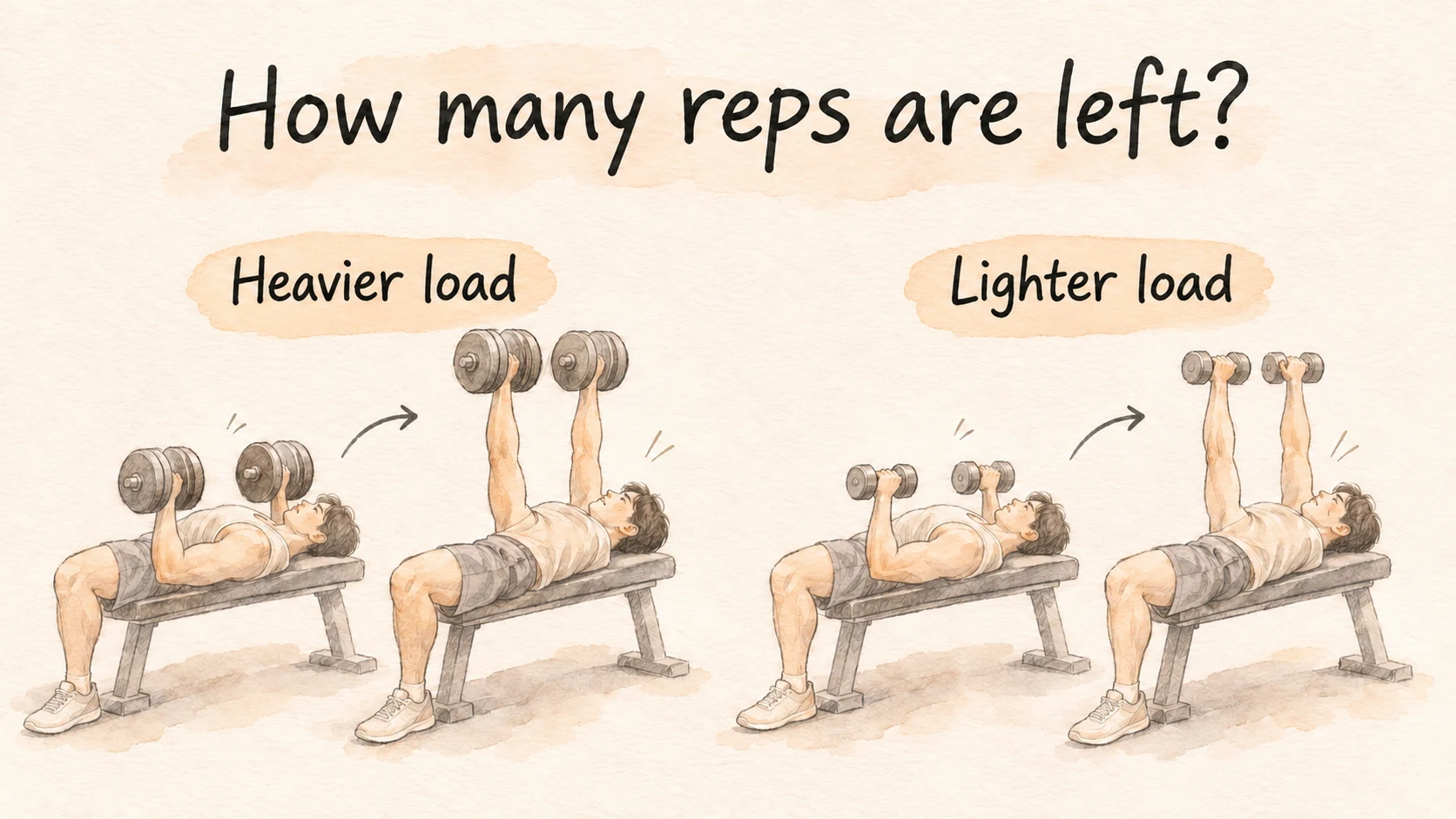
Researchers have asked lifters to distinguish these feelings, too. In one experiment, 24 people with resistance-training experience performed barbell bench presses at 75% of their maximum weight for one rep. Across two sessions, they said when they thought they had one or three reps left. They then kept going under supervision so the researchers could count the extra reps [1].
How close did they get? The researchers averaged the size of the difference between what each lifter guessed and what they did. A guess of two followed by one rep is off by one. A guess of two followed by three reps is also off by one. Across the experiment, the average absolute error was about 0.65 reps [1].
That's fairly close for experienced lifters doing this particular exercise and load. You still can't give a fraction of a rep back to someone in the gym. Each lifter either finished the next full rep or didn't. The fraction describes how close the guesses were across the study.
If you're learning a different lift, keep the notes for it separate. Bench pressing and pulling a cable put you in different positions, and a slow rep might feel different in the two exercises. The result from that one bench-press protocol describes those lifters under the same conditions. You can use it to understand what the estimate represents while you build up your own separate records.
Why did another group miss by more?
Another study enrolled 141 people with a range of training experience. They did one set of each exercise in a full-body workout, first guessing how many total reps they could complete and then letting the researchers count. People generally guessed fewer reps than they eventually completed. More experienced people tended to guess closer [2].
The question came at a different time. Before the set, you have your previous sessions to go on. After the eighth rep, you've felt how this weight moves today. Comparing the studies helps explain why a prediction at the start of a set is different from a guess when you're already a few reps in.
Does practicing a lift mean your guesses will get better every week? In a smaller study, trained men bench pressed for six weeks. During the last set of each session, researchers compared the reps lifters thought they had left with the reps they went on to complete. Guessing accuracy did not clearly improve over those six weeks. Familiarity can help you describe a set, but your accuracy still depends on what you're doing and when you make the prediction [3].
If a program says to leave two reps, you can use that as a cue to stop when you feel you have a little room. On an unfamiliar machine, you can keep a broader estimate, say two to four. As you get used to the start position and the range, see whether you feel comfortable giving a narrower range. The wider range still tells you something you might forget later: you weren't sure.
To see how a set changes within a workout, suppose you log eight reps at 20 kilograms on sets one and three. You think you had three left on the first, one on the third. The total count doesn't show this change in effort. For a week-to-week comparison, match the first set to the first set.
What's one line to add to your log?
Pick a movement you already know. Write down the weight and count as usual, then add “about two left” or “two to three left.” If the last rep was visibly slower but you finished the usual range, add that too. A few words about the rep can still be helpful when two estimates overlap.
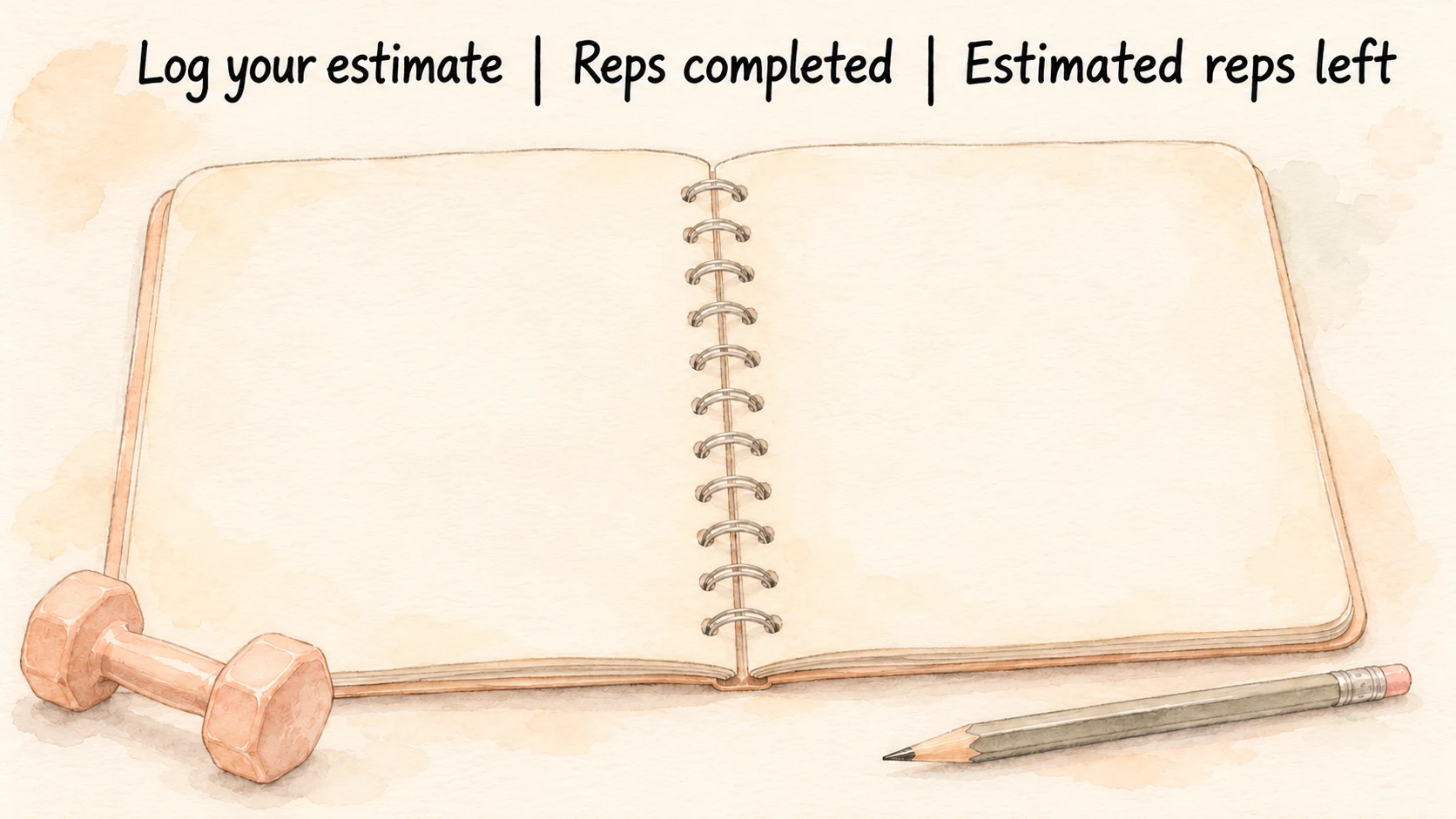
You can also choose the same point in the workout to make the note. Say you'll write it after set three, once you put down the weight. If you wait until you're home, you may remember how hard the whole exercise felt and lose track of the one set you wanted to compare. Set three may feel different from set one.
There is no need to run every set to the point where you can't move the weight to grade your guess. Keep the estimate and compare it with the next few sessions of the same exercise. You might find that a set of eight recently felt more controlled and left you with more room than the same set did a few weeks ago. Now when a friend asks if you had two left, you can check what you did and how the last rep moved, instead of relying on whether your arms felt tired.
References
[1] Refalo MC, et al. Accuracy of intraset repetitions-in-reserve predictions during the bench press exercise in resistance-trained male and female subjects. J Strength Cond Res. 2024;38(3):e78–e85.
[2] Steele J, et al. Ability to predict repetitions to momentary failure is not perfectly accurate, though improves with resistance training experience. PeerJ. 2017;5:e4105.
[3] Remmert JF, et al. Changes in intraset repetitions in reserve prediction accuracy during six weeks of bench press training in trained men. J Strength Cond Res. 2023.