
Do You Need to Load Creatine? What Six Days and 28 Days Meant in a Study
A loading phase can raise muscle creatine sooner. What that early change means for strength and lean mass depends on what a study measures.

You've finished your last set of bench presses and stop to check your phone. A friend sends you a creatine schedule with a big dose for the first few days and a smaller one afterwards. The tub you bought lists one serving a day. Which one works?
A loading phase raises muscle creatine faster. A smaller amount taken steadily can reach a similar increase. In a study that sampled muscle, the researchers measured an increase of about one fifth after six days on one schedule and after 28 days on the other. Whether you'll lift more in week one is a different question and takes a different experiment to answer.
What is creatine doing as the bar leaves your chest?
Muscle needs ATP to contract. ATP provides energy for the muscle to pull, and it becomes ADP when it gives up a phosphate group. Do several hard reps in a row and muscle goes through ATP quickly. It has to replenish it quickly, too.
Muscle stores some of its creatine as phosphocreatine. Phosphocreatine can transfer its phosphate to ADP and quickly regenerate ATP. That route comes in handy during short, forceful efforts, from launching into a sprint to grinding out a lift. In a study that had people cycle all-out twice for 30 seconds, researchers also observed changes in phosphocreatine in muscle samples after supplementation [5].
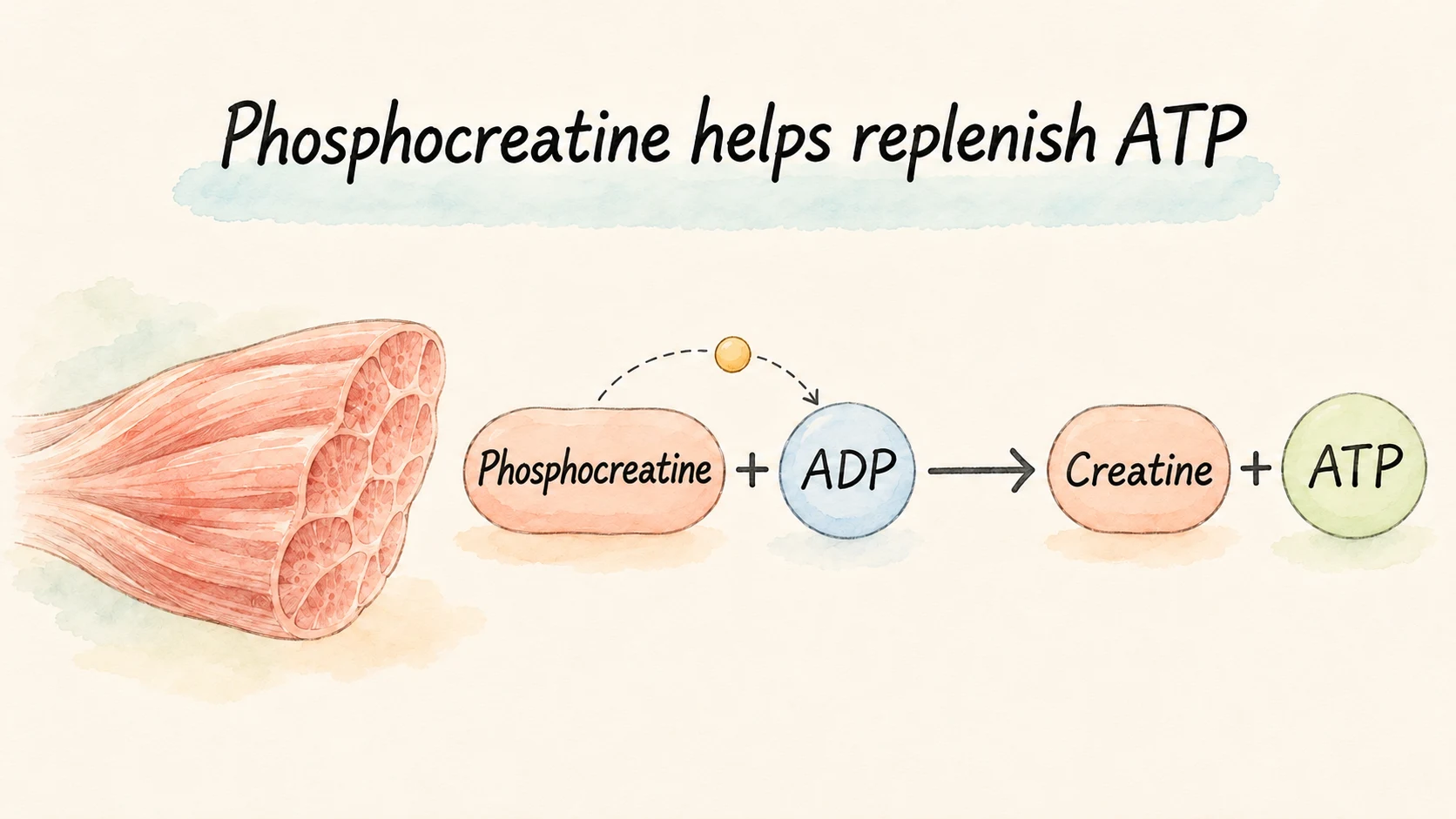
The idea behind a loading phase is to have more creatine in the muscle by the end of the first week. To find out how much sooner any change shows up, you need to measure what's in there. The size of the scoop gives you the amount going in, but what's in the muscle is a separate measurement.
What exactly rose by 20% after six days or 28?
In 1996, researchers tested several creatine schedules in 31 men. They took muscle samples and measured total muscle creatine concentration, which includes creatine and phosphocreatine together [1].
- Higher dose in the study — At 20 grams per day, the total muscle creatine concentration was about 20% higher than at the start when measured on day six.
- Lower dose in the study — At three grams per day, the researchers measured a similar increase on day 28.
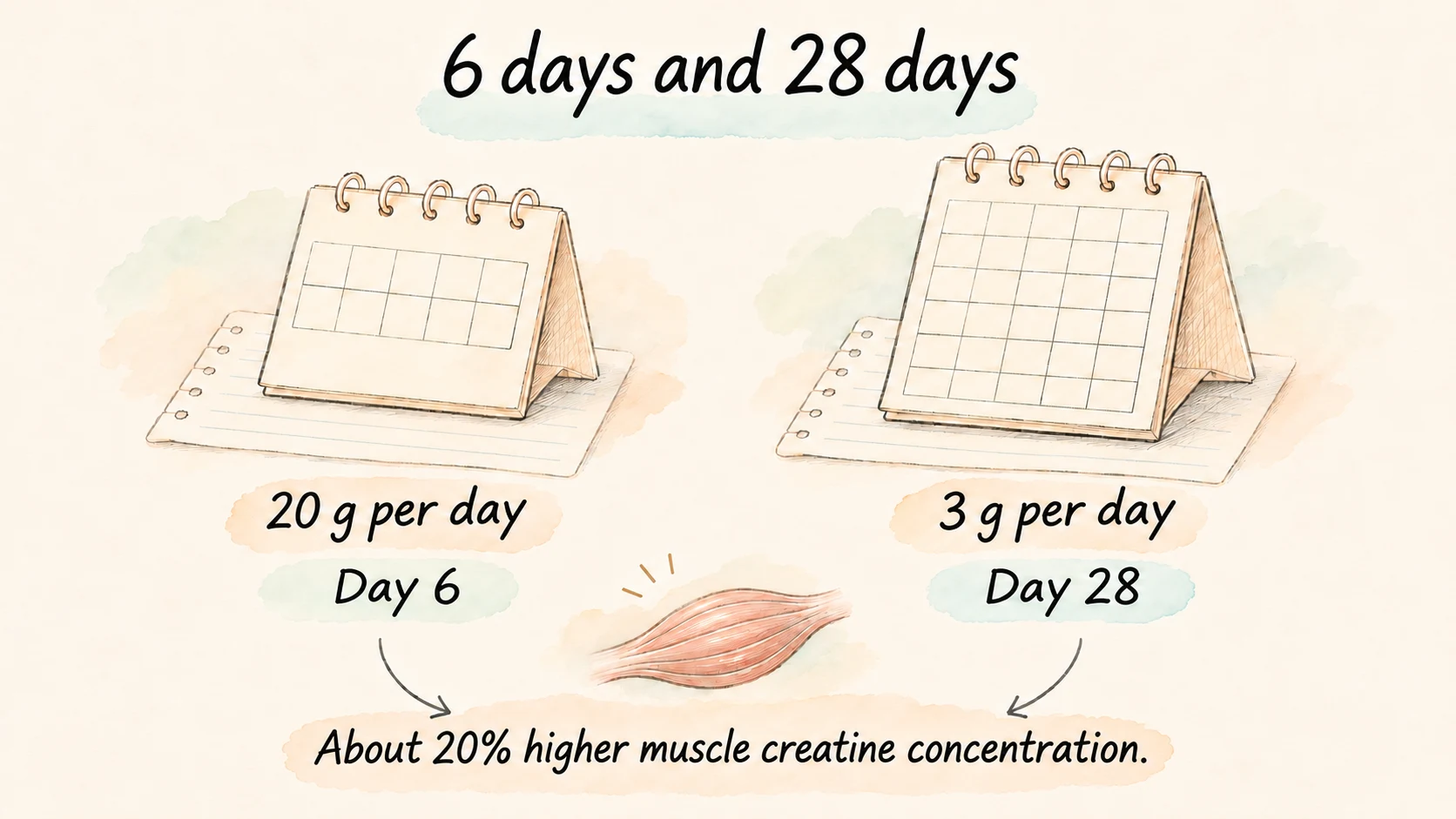
Put the two calendars next to each other. The increases in muscle creatine concentration were similar, and the group with the higher dose got there sooner. That 20% tells you what changed in a muscle sample. The weight on the bar belongs to a different experiment [1].
The group that moved to two grams a day after loading maintained its higher stores for the next 30 days. Another group stopped and had returned close to its starting concentration after 30 days. Those are measurements from these men on specific sampling days. Six and 28 days give us a sense of the time involved, and the results leave individual limits open [1].
Do faster-rising stores mean a heavier lift after a few weeks?
In 2024, researchers pooled 23 resistance training trials, mostly in men, in a review focused on healthy people under 50. Training lasted between four and 12 weeks. In studies using five grams or less a day for maintenance, upper-body maximal strength rose on average 4.17 kg more than in the comparison placebo groups. In studies using more than five grams a day, the pooled difference was 6.11 kg [2].
Subtract the first number from the second and it looks like more creatine bought about two kilograms of added strength. But the difference between dose subgroups wasn't statistically significant. The researchers also found no statistically significant subgroup difference between studies with a loading phase and those without one [2].
To see what the difference means, imagine two groups that both start out benching 40 kg. One group gets to 49 kg after training and the other to 45 kg. They gained nine and five kilograms, respectively. The extra gain between groups is four kilograms. Those are made-up numbers, but that last number is the kind of comparison the study reports. Both groups made progress through training.
Some participants already lifted regularly, others were new to it, and the programs varied. Those trials tell us about strength after several weeks. To see if loading helps you get one more rep on your first week, you'd need a study that gives both groups the same program and compares their lifts in week one.
Why did lean mass rise before the first training session?
In 2025, a University of New South Wales team assigned 63 adults, around 31 years old on average, to take five grams of creatine monohydrate a day or to a group that received neither creatine nor a placebo. Both groups waited seven days before starting the training program. Using a DXA body-composition scan, researchers found that at the seven-day mark, the creatine group had gained about 0.51 kg more lean mass than the comparison group [3].
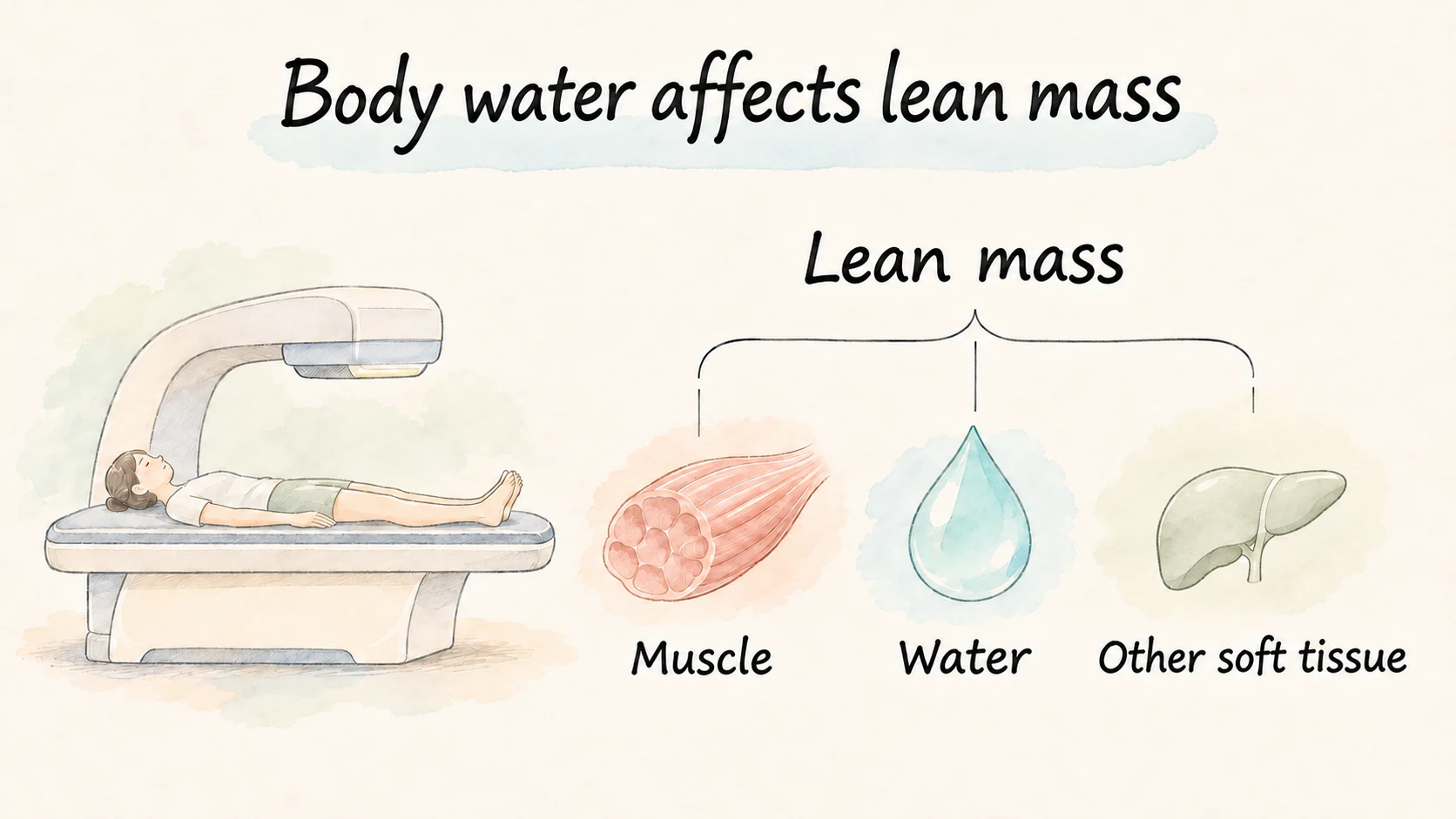
The participants hadn't started lifting in the program. Water in the body can affect the scan's lean mass estimate. The researchers didn't measure body water separately, and they noted that half a kilogram fell within their scanner's measurement error. The experiment measured a difference between group averages. It doesn't say how much was water or how much was new muscle [3].
The researchers used the same scanner, with participants lying in the same position and wearing the same clothes from scan to scan. The standard error of measurement for repeat lean mass scans in this sample was 0.59 kg. If you see a small swing on a scan of your own, it helps to compare how and when the tests were done [3].
Then both groups followed the same 12-week lifting program. Counting from the first day of training, each group added about two kilograms of lean mass, with no statistically significant difference between them. The day you start the clock matters. From before the first supplement serving, your calculation includes the seven days before training. From day one in the weight room, it starts with the training itself.
Where should you look when you have a tub in your hand?
Taiwan's food-labeling regulation requires a warning on foods that use creatine as an ingredient. It says that creatine is unsuitable for general consumption and should be used under the guidance of a physician, dietitian or other qualified professional. The study doses belonged to particular participants and measurement schedules. When looking at a product, read the labeled serving and warnings and ask a qualified professional whether it suits you [4].
When someone shares another dosing chart, look for what the study actually measured. A muscle sample tracks the change in creatine stores. A bench press test tells you how much weight someone lifted. A body-composition scan adds useful information once you know what it measured and when. That gives you a way to read the chart alongside what you see in the gym.
References
[1] Hultman E, et al. Muscle creatine loading in men. J Appl Physiol. 1996;81(1):232–237.
[2] Wang Z, et al. Effects of creatine supplementation and resistance training on muscle strength gains in adults under 50 years of age. Nutrients. 2024;16(21):3665.
[3] Desai I, et al. The effect of creatine supplementation on lean body mass with and without resistance training. Nutrients. 2025;17(6):1081.
[4] Taiwan Food and Drug Administration. Labeling requirements for creatine used as a food ingredient. 2019.
[5] Casey A, et al. Creatine ingestion favorably affects performance and muscle metabolism during maximal exercise in humans. Am J Physiol. 1996;271(1):E31–E37.