
If You Sit All Afternoon, Can Two-Minute Walking Breaks Change Anything?
Nineteen adults sat through three lab visits and had the same test drink each time. Short walking breaks changed what researchers measured over the next five hours.
You sit back down after lunch, answer a few emails, and look outside to find the light starting to go. You got up for water once. Suppose next time you walk to the end of the hall and back before sitting down. Could two minutes of walking at a time make any difference by the end of the afternoon?
Researchers put that idea to the test. When people walked for two minutes every 20 minutes, their five-hour glucose and insulin responses were smaller than when they stayed seated. They walked 14 times, for 28 minutes in total. The study measured a response over several hours. The result doesn't give a percentage you can subtract from a blood sugar reading after your next meal [1].
Same people, three ways to spend an afternoon
The study included 19 adults aged 45 to 65 who met the trial's weight criteria and didn't have diagnosed diabetes. Each person visited the lab three times and tried the three conditions in randomly assigned order. They started each visit by sitting for two hours. Then they had the same 200 mL test drink, containing 75 grams of carbohydrates and 50 grams of fat. Researchers followed their responses for the next five hours [1].
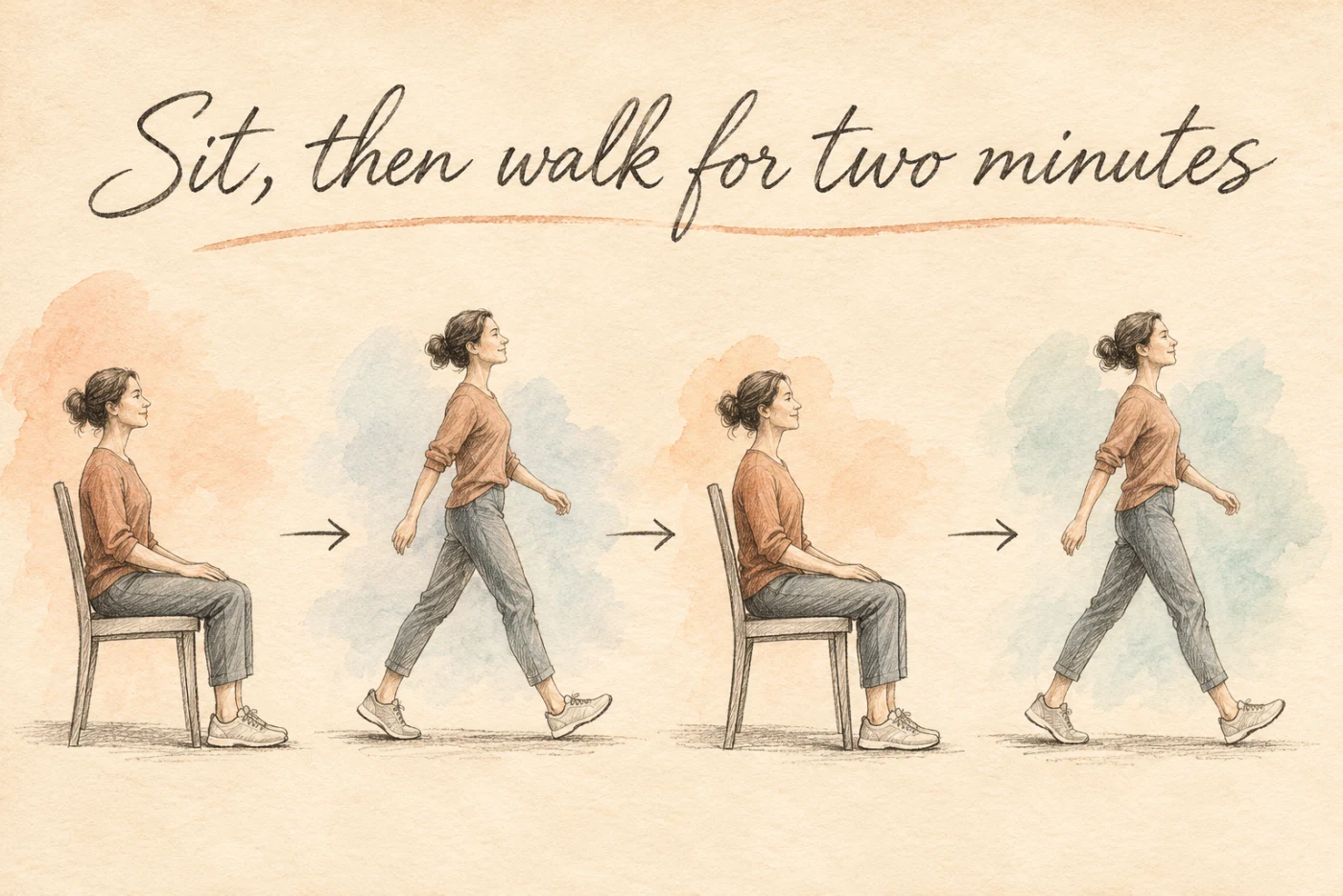
On one visit, participants mainly stayed in the chair, getting up only to use the bathroom. On the other two, they spent two minutes walking on a treadmill every 20 minutes and sat back down after each walk. On the light-activity day, the speed was 3.2 kilometers per hour, or about 2 miles per hour. The other day was faster, at an individually adjusted speed. The walks filled the same amount of time on both visits [1].
The same people tried every condition. If the researchers had compared a group that usually sits with a group that already walks around the office, the groups could have differed before the test began. The lab gave each participant the same drink each time and randomized which condition came first. That makes it easier to ask how the visits differed for the people who completed them.
What was smaller by about a quarter?
The researchers took blood samples every hour. Picture a line at the glucose level just before the drink. Now plot the readings after the drink across the next five hours. If the readings rise and stay high for longer, there's more space between the curve and that starting line. The researchers estimated the portion above the starting line, called the positive incremental area under the curve [1].
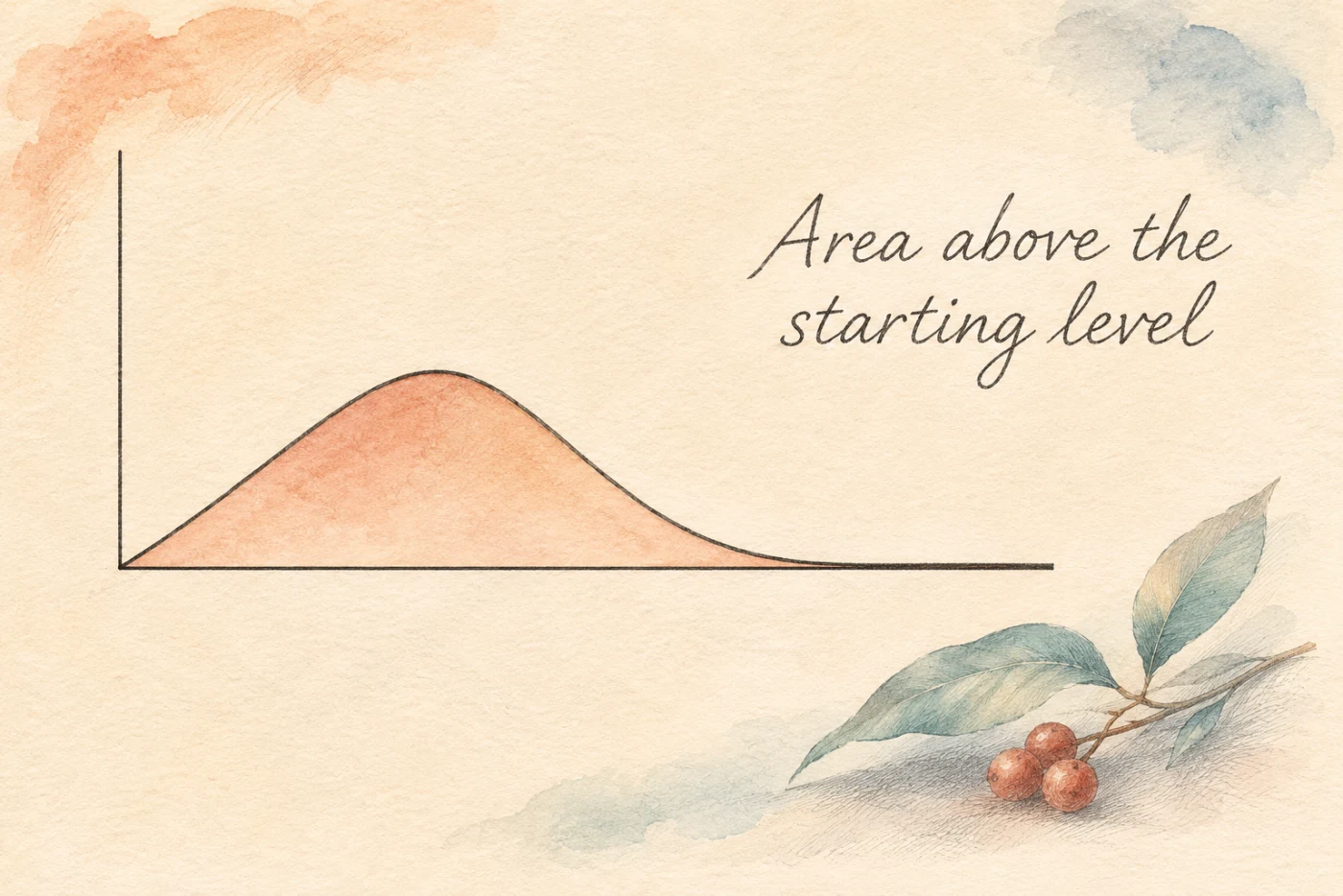
The average area on the seated day was 6.9 mmol/L·h. It was 5.2 on the day with light walking and 4.9 on the faster-walking day. The study's model estimated that the area was about 24% smaller during light walking and about 30% smaller during faster walking, compared with staying in the chair. Insulin response was also lower in both walking conditions. This doesn't mean that any individual reading dropped by 24%. The area reflects how high readings were above the starting level and how long they stayed there [1].
Insulin helps muscle take up and use or store glucose. The contractions that occur when you walk also send signals that can promote glucose uptake. The researchers discussed that as one possible explanation. Their blood measurements didn't trace exactly which tissues took up how much glucose during each visit [1].
Suppose a person's blood glucose is 2 mmol/L above its starting level an hour after the drink on both days. At hour three, the reading on one day is back at the starting level. On the other day, it's still 1 mmol/L above it. These are made-up numbers to show the idea. The one-hour result is the same and the five-hour area can still differ. A single reading after lunch is a point on the curve, and it doesn't tell you how long glucose stayed there.
There is a detail in the insulin result that's easy to miss. The researchers saw a smaller insulin response alongside the smaller glucose response, in both activity conditions. They didn't see glucose stay lower while people had a larger measured insulin response to the drink. That pairing is one reason the study is more interesting than a comparison of one glucose value. The researchers still didn't directly measure how sensitive each person's muscle was to insulin during every walk [1].
Do you have to set a timer for every 20 minutes?
Twenty minutes was the interval chosen for this experiment. The researchers didn't put it up against breaks every 40 or 60 minutes, and they didn't compare 14 short walks with one continuous walk of the same total duration. The blood responses were smaller with both walking speeds than with sitting. The sample was small, so it's hard to say from these data how much walking speed would matter for any other group.
In a second small crossover experiment, a comparable light-walking schedule reduced glucose and insulin responses over three days. That's longer than a lab afternoon, but still a long way from measuring a change in blood sugar at your next annual checkup [2]. The measurement you choose needs to match the change you're asking about.
For a long afternoon at a desk, start with a moment already in your calendar. If you get up to refill a glass, walk to the far end of the hallway on your way back. Try a short trip outside between meetings when there is room for it. At the end of the day you can ask a question you don't need a lab to answer. Did the walk actually break up a stretch of sitting that otherwise would have gone on? You can also notice whether it was comfortable and easy to fit into your work. That makes it easier to decide when you might do it again.
The next time you look up from your lunch-to-dusk stretch, think of the point when you were going to get up anyway. Add a short walk there and see how it fits the day you actually have.
References
- Dunstan DW, et al. (2012). Breaking up prolonged sitting reduces postprandial glucose and insulin responses. Diabetes Care.
- Larsen RN, et al. (2015). Breaking up prolonged sitting over three days. Clinical Science.