
A Grip Test Measures Your Hand. What Can It Tell You About Aging?
From carrying groceries to a study across 17 countries, here's what a grip test measures and how to read it in context.
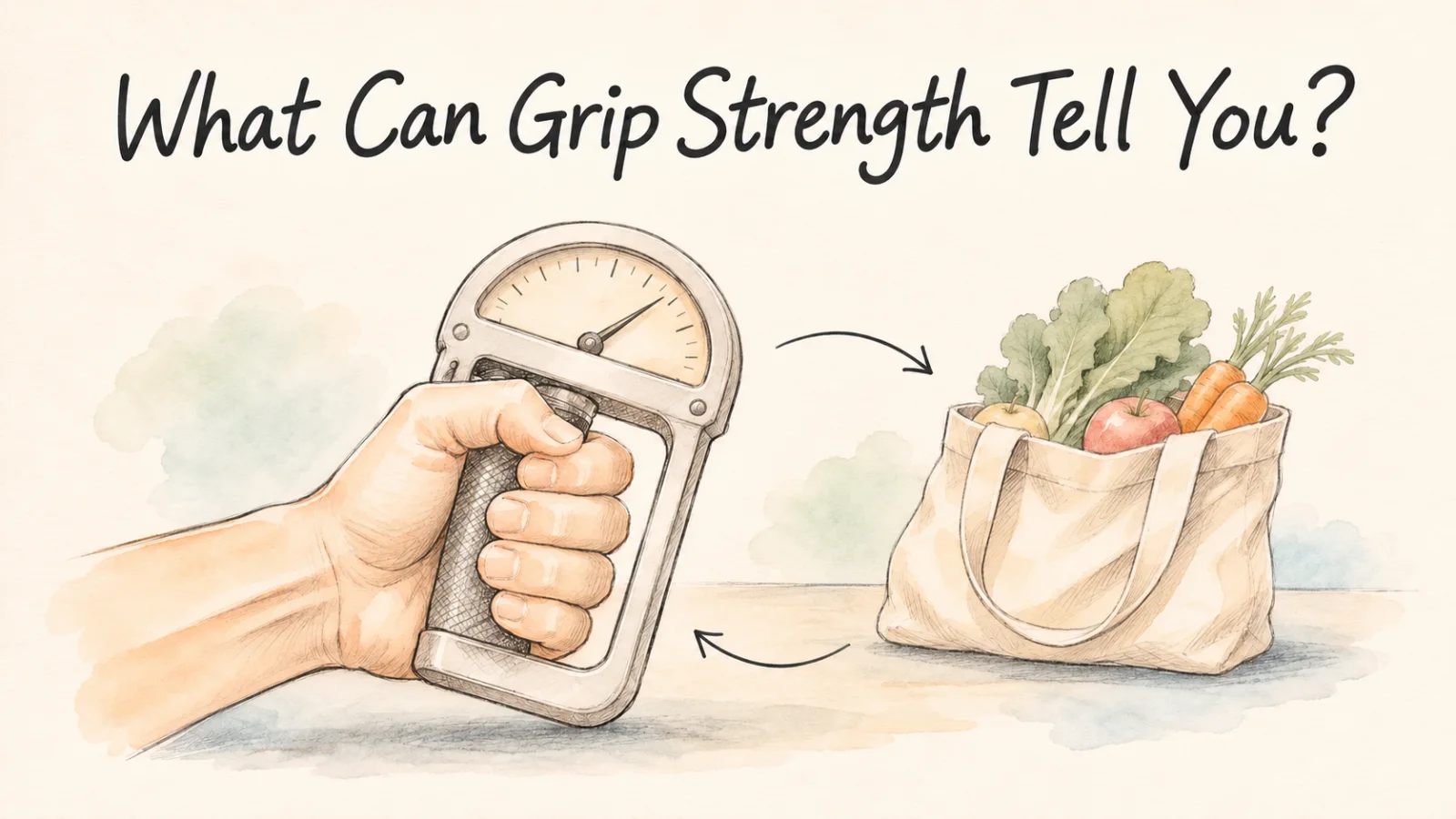
You're carrying a tote of groceries home and start switching hands a block before your door. At a health check, you're offered a different test of hand strength. Squeeze a handle for a few seconds and a dial gives you a number. How much can that number say about the rest of your body?
Grip strength is one clue to muscle function. In a study of nearly 140,000 people, those with a lower reading at the start had a higher rate of death during follow-up. To make sense of an individual reading, you also need to know which hand was tested, how it was tested, and whose measurements you're comparing it with [1][2].
What does a grip test measure?
A grip dynamometer measures how much force you can put into a squeeze. The dial may read in kilograms, which expresses the force in terms of how much weight it would take to exert the same force. Carrying groceries adds other demands. You're holding on for a longer time, and the weight, the width of the handle, and how you position your arm can all change how the trip feels.
Researchers make the squeeze as consistent as possible. In the PURE reference-range study, participants held the same model of dynamometer with the upper arm at their side and elbow bent 90 degrees. They squeezed as hard as they could for about three seconds and rested for at least 30 seconds between attempts. In the later version of the protocol, both hands were tested. The researchers used the highest reading from each hand [2].
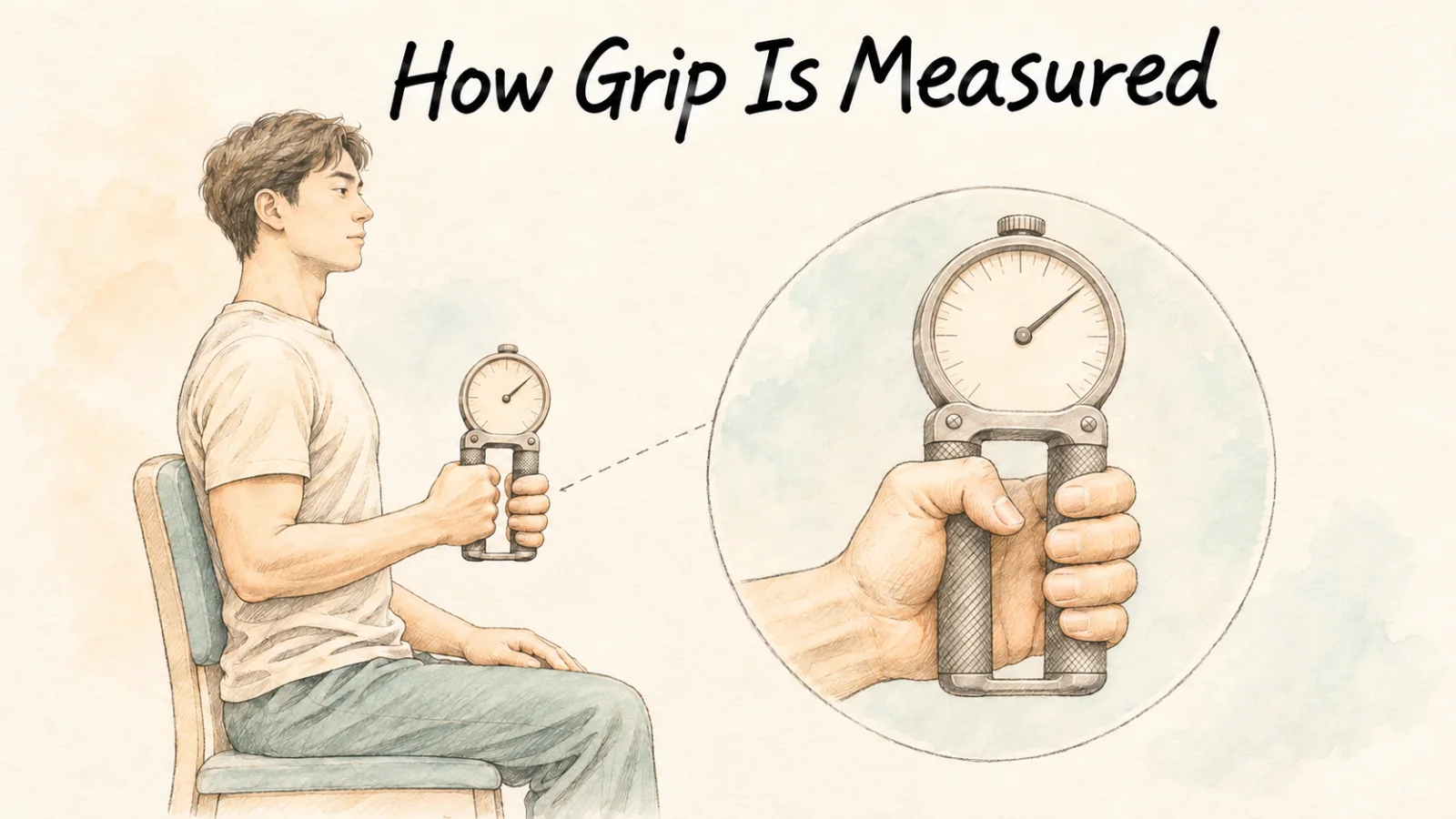
The hand you test can matter. Among women aged 35 to 40 in the study's Chinese sample, the median was 30 kilograms in the dominant hand and 27 kilograms in the other hand. A table might show the dominant hand, the other hand, or a value calculated from both. Check the heading before you compare your reading with a reference [2].
A spring-loaded grip trainer answers a different question. If you're tracking practice with one, you can log how many times you close it or how long you hold it shut. The kilogram label on the device may describe its resistance. In the study, the researchers used the force measured during the squeeze under a defined setup.
They squeezed once, then researchers followed them for years
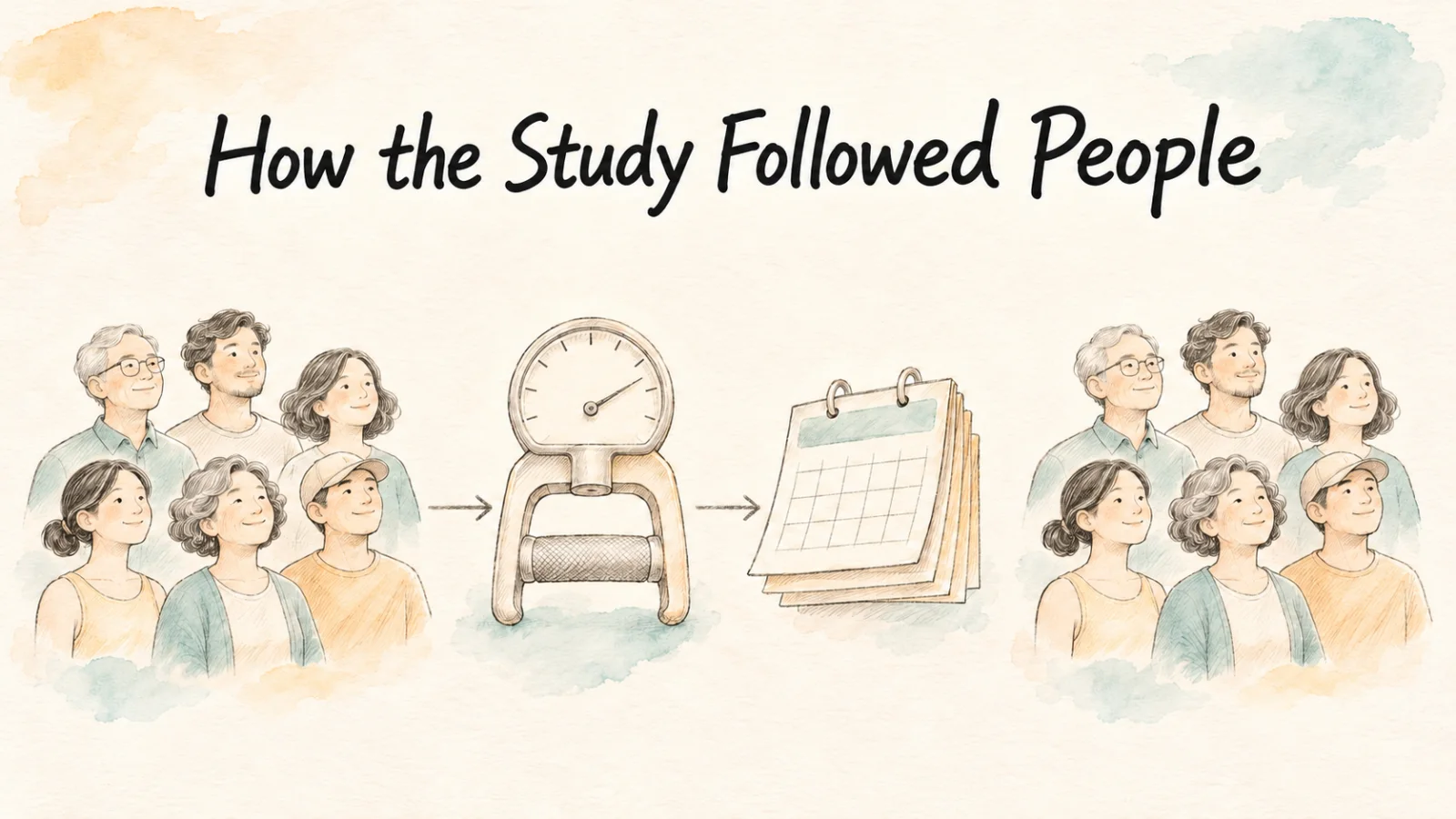
Published in 2015, the PURE study drew on participants in 17 countries. The researchers analyzed 139,691 people whose follow-up status was known. They measured grip strength at the start and followed people for a median of four years. During follow-up, 3,379 participants died. The team compared starting grip strength with later outcomes, accounting for factors including age in its statistical model [1].
For each 5 kilograms lower grip strength at the start, the hazard ratio for death was 1.16. Put the model's rate for people with the higher reading at 100 for illustration. The rate for people 5 kilograms lower at the same point in follow-up is about 116. That's a 16% relative difference in the rate estimated by the model. It takes more information to say what chance an individual has of dying within four years [1].
An obvious follow-up question is whether training your grip so it rises by 5 kilograms changes that outcome. In PURE, the researchers measured an existing difference between people. Other factors, such as their overall strength, daily activity, and health status, could help explain the pattern. Testing the effect of a training program would take an intervention and measurements of what happened afterward [1].
The outcomes also varied. In the same analysis, there was no statistically clear association between starting grip strength and injuries from falls or fractures. A squeeze is quick to measure, which makes it useful in a large study. The study still had to check each outcome separately to see how much the reading could tell researchers about it [1].
How to read the finding. PURE linked a measurement at the start to events later among different people. A study of the same person's response to training would answer another question [1].
Two people squeeze 28 kilograms. How do you read each result?
The PURE team later compiled grip results from 125,462 healthy adults aged 35 to 70 across 21 countries. They grouped the results by age, sex, region, and which hand was tested. Take the combined hand measure for women in the Chinese sample. The median was 28 kilograms at ages 35 to 40, and 23 kilograms at ages 61 to 70. The middle half of the younger group ranged from 24 to 32 kilograms. The middle half of the older group ranged from 20 to 27 kilograms [2].
The median is the middle of a set of readings, so a reading of 28 lands in a different place depending on the group. You can also see that the two ranges overlap. These are different participants measured in different age groups, so to see how much a person changed over 20 years, you'd need to measure that same person again [2].
The Asian Working Group for Sarcopenia uses grip in another way. Its 2025 consensus identifies low grip strength in adults 65 and older as under 28 kilograms for men and under 18 for women. At ages 50 to 64, it uses under 34 for men and under 20 for women. An assessment for sarcopenia also needs evidence of low muscle mass. The research table describes what a group recorded. The consensus cutoffs serve a specific purpose in an assessment [3].
Make your next reading comparable
If you already have grip records, keep three details with each number: the device, the hand, and your position. A different handle or a different number of attempts can make comparison harder. A quick note about how your hand felt that day, or whether you'd just been moving boxes, can also tell you something about the circumstances.
A record might say, “Right hand, same meter, seated, just carried shopping.” That's enough to flag a difference in the way the reading was taken. If a second entry surprises you, start by checking the setup and the notes against the earlier one.

Pick a familiar everyday activity to watch alongside the reading. Maybe it's carrying the usual groceries the last block home, or getting up from the chair you always use. Did you switch hands sooner or reach for the chair arms more often? Keep the conditions in mind. A tote with a bag of rice in it makes for a different comparison than last week's two cartons of tofu.
The grip meter records a few seconds of force. A repeatable setup and observations from familiar tasks make it easier to see patterns across days and months.
References
[1] Leong DP, et al. Prognostic value of grip strength: findings from the Prospective Urban Rural Epidemiology (PURE) study. Lancet. 2015;386(9990):266–273.
[2] Leong DP, et al. Reference ranges of handgrip strength from 125,462 healthy adults in 21 countries: a prospective urban rural epidemiologic (PURE) study. J Cachexia Sarcopenia Muscle. 2016;7(5):535–546.
[3] Chen LK, et al. A focus shift from sarcopenia to muscle health in the Asian Working Group for Sarcopenia 2025 Consensus Update. Nat Aging. 2025;5(11):2164–2175.