
How Fast Is a Brisk Walk? How to Use 100 Steps a Minute
Walking cadence and effort can tell different stories. Learn where the 100-step rule comes from, then try it alongside the talk test.
You're walking to the train after work with a colleague. By the time you reach the next intersection, you've finished the story you were telling. Your colleague has kept up but needs a moment to catch their breath before replying. You set off together and crossed the street together. Were you both walking briskly?
On level ground, 100 steps a minute is a reasonable starting point. If you're breathing harder than usual and can still finish a sentence but would struggle to sing, you may be close to what's called moderate intensity. One clue comes from your feet, the other from how hard you're working. On a hill, your steps may slow down even as your breathing speeds up.
How do two people take 100 steps and cover different distances?
Imagine you each take 100 steps in a minute. Your average step is 60 centimeters, and your colleague's is 75 centimeters. After a minute, you've covered 60 meters and they've covered 75. Same step rate, 15 meters a minute apart. It takes both the rate and the length of the steps to work out how fast someone is moving.
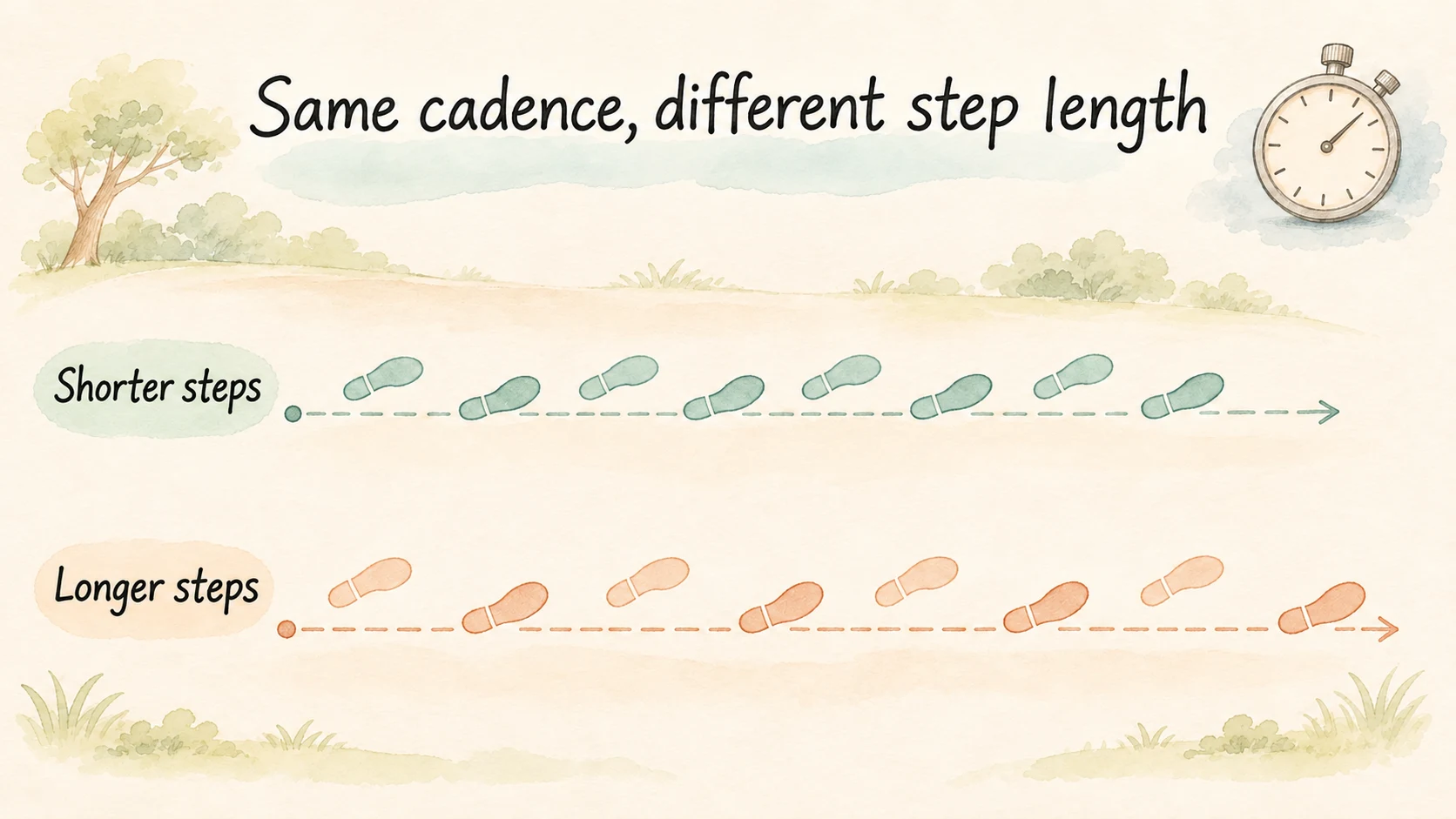
Step count tells you how many times your feet hit the ground. Cadence is that number per minute. Effort also depends on the ground and on your fitness. Think of taking a hundred steps along the pavement and then a hundred up to a footbridge. The counter can tick at the same rate, but on the bridge approach your muscles are also lifting you uphill. You can feel the change before you glance at the watch.
Go back to you and your colleague. The next corner is 69 meters away. You could get there in a minute with 115 steps of 60 centimeters. Your colleague could take 92 steps of 75 centimeters and arrive at the same time. Both of you move down the street at the same speed, but your feet are moving to different beats. Keeping pace with someone on a walk doesn't require matching each of their footsteps.
That's why researchers count footfalls and measure breathing at the same time. They want to see how much oxygen your body needs when your feet start moving more quickly, then see how closely the two measurements line up.
Why did researchers land on 100?
In 2019, a University of Massachusetts Amherst team tested 76 healthy adults aged 21 to 40. Participants walked in five-minute bouts with two minutes of rest in between. The treadmill moved a little faster on each round. Researchers counted steps by watching the participants, who also breathed through a mask that let the team measure their oxygen use [1].
They expressed intensity in metabolic equivalents, or METs. One MET is a standard value close to the oxygen cost of resting quietly. At 3 METs, oxygen use is about three times that standard, the study's cutoff for moderate intensity. This gives researchers a common ruler. The same level of 3 METs can still feel easy to one walker and fairly demanding to another.
In those treadmill bouts, about 91% of bouts at 100 or more steps a minute reached 3 METs. At 130 or more steps a minute, about 71% reached 6 METs, the study's cutoff for vigorous intensity [1].
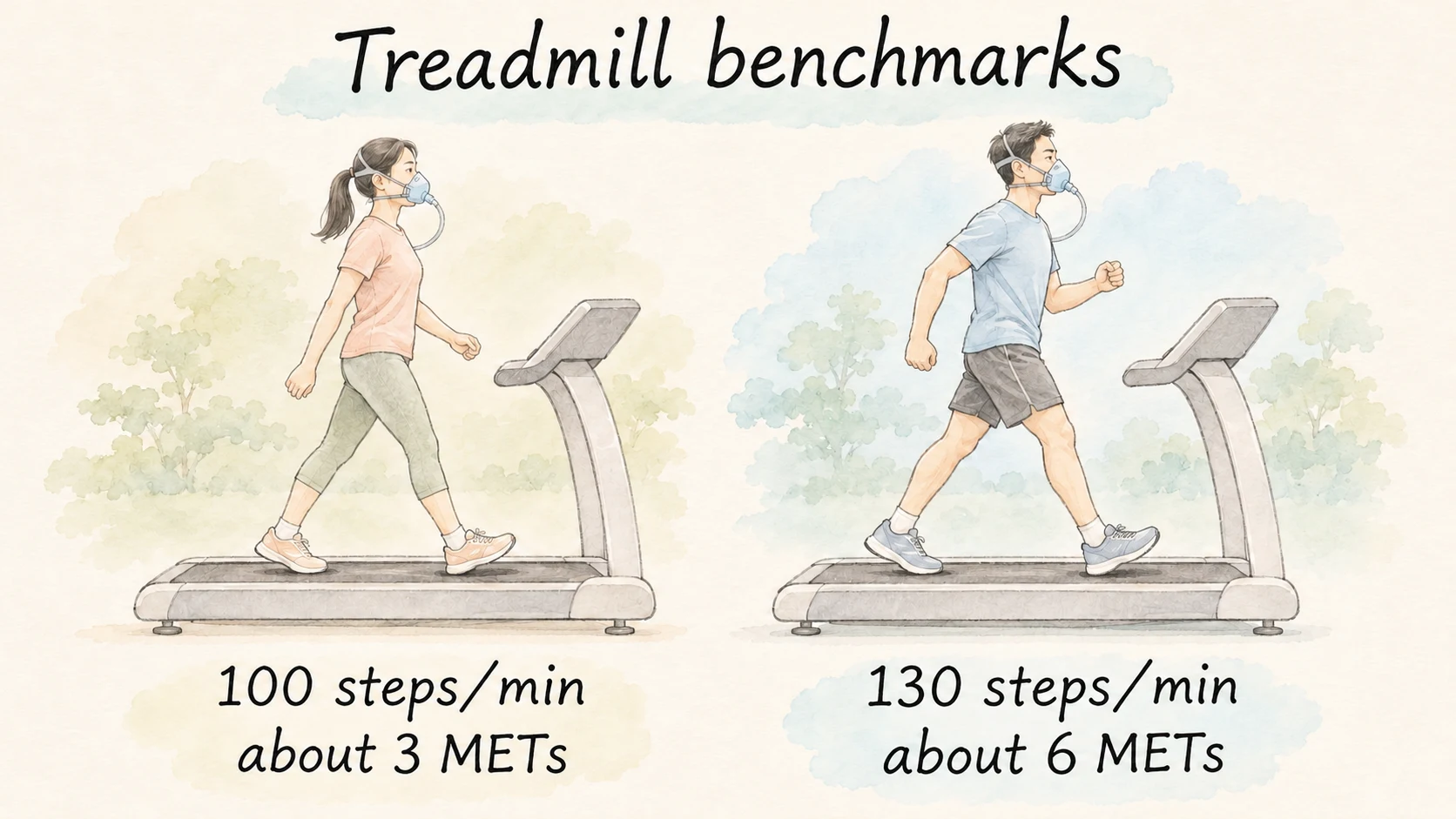
Think of those numbers as guideposts. A reading of 102 on your watch doesn't settle how hard you're working. And 130 comes from treadmill tests of healthy young adults. There is no reason to rush your steps just to match the study.
Does 100 work once you get off the treadmill?
The team later asked 174 adults aged 41 to 85 to walk for five minutes at their own preferred pace on a level indoor route. Of the 145 people who reached 100 steps a minute, 114 met the study's moderate-intensity threshold. Of the 29 people below 100 steps a minute, 13 did too [2].
Said another way, about eight in ten of the people at or above 100 reached moderate intensity. So did nearly half of those below 100. If your usual cadence is a little lower, that second number explains why it's worth checking how the walk feels, too.
So 100 is a place to start on a flat stretch, with room for individual differences. You can see why if your watch displays 98 halfway up a familiar hill and you're already breathing harder. The hill changes how hard you have to work. Two extra steps in a minute don't tell you much about that change.
Do your fastest 30 minutes have to come in one stretch?
One UK study collected daily step rates from wrist-worn activity trackers in 78,500 adults. For each day, the researchers averaged the 30 one-minute periods with the highest cadence. Two minutes hurrying for the bus, five minutes out for lunch and a stretch of an evening walk could all end up in the calculation [3].
Over a median seven years, the UK team found that faster stepping was associated with lower mortality even after they accounted for daily step count. A US study that followed 4,840 adults found no statistically significant association between cadence and mortality after accounting for daily steps [3][4].
Both studies observed people going about their usual lives. Those who are already fitter may find it easier to walk at a brisk pace. Where people live or work can also shape how they walk. The studies show how researchers can examine cadence alongside daily steps. They can't tell you how much changing your own cadence on one route would affect your health.
What could you say on your next walk to the train?
On a level stretch with no lights to wait for, walk at your usual pace for a few minutes. Once your rhythm settles, try two things.
- Count for 30 seconds. Each time either foot lands, count one step. If you reach 50, that's 100 steps a minute. Start the count after you cross the street if you have to wait for a light.
- Say a full sentence. Try “I'm going to get dinner after this. Want to come?” If you can finish a sentence and would find it hard to sing, you're likely near moderate effort. If you have to keep pausing mid-sentence for a breath, ease your pace a little [5].
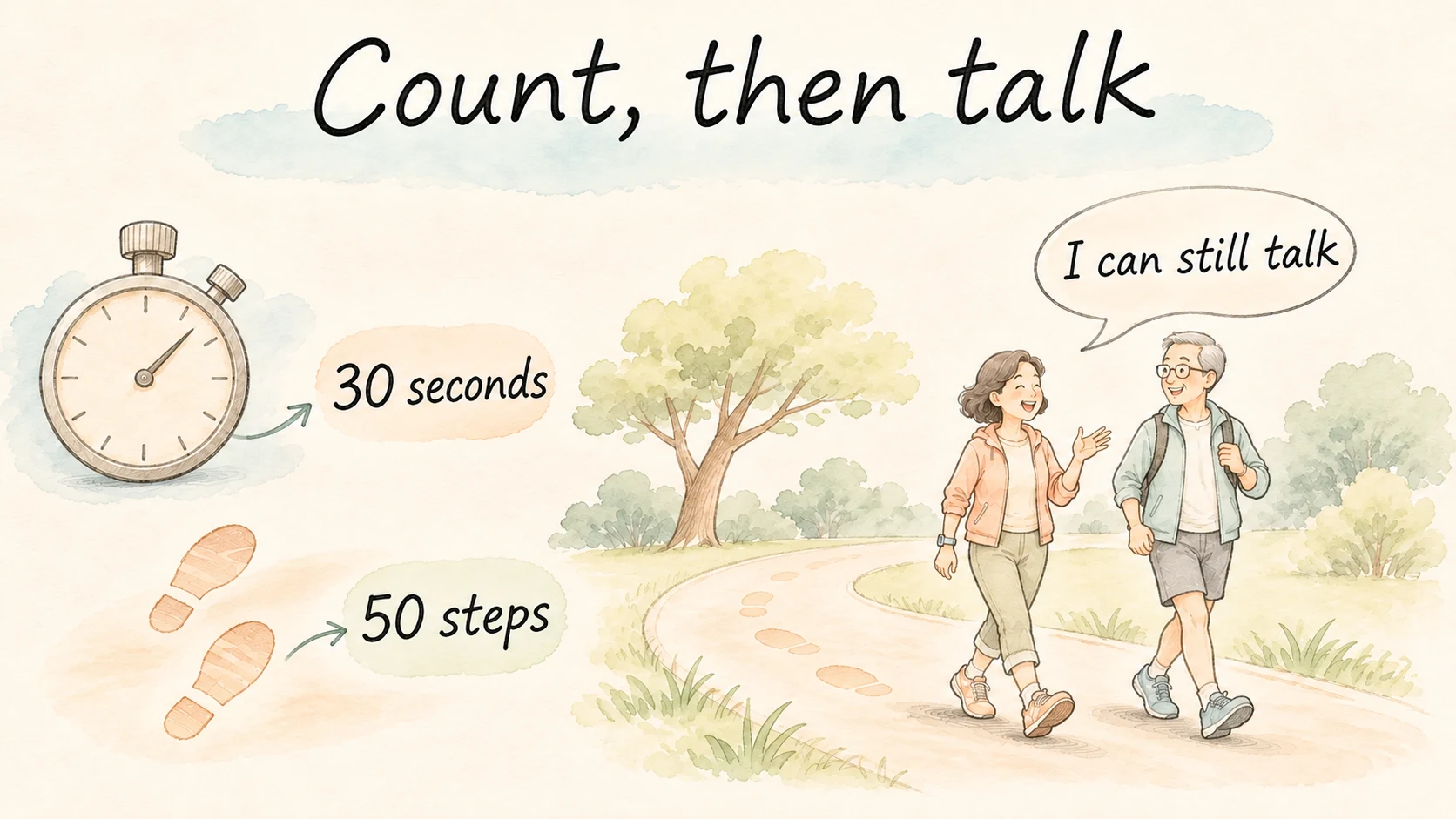
Sometimes the step rate in a workout summary will differ from the one you counted by hand. Say you take 50 steps during the first half of a minute and spend the second half at a light. The entire minute contains 50 steps. During the part when you were moving, the rate was twice as high. To see what a brisk pace feels like, start by measuring a stretch where you can keep moving.
Try the same sentence on the footbridge approach. Maybe it takes 100 steps a minute to get a little out of breath on the flat and 90 on the hill. Pay attention to where you breathe harder and where you can ease off. You'll start to recognize the right rhythm on that route without having to look down at your watch.
References
[1] Tudor-Locke C, et al. Walking cadence (steps/min) and intensity in 21–40 year olds: CADENCE-adults. Int J Behav Nutr Phys Act. 2019;16:8.
[2] Aguiar EJ, et al. Cadence-based classification of moderate-intensity overground walking in 41- to 85-year-old adults. Scand J Med Sci Sports. 2023;33(4):433–443.
[3] del Pozo Cruz B, et al. Prospective associations of daily step counts and intensity with cancer and cardiovascular disease incidence and mortality and all-cause mortality. JAMA Intern Med. 2022;182(11):1139–1148.
[4] Saint-Maurice PF, et al. Association of daily step count and step intensity with mortality among US adults. JAMA. 2020;323(12):1151–1160.
[5] US Centers for Disease Control and Prevention. What counts as physical activity for adults.