
Do the Same Extra Calories Lead to the Same Weight Gain?
In a study of 12 pairs of identical twins, weight gain ranged from 4.3 to 13.3 kilograms on the same extra calories. Here's how the meals and measurements worked.

Two coworkers order the same chicken bento at lunch. A few months later, one's trousers feel tighter while the other is wearing the same pair as before. Their lunch receipts match. Would their bodies respond the same way if both actually ate the same amount of extra food? In a 1990 feeding study, 24 participants added the same number of calories above their own starting diets. They all gained weight, and the amount varied from 4.3 to 13.3 kilograms [1].
A lunch receipt tells you what someone ordered. It leaves out what they finished, what they ate at dinner, and what they did after work. To find out what happens when two people eat the same extra calories, the researchers first looked at how much each person ate to maintain his starting weight.
The same extra amount can mean a different total
Suppose one person maintains his weight on 2,000 calories a day and another on 2,400. Add 1,000 calories to each diet and the daily totals are 3,000 and 3,400. The extra amount above their own starting point is the same. These are hypothetical numbers to show how the study set each person's portions.
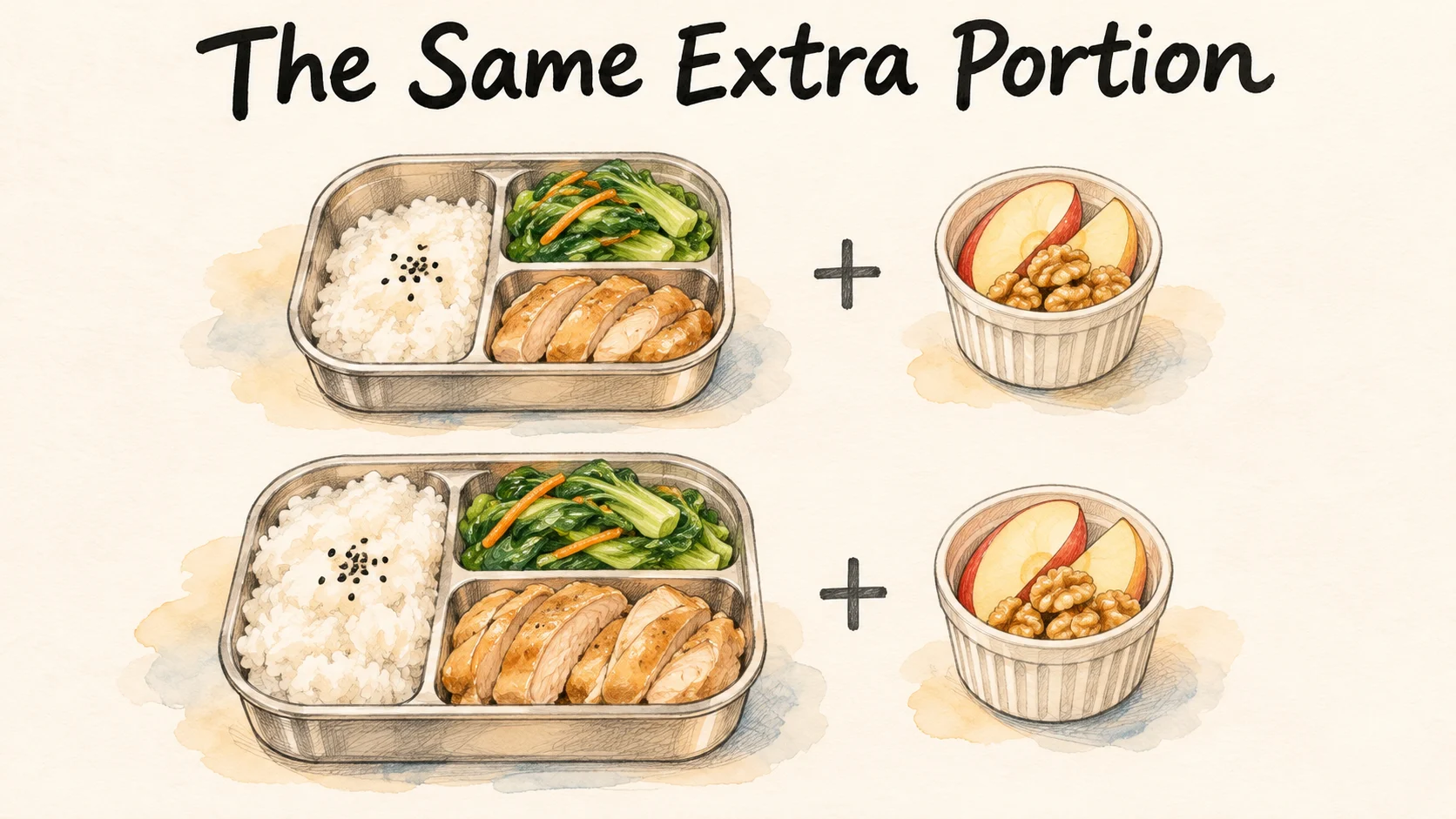
The Laval University team recruited 12 pairs of young adult male identical twins, 24 men in all. The researchers spent two weeks estimating each man's maintenance intake. The men chose their food, and the team weighed both the portions they took and the leftovers. To estimate maintenance, the researchers combined the food records with changes in weight and body composition during that period. For the next 100 days, the study provided 1,000 extra calories on six days of the week. On the seventh day, the men ate their original amount. They received extra food on 84 days, for a total of 84,000 extra calories each [1].
The men ate three meals and a snack, and the researchers supervised what they ate and controlled activity. The daily schedule included a half-hour walk. Spread over all 100 days, the additional food averaged 840 calories a day. This is the same amount of extra food described two ways. There were 1,000 extra calories on days with extra food, and an average of 840 across all days [1].
How far apart were the weight changes?
The average increase was 8.1 kilograms, with the lowest gain at 4.3 kilograms and the highest at 13.3 kilograms. The ends of the range were 9 kilograms apart. The highest gain was roughly three times the lowest [1].
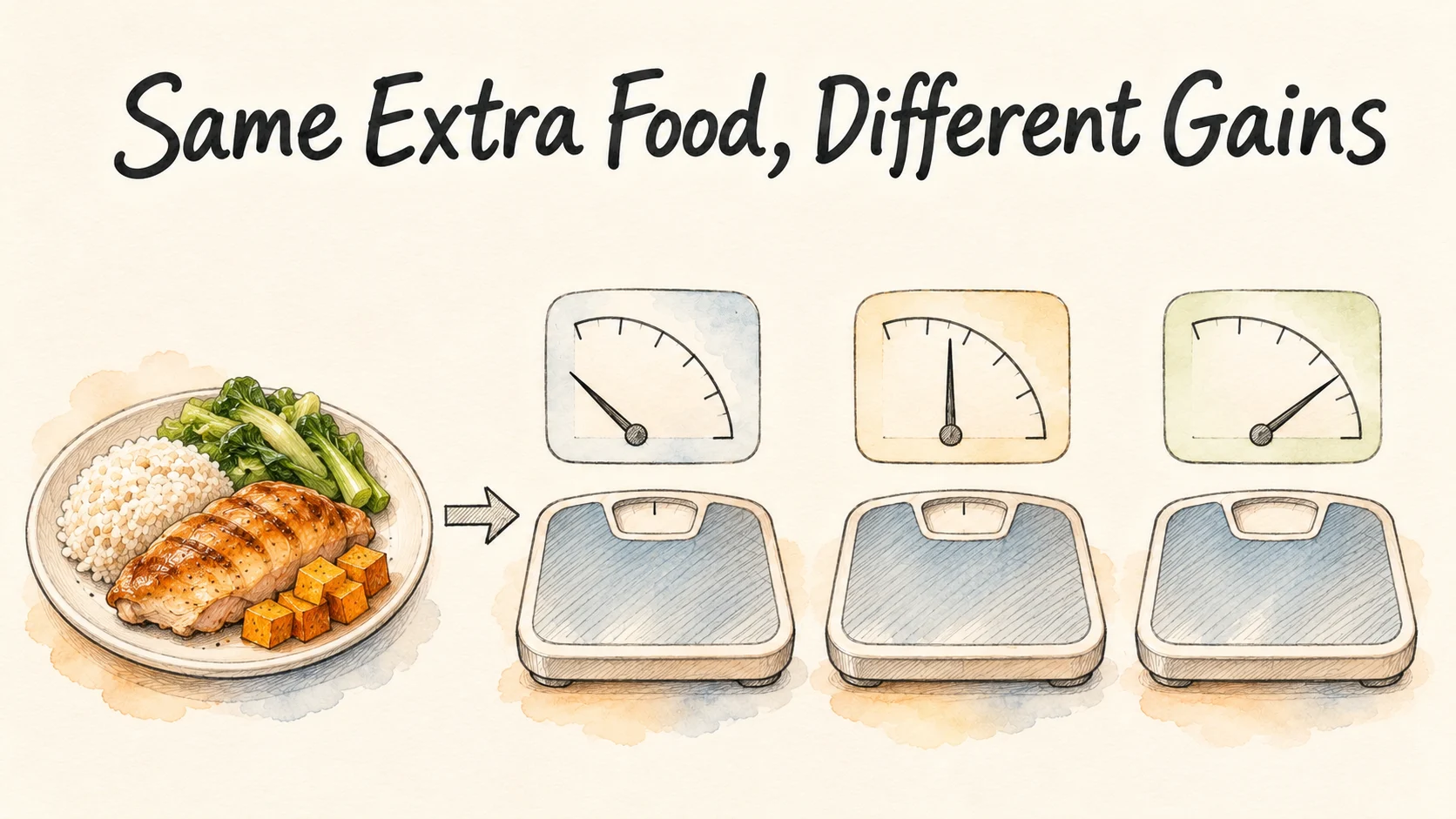
The team weighed participants daily. Each weight used for the before-and-after comparison was an average of three days, which reduced the influence of a single reading. The study also estimated body composition from underwater weighing. Of the average 8.1 kilograms gained, 5.4 kilograms was fat mass and 2.7 kilograms was fat-free mass. Fat-free mass includes water and lean tissues, so the change in fat-free mass cannot be read as an amount of new muscle [1].
The 84,000 calories refer to what the men took in over their estimated starting needs. Their bodies still used energy to maintain basic functions, handle food, and move. The schedule held much of the activity constant, but it didn't ensure everyone used the same amount of energy. A change in kilograms also combines tissues that store different amounts of energy. Dividing the extra food by the kilograms gained gives a ratio. It leaves the amounts used and stored by each person unresolved. When the researchers applied different energy values to the fat and fat-free tissue gained, their group estimate came to about 55,000 calories stored. That left about 29,000 calories unaccounted for in the added tissue. The difference comes from a calculation using estimated tissue gains, so it does not tell you how much each person used for a specific activity or bodily function [1].
What did the resemblance between twins show?
The researchers lined up the results within each twin pair. The statistical variation in weight gain between pairs was about three times the variation within pairs. Fat mass showed a similar pattern. If one twin gained more, his brother often did, too. Their responses tended to be closer to each other than to the responses of men in other pairs [1].
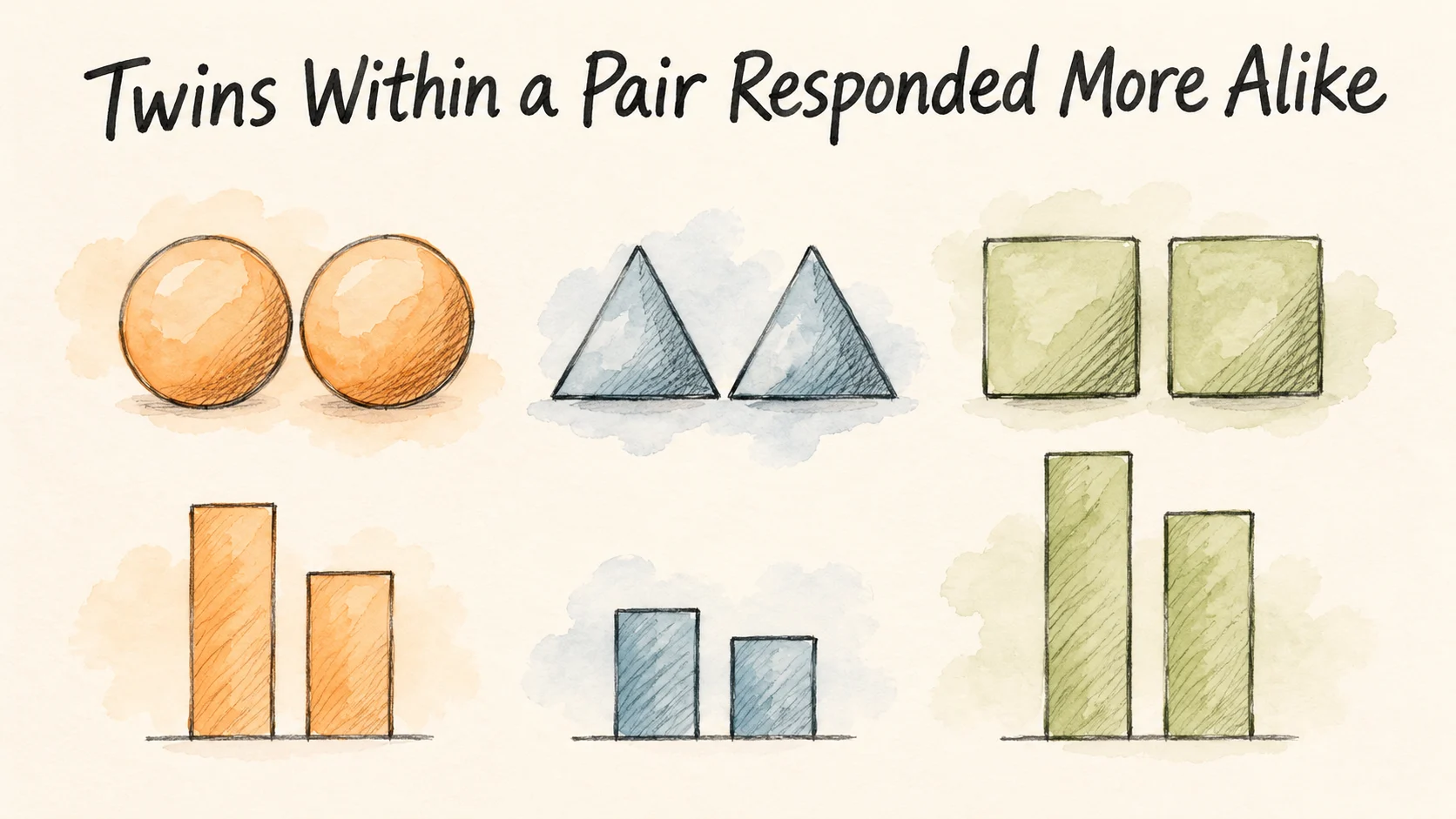
The paired measurements in the picture are schematic. In the paper, the ratio of roughly three compares variation across the group. It is separate from the roughly threefold difference between the men at the ends of the weight-gain range. Neither figure means each pair had the same-sized gap [1].
Identical twins share very similar DNA and may also share much of their upbringing. Their resemblance makes inherited influences worth investigating. This study included no fraternal twins or unrelated comparison group, so it cannot estimate how much similarity came from genes and how much came from shared environment. The range describes what happened to these 24 young men during the trial. It doesn't tell us the likely range for other people or for other diets. The team also used CT to measure the area of fat inside the abdomen. Weight gain alone did not reliably indicate how much that area increased. Similar numbers on the scale leave room for different changes in where fat is stored [1].
What if food stays constant and activity changes?
A second study from the same team kept daily food and nutrient intake constant for seven pairs of young male identical twins. For 93 days, on nine days out of every ten, the participants did two sessions a day on a stationary bike. At the end, average weight was down 5.0 kilograms. The average drop came from fat mass, and average fat-free mass was stable. Changes in weight and fat mass also tended to be similar within twin pairs [2].
The first experiment set the extra food above each person's maintenance intake. The second set food intake and added a structured exercise load. Each produced a range of individual responses. The five-kilogram average came from 14 participants doing the study's specific workout schedule under controlled feeding. An evening walk or a different lunch would be a different change from the one measured there.
Back at lunch, those two matching receipts still tell us what was ordered. If you already keep a food or weight log, follow your own readings over several weeks under similar conditions and make a note when portions or activity change. You can look for a trend without reading too much into a single day's number. The evidence for those changes comes from what happened during your own stretch of meals and ordinary days.
Sources
[1] Bouchard C, et al. The response to long-term overfeeding in identical twins. N Engl J Med. 1990;322(21):1477–1482.
[2] Bouchard C, et al. The response to exercise with constant energy intake in identical twins. Obes Res. 1994;2(5):400–410.