
You've been on a diet for three weeks. The scale says you lost 2 kg. But where did those 2 kilograms physically go? Did you sweat them out? Pee them out? Did they convert into "energy" somehow?
If you guessed any of those, you're in good company. When researchers surveyed 150 doctors, dietitians, and personal trainers, more than half got it wrong.
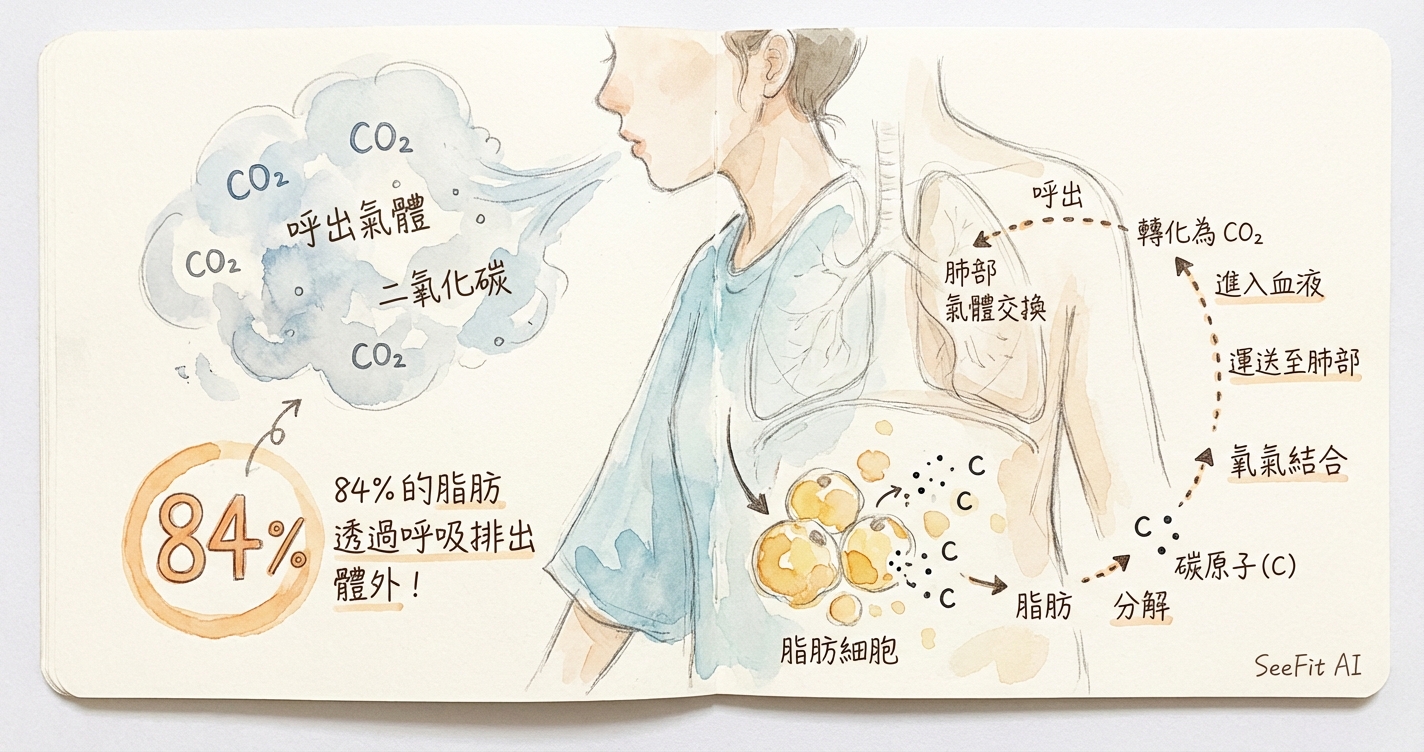
The real answer: you breathed most of it out.
The Study That Surprised Everyone
In 2014, physicist Ruben Meerman and biochemist Andrew Brown published a paper in the BMJ (British Medical Journal) that tracked every single atom in a fat molecule through the metabolic process. Their question was deceptively simple: when somebody loses weight, where does the fat go?
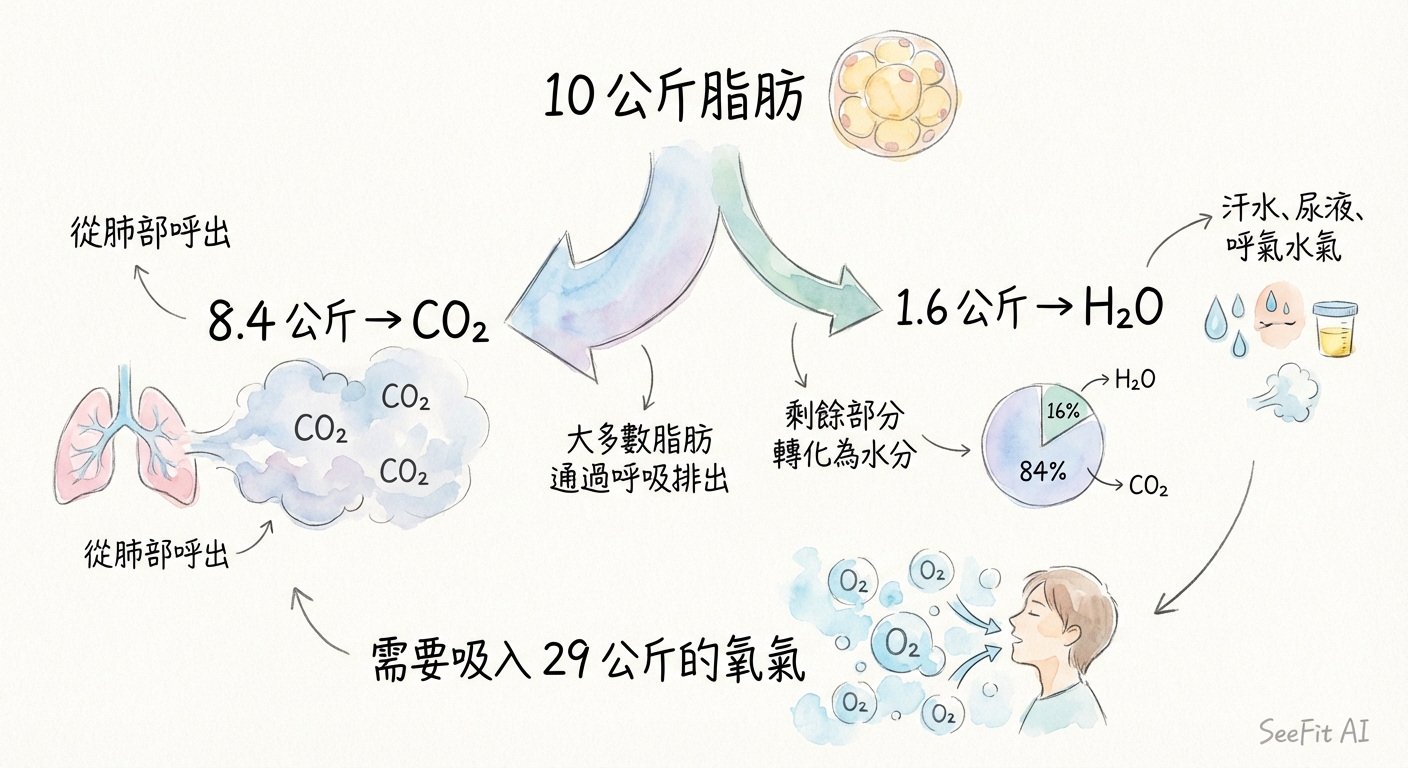
The answer shocked even medical professionals. When you metabolize 10 kg of human fat, 8.4 kg leaves your body as carbon dioxide through your lungs. The remaining 1.6 kg becomes water, which you excrete through urine, sweat, tears, and other bodily fluids.
That's right — 84% of the fat you lose is literally exhaled.
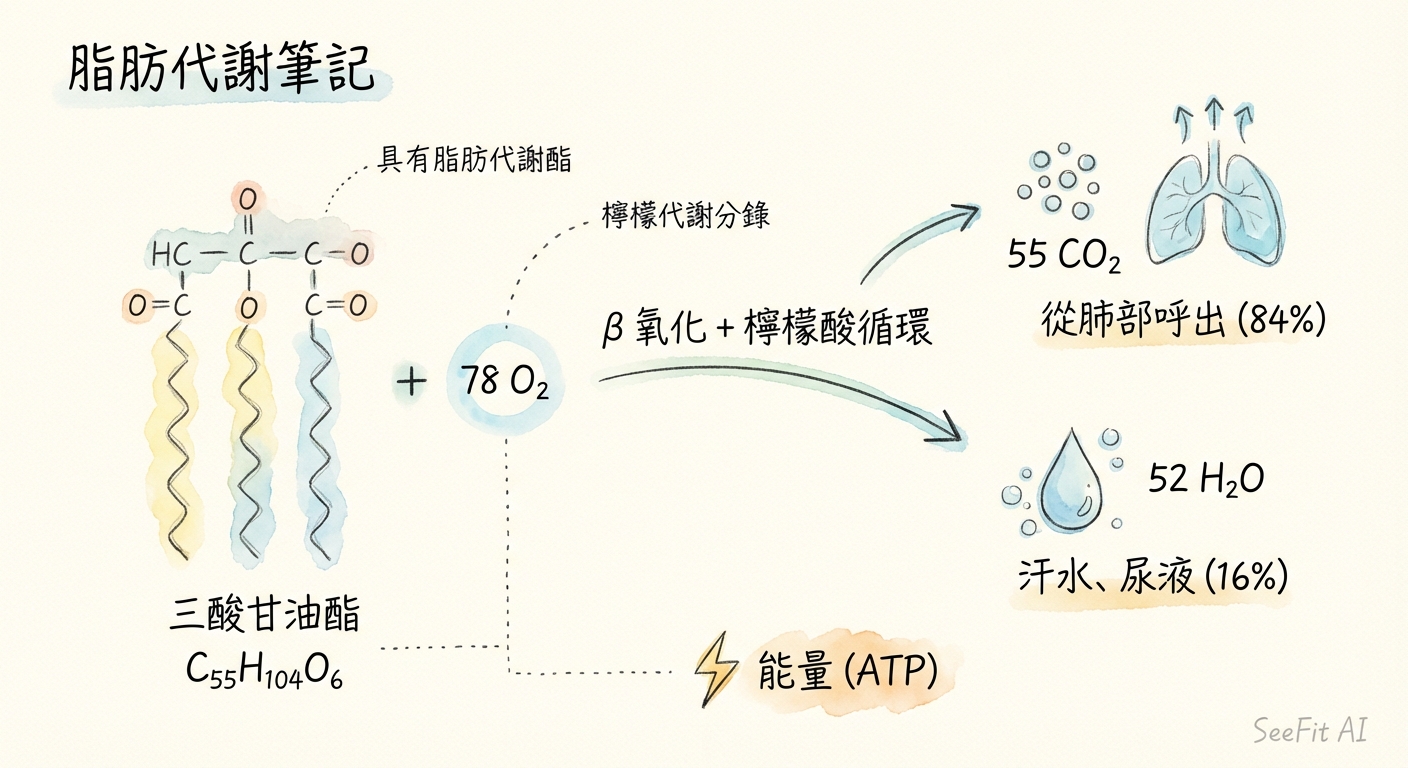
What the science says right now: Meerman & Brown's stoichiometric analysis (BMJ 2014, doi:10.1136/bmj.g7257) demonstrated that complete oxidation of a single triglyceride molecule requires 78 oxygen atoms, producing 55 CO2 molecules and 52 H2O molecules. The chemistry is definitive — this isn't preliminary evidence, it's basic biochemistry that was simply never calculated before.
What's Actually Inside a Fat Cell
Your fat cells store triglycerides — molecules made up of just three elements: carbon (C), hydrogen (H), and oxygen (O). The chemical formula of an average human triglyceride is C₅₅H₁₀₄O₆.
When your body needs energy, hormones like adrenaline and noradrenaline signal fat cells to release these triglycerides into the bloodstream. Then your cells break them apart through a process called beta-oxidation, which feeds into the citric acid cycle (Krebs cycle) in your mitochondria.
The complete reaction looks like this:
C₅₅H₁₀₄O₆ + 78 O₂ → 55 CO₂ + 52 H₂O + energy
Translation: one fat molecule plus 78 oxygen molecules produces 55 carbon dioxide molecules, 52 water molecules, and the energy your body uses for everything from thinking to running.
The 10 kg Math
Here's where it gets vivid. If you burn 10 kg of fat:
- 8.4 kg exits through your lungs as CO₂
- 1.6 kg becomes water (urine, sweat, breath moisture)
- You need to inhale 29 kg of oxygen to make this happen
An average person at rest breathes about 12 times per minute. Each breath exhales roughly 33 mg of CO₂, of which about 8.9 mg is carbon. Over a day, that's about 17,280 breaths, releasing approximately 200 grams of carbon.
So on a normal day, without any exercise, you exhale about 200 g of carbon. A good chunk of that comes from the food you ate, not stored fat. You only tap into fat stores when you're in a caloric deficit.
"So Can I Just Breathe Really Hard?"
This is the question everyone asks. And the answer is no — for a very specific reason.
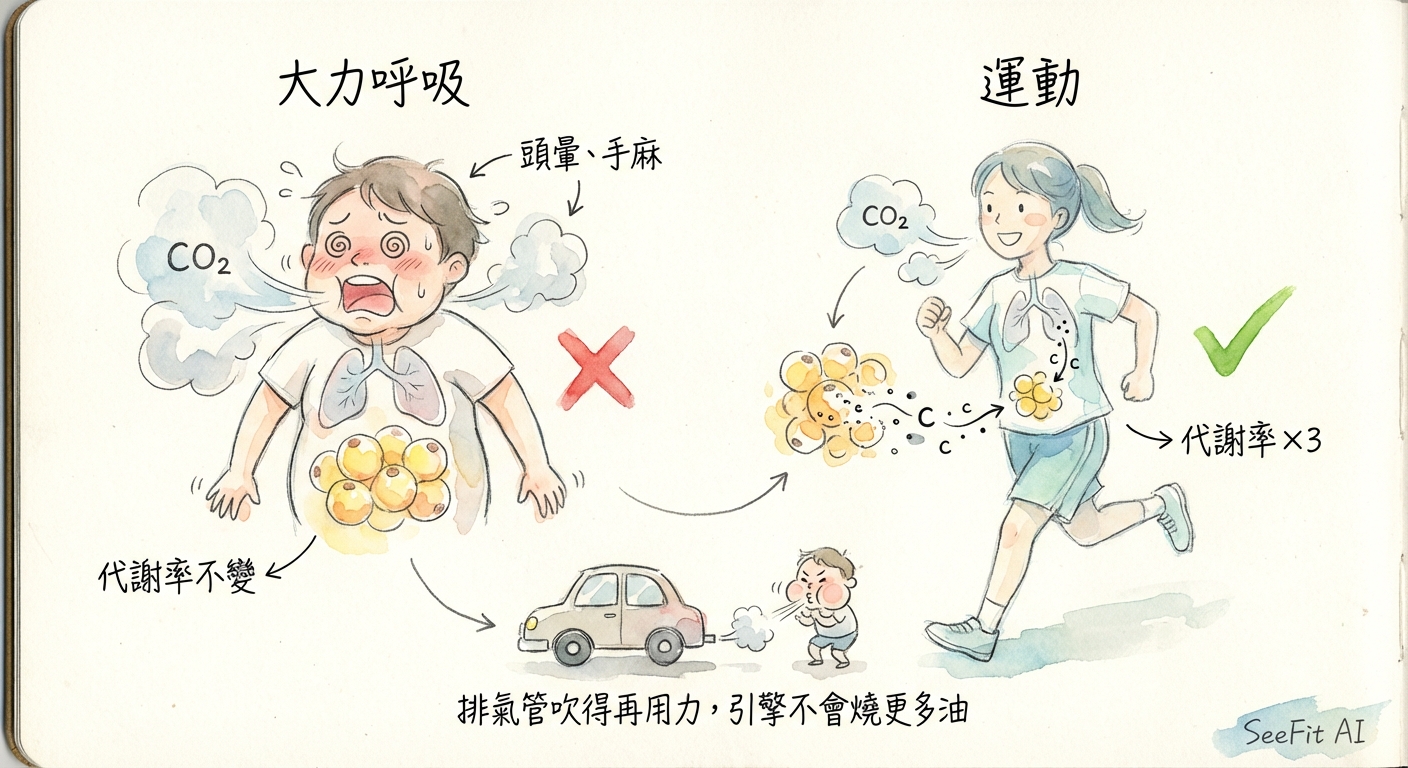
Heavy breathing (hyperventilation) increases the rate at which you expel CO₂, but it does NOT increase the rate at which your body breaks down fat. Fat oxidation is controlled by your metabolic rate, which is determined by energy demand from your muscles and organs.
If you hyperventilate without increasing your metabolic demand, you'll blow off too much CO₂, making your blood alkaline (respiratory alkalosis). Symptoms include dizziness, tingling in your fingers, lightheadedness, and even fainting.
Your body produces CO₂ as a byproduct of metabolism. Breathing faster doesn't create more CO₂ — it just expels whatever CO₂ your metabolism has already produced. You can't force the exhaust pipe to make the engine burn more fuel.
What the science says right now: Hyperventilation leads to hypocapnia (low blood CO₂), which causes cerebral vasoconstriction and reduced oxygen delivery to tissues (Laffey & Kavanagh, NEJM 2002). Ironically, breathing too fast can actually impair your body's ability to use oxygen efficiently, working against fat oxidation rather than helping it.
What Actually Makes You Breathe Out More Fat
The only way to increase CO₂ output from fat is to increase your metabolic rate through genuine energy expenditure. Here's what the research supports:
Exercise — Any physical activity increases oxygen consumption and CO₂ production. A person jogging at moderate pace roughly triples their metabolic rate. An hour of moderate exercise can increase your CO₂ output by about 40 g of carbon beyond what you'd exhale at rest.
NEAT (Non-Exercise Activity Thermogenesis) — Fidgeting, walking to the kitchen, standing while working, taking stairs. These "invisible" movements account for 15-50% of daily energy expenditure in most people, and the variance between individuals is enormous.
Muscle mass — Skeletal muscle at rest consumes about 13 kcal/kg/day. Having more muscle doesn't just burn calories during exercise; it keeps your baseline metabolic rate higher 24/7.
Sleep — Poor sleep disrupts hormones (leptin, ghrelin, cortisol) that regulate fat metabolism. You produce CO₂ while you sleep — about 150-200 g of carbon per night. Good sleep quality actually optimizes the efficiency of overnight fat oxidation.
Cold exposure — Your body burns energy to maintain core temperature. Brown fat (brown adipose tissue) is particularly active during cold exposure and directly oxidizes fatty acids to produce heat. A 2014 study showed that regular mild cold exposure can increase brown fat activity and modulate insulin sensitivity (Lee et al., Diabetes 2014).
How to Know If You're Actually Burning Fat
Here's a practical framework:
Heart rate — Fat oxidation peaks at moderate intensity, typically 60-70% of your maximum heart rate. At higher intensities, your body shifts to burning more carbohydrates. This is why "the fat-burning zone" on cardio machines exists, though total calorie burn matters more than the fuel ratio.
RER (Respiratory Exchange Ratio) — In metabolic labs, researchers measure the ratio of CO₂ exhaled to O₂ inhaled. An RER of 0.7 means you're burning almost entirely fat. An RER of 1.0 means almost entirely carbohydrates. Most daily activities sit around 0.8.
Practical signals — You're in a caloric deficit when you feel a mild, manageable hunger before meals. Your weight trends downward over weeks (daily fluctuations are mostly water). Your waist measurement decreases.
Try It Yourself: The Breathing Awareness Experiment
Next time you exercise, try this:
- Before exercise — Sit still and count your breaths for one minute at rest. Note how shallow and slow they are.
- During moderate exercise (brisk walk or light jog) — Notice your breathing deepen and quicken. Each of those bigger breaths carries more CO₂ out.
- Calculate it — At rest, you exhale about 200 mg CO₂ per minute. During moderate exercise, that jumps to 600-1000 mg per minute. You're literally tripling your fat exhaust rate.
- After exercise — Your breathing stays elevated for minutes to hours (excess post-exercise oxygen consumption, or EPOC). You're still exhaling extra CO₂.
If your breathing hasn't changed, you're not burning significantly more than baseline. The heavier you breathe during exercise, the more CO₂ — and therefore carbon from fat — you're expelling. Your lungs are the exhaust pipe.
What the science says right now: Post-exercise oxygen consumption (EPOC) can elevate metabolic rate for 12-24 hours after intense exercise, with the magnitude proportional to exercise intensity and duration (Børsheim & Bahr, Sports Medicine 2003). The "afterburn effect" is real, though often overstated in fitness marketing.
Key Takeaways
Your fat doesn't melt, dissolve, or convert into energy. It's disassembled atom by atom and exits your body primarily through your lungs as CO₂. This is basic chemistry, confirmed by tracking every atom through the metabolic pathway. Breathing harder won't speed up fat loss — only increasing your actual metabolic demand through movement, muscle, and lifestyle will. The best fat-loss strategy is anything that sustainably increases the amount of oxygen your cells process: regular exercise, more daily movement, adequate sleep, and maintaining muscle mass.
References
-
Meerman & Brown (2014). "When somebody loses weight, where does the fat go?" Link
-
Laffey & Kavanagh (2002). "Hypocapnia." Link
-
Borsheim & Bahr (2003). "Effect of exercise intensity, duration and mode on post-exercise oxygen consumption." Link
-
Lee et al. (2014). "Temperature-acclimated brown adipose tissue modulates insulin sensitivity in humans." Link
-
Maunder et al. (2018). "Contextualising maximal fat oxidation during exercise: determinants and normative values." Link
-
Rothschild et al. (2022). "Factors influencing substrate oxidation during submaximal cycling: a modelling analysis." Link
-
Carpentier et al. (2018). "Brown adipose tissue energy metabolism in humans." Link
-
Chung et al. (2018). "Non-exercise activity thermogenesis (NEAT): a component of total daily energy expenditure." Link
This content is for informational purposes only and does not constitute medical advice. Consult a qualified healthcare professional for personal health concerns.