
Can Your Waist Change If Strength Training Leaves Your Weight the Same?
Body weight and waist circumference can change separately. An eight-month trial shows how to read the two numbers, and how to measure your waist consistently.
You've been lifting for a while. The scale keeps settling around the same number, but your jeans are getting a little easier to button. You dig out a tape measure, check in the morning and then try again after dinner. Which reading should you believe?
Your waist can change even when your weight barely moves. The scale adds up what your whole body weighs. The tape measures the distance around one level of your abdomen. The scale can't tell you where the weight sits, and the tape can't tell you which tissue changed. To see whether your waist is changing, first make sure you're measuring the same place each time.
What is inside that loop of tape?
Picture the tape as a level line that starts at your side, follows the outline of your abdomen and comes back to where it started. Under the skin is subcutaneous fat. Further in, beyond the abdominal wall, some fat sits around the organs. That's visceral fat. Your posture, breathing and how your abdomen expands at the time can all change the distance the tape travels.
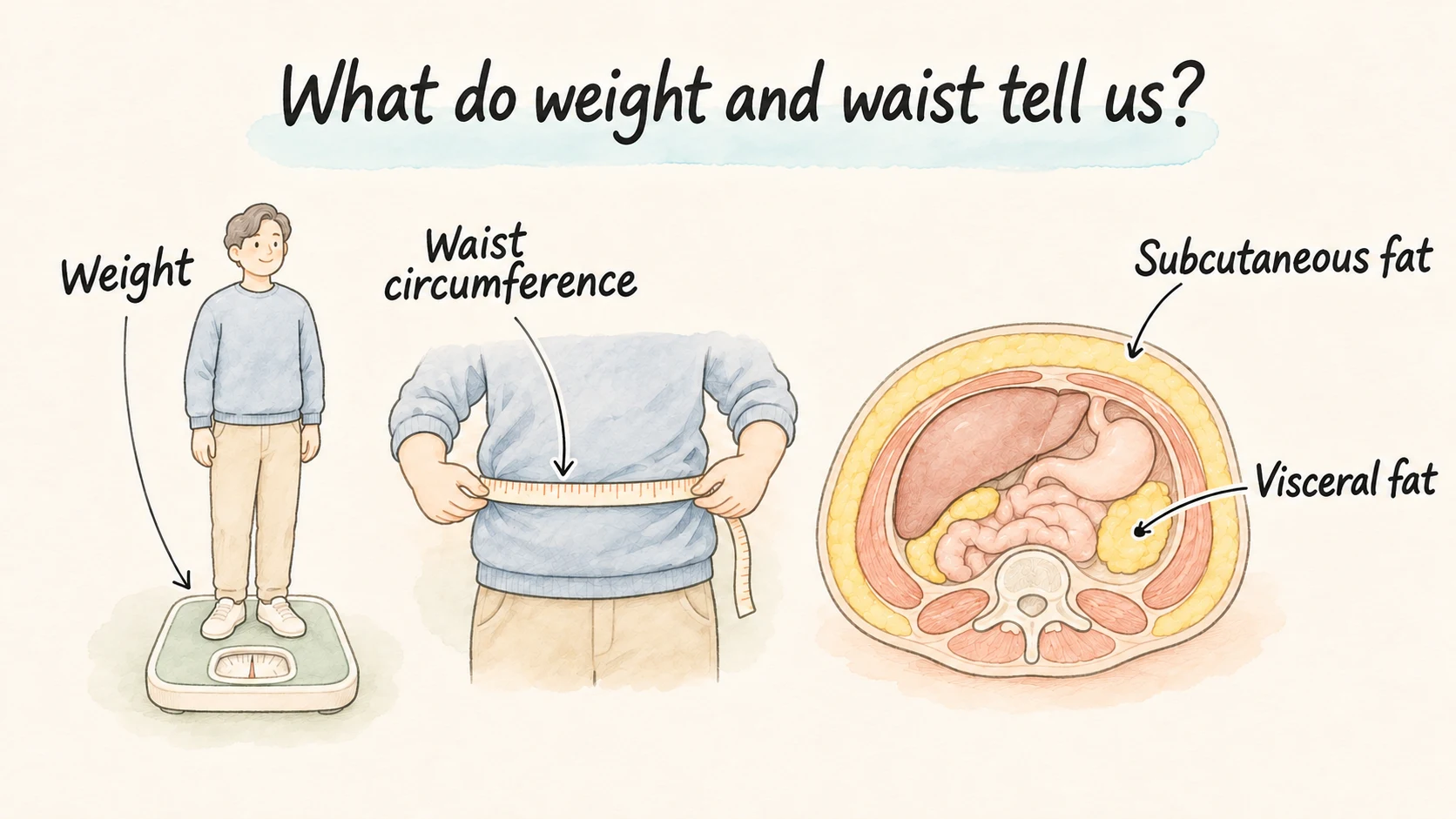
Say you measured 88 centimeters a few weeks ago and 86 today. The two centimeters are a change in circumference. The end of the tape meets the starting point two centimeters sooner after going all the way around. You can't read that as two centimeters off the front of your abdomen, or divide it into how much changed below your skin and how much changed around your organs. For that, researchers can use CT or MRI to locate the different fat deposits [2].
Even moving the tape up a little can produce another measurement. The waistband of your jeans might sit at a different level from either one. The way your jeans fit can draw your attention to a change. A tape settles on a number you can come back to several weeks later, if you use the same spot and the same conditions.
What happened to the two numbers after eight months?
A team at Duke University and other institutions studied adults who did little exercise, had overweight or obesity, and had abnormal blood lipids. They assigned 196 people at random to strength training, aerobic training or a combination of both for eight months. Of the 144 who completed their programs, 86 had the full set of before-and-after measurements used in this analysis [1].
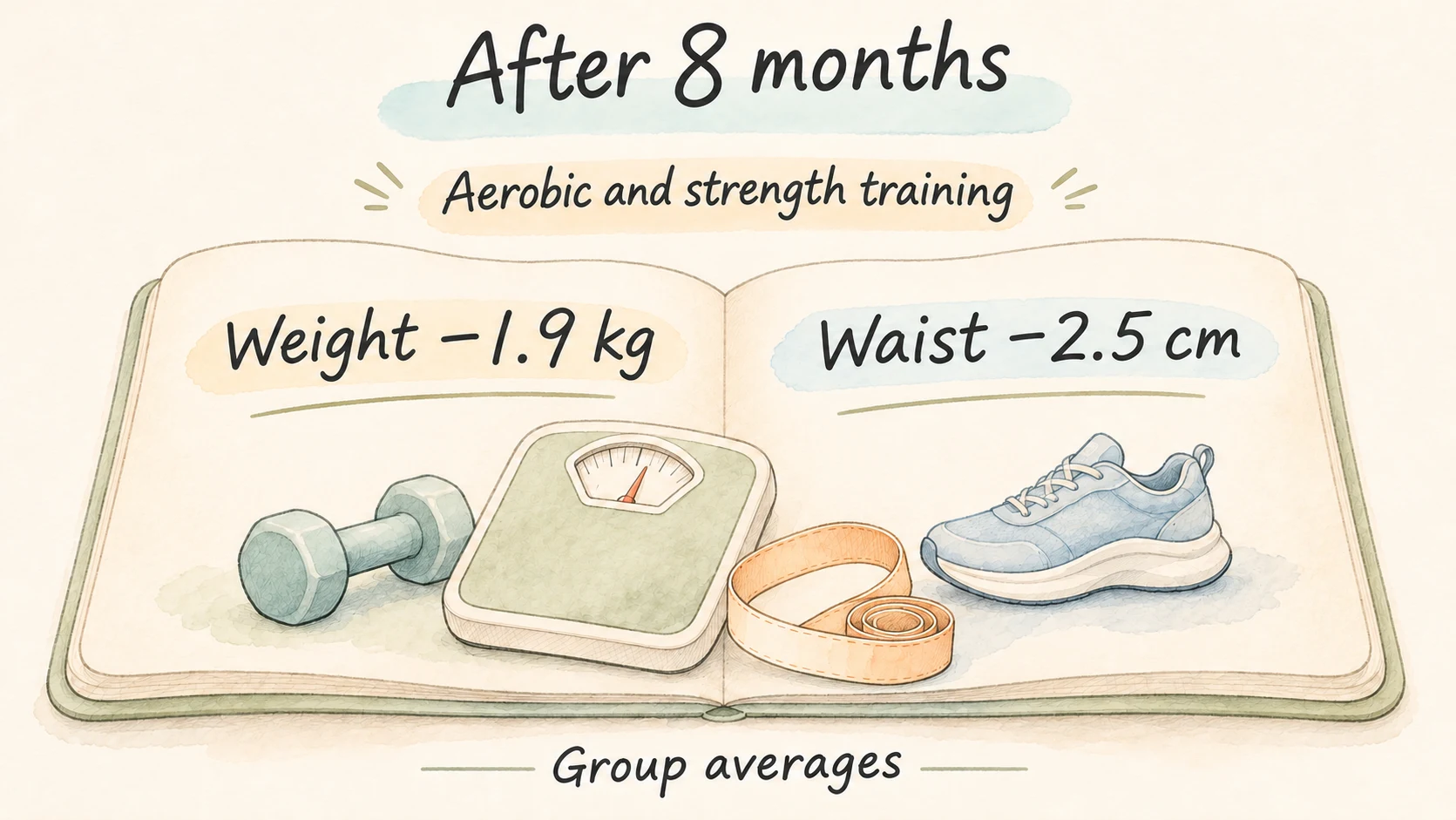
Researchers wrapped the tape around the abdomen at the top of the hip bones, measured twice and took the average. They measured body weight separately. After eight months, the group averages looked like this [1].
- Aerobic and strength training — Weight fell about 1.9 kg, waist circumference about 2.5 cm. Both changes were statistically significant.
- Aerobic training alone — Weight fell about 1.5 kg, waist circumference about 1.1 cm. The waist change did not reach statistical significance.
- Strength training alone — Weight rose about 0.7 kg, waist circumference about 0.3 cm. Neither change reached statistical significance.
How they set up the training — The combination group followed both exercise programs, so it trained for longer than either single-program group. The trial leaves open what would happen if all three groups trained for the same amount of time [1].
The three groups started with mean waists of roughly 103 to 104 centimeters. The 2.5-centimeter change is an average for one group near that starting point. A person's waist might have changed more, less or hardly at all. Use the result to understand the measurements taken in the trial. Predicting when your own tape might move is a separate question [1].
Why did strength training give a different result in other studies?
A 2024 review pooled 84 randomized trials involving 4,836 people with overweight or obesity. Waist circumference was available from 42 trials involving 2,393 people, and weight from 72 trials involving 4,123. These were separate sets of measurements. Compared with people assigned to no exercise or light stretching, the pooled results showed a statistically significant drop in waist circumference for strength training. The difference in body weight did not reach statistical significance [2].
The Duke trial examined one strength program over eight months. The review combined several programs and populations. Some exercise plans could be compared directly, while others were linked through a shared comparison group. Some plans increased weights over time, and the reports didn't all describe training intensity with the same level of detail. The larger set of studies helps answer whether the tape and scale can move separately. How much your waist might change would still depend on your circumstances and the program [2].
If you're reading a report specifically for visceral fat, look for the method used to measure it. A paper can have one column for waist circumference and another for visceral fat. Each column reflects its own measurement. A two-centimeter change on your tape is best recorded as what you know for sure, a change around the outside of your waist.
Can moving the tape make a difference of several centimeters?
One study measured 542 adults at four sites. A trained observer used the same tape at the top of the hip bones, the midpoint below the ribs, the navel and the narrowest part of the waist. In the women in that sample, the average reading at the navel was 8.6 cm larger than the reading at the narrowest point. In the men, the difference between those averages was 2.5 cm, and the differences across sites were not statistically significant [4].
Most of the participants were white. The 8.6 centimeters describe a difference between sites in this group. If you can't remember which level you picked the first time, take a new measurement at a level you can find again.
How do you compare a morning reading with one after dinner?
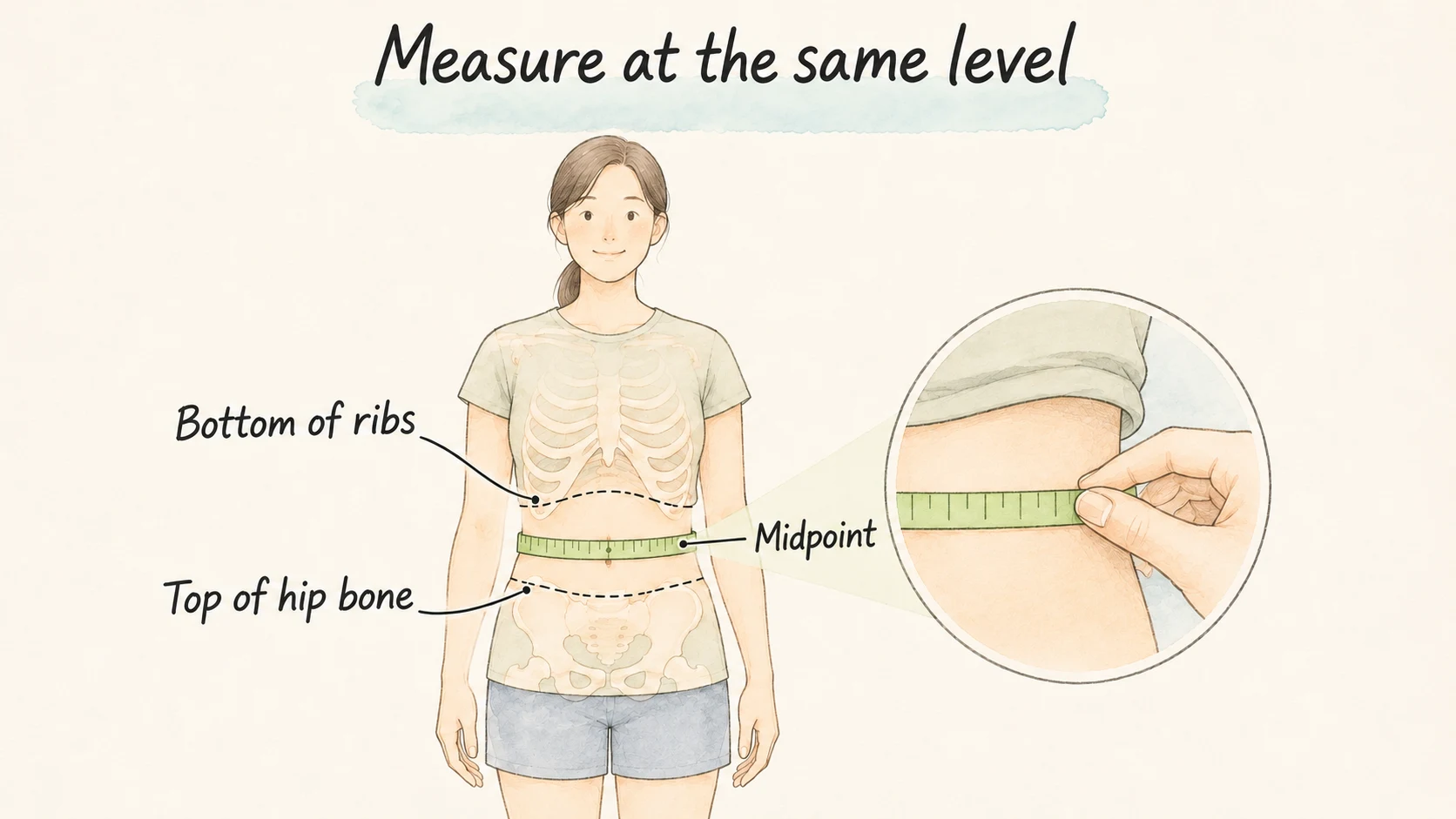
Taiwan's Health Promotion Administration uses the midpoint between the bottom of the ribs and the top of the hip bones. The Duke researchers measured at the top of the hip bones. Those are different levels. At home, pick a method and keep using it so your readings refer to the same spot [1][3].
- Choose a time. One option is before breakfast, with your waist uncovered and your stance relaxed. If your first reading was after dinner, start a fresh morning record for comparison.
- Find the same level. Feel for the lower ribs and the top of the hip bones. Meet halfway, with the tape level with the floor. Let it touch the skin without pinching it.
- Read at the end of a normal breath out. Let your abdomen relax. If the tape slips, find the same spot and try again. Save the reading with the date and look back after a few weeks [3].
If you recorded 88 cm after dinner last week and 86 cm before breakfast today, keep both and note when you took them. Gather another couple of readings before breakfast. You can then compare those mornings under similar conditions.
Next time those jeans button more smoothly, you can write that down and check the measurement separately. If the tape records a smaller reading several times under similar conditions, you have something useful to set next to your weight. The day you first noticed your jeans fitting differently makes a good place to start.
References
[1] Bateman LA, et al. Comparison of aerobic versus resistance exercise training effects on metabolic syndrome. Am J Cardiol. 2011;108(6):838–844.
[2] Chen X, et al. Effects of various exercise types on visceral adipose tissue in individuals with overweight and obesity. Obes Rev. 2024;25(3):e13666.
[3] Taiwan Health Promotion Administration. How to measure your waist circumference. 2022.
[4] Mason C, Katzmarzyk PT. Variability in waist circumference measurements according to anatomic measurement site. Obesity. 2009;17(9):1789–1795.