
Why Does the Scale Drop So Quickly When You Cut Carbs?
Muscle biopsies and a controlled feeding study show how glycogen and water can move the scale within days of a change in carbohydrate intake.
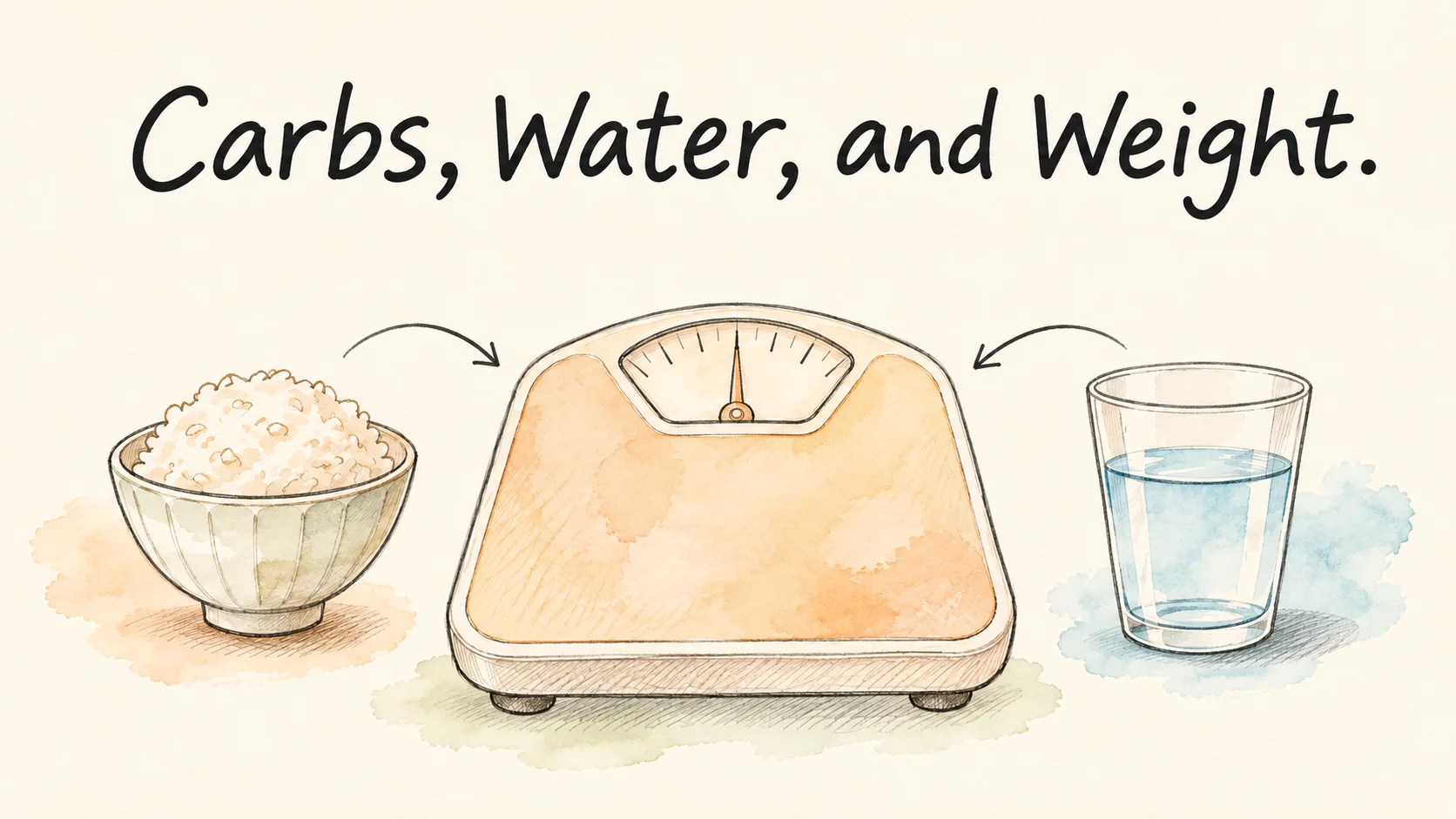
You serve yourself less rice at dinner for a few days, and the scale drops. Over the weekend you go back to your usual portions, and some of the weight comes back. Part of that quick swing can come from changes in glycogen and water. When your body uses some of its stored carbohydrate, the amount of water in your tissues can shift. When those stores refill, some of that weight can come back.
Imagine stepping on the scale with a half-liter bottle of water in your hand. Put the bottle down and the reading immediately drops by about half a kilogram. Water inside the body is harder to separate out, but it has weight just the same. To understand how a smaller serving of rice can affect that number, it helps to look at the form in which the body stores some of the carbohydrates you eat.
Your muscles store some carbohydrates as glycogen
The starch in rice, pasta, and potatoes breaks down into glucose during digestion. Your body can use glucose right away. It can also link glucose molecules into long, branching chains called glycogen. The liver stores glycogen, and muscles have stores of their own. A muscle can draw on that local supply when it needs fuel for movement.
Glycogen sits in cells that already contain water. As the amount of glycogen in a muscle changes, the amount of water there can change with it. You may have heard that a gram of glycogen comes with three grams of water. The origin of that number is easier to understand if you look at the conditions in which the researchers measured it.
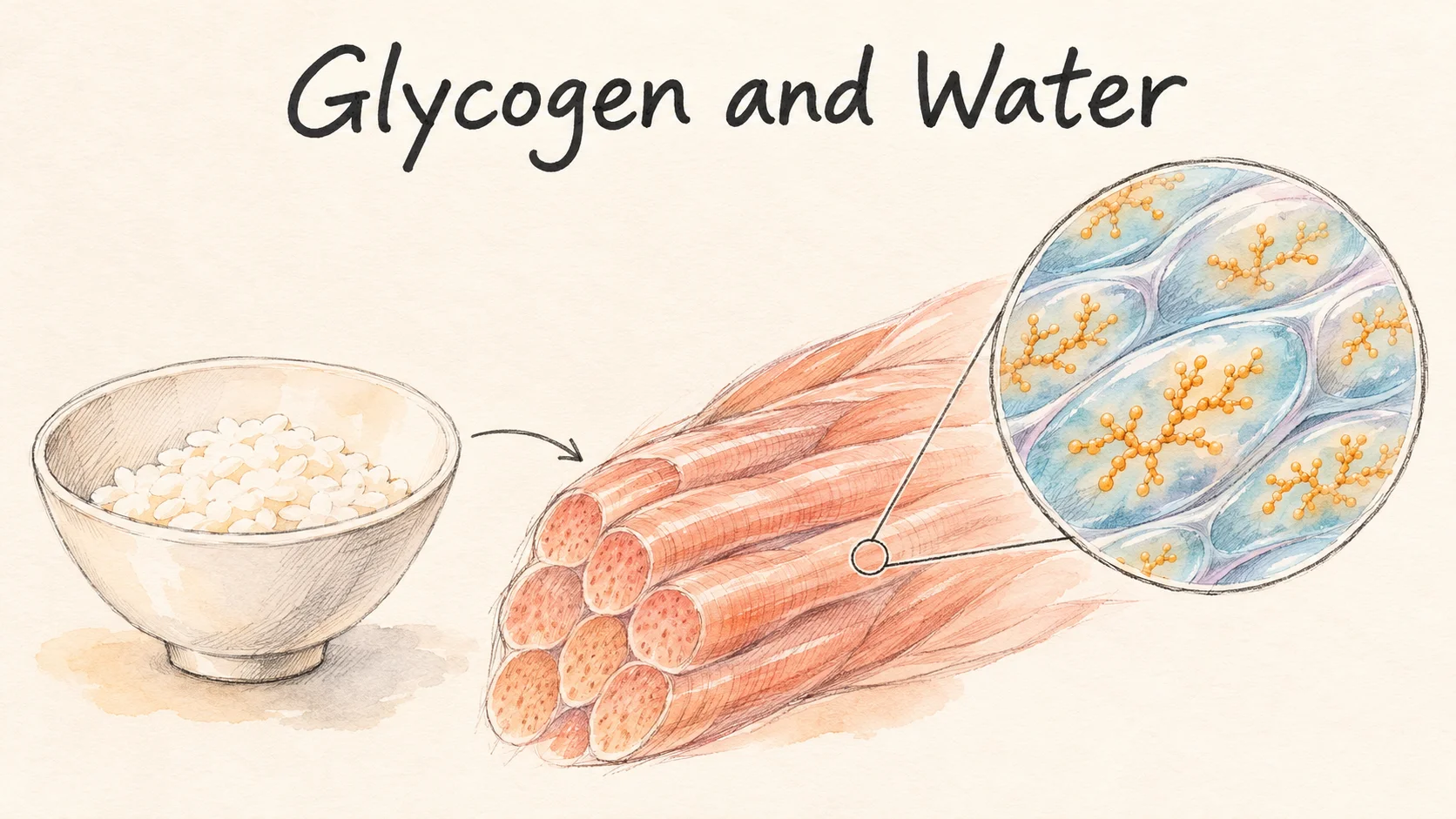
A team in Spain studied nine trained cyclists after a long ride in the heat. The cyclists got the same amount of carbohydrate in two recovery tests. In one test they received less water, and in the other they received enough to replace what they had lost. The researchers sampled thigh muscle to measure how much glycogen and water it contained [1].
With less water available, the muscle gained about three grams of water for each gram of glycogen restored. With full rehydration, the measured ratio was about 17 to one. Those extra grams of water had other places to go within the muscle. The ratio describes how much each measurement changed in the sampled tissue after a hot ride.
To get a feel for the scale of the change, imagine 100 grams less glycogen and 300 grams less associated water. Together that would weigh 400 grams, close to a half-liter bottle of water. This illustration uses the three-to-one ratio from one test. The study did not measure what happens when someone eats one less serving of rice [1].
Two diets, two ways of measuring the change
Researchers at the U.S. National Institutes of Health fed 19 adults with obesity in a metabolic ward. They started with five days of food that maintained weight, followed by six days of calorie restriction. In one round they removed calories from carbohydrate. In the other they removed calories from dietary fat. Both cuts were 30 percent of the starting intake, and protein stayed the same. Nineteen people completed the reduced-carbohydrate round and 17 completed the reduced-fat round [2].
| Average change during the trial | Less carbohydrate | Less dietary fat |
|---|---|---|
| Weight lost over six days | 1.85 kg | 1.30 kg |
| Daily body fat lost, estimated from fat balance | 53 g | 89 g |
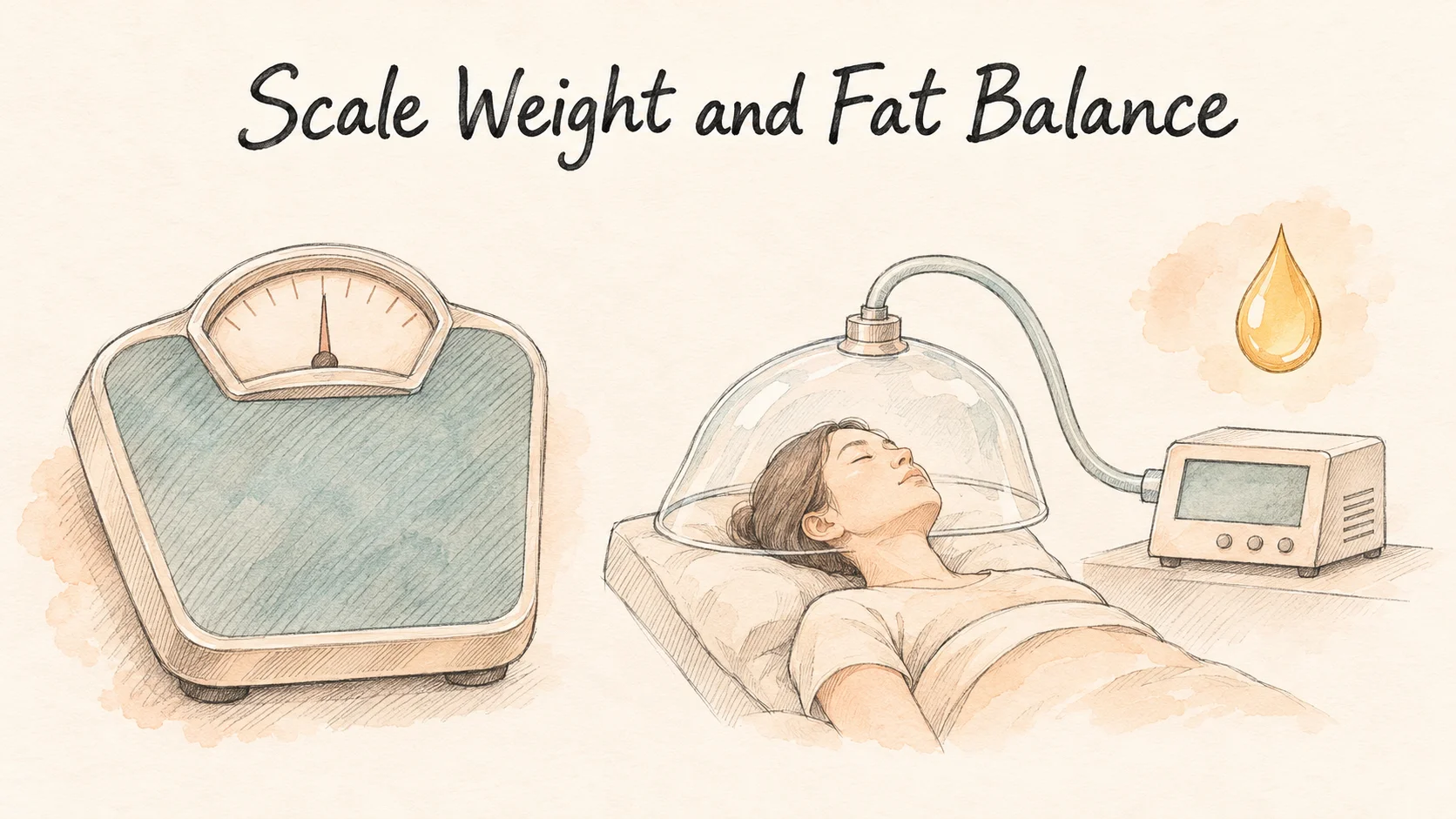
Look at the first row and the reduced-carbohydrate round comes out 550 grams ahead. Look at the second row and the order flips. On average, that round produced a smaller estimated daily loss of body fat, even though the number on the scale fell further.
The fat-balance estimate started with the amount of fat on the menu. In a room that measured respiratory gases, the researchers recorded the oxygen participants used and the carbon dioxide they produced. The illustration shows another way to measure those gases. That gave them an estimate of how much fat the body was using, which they could compare with how much fat came in. A separate measurement with a dual-energy X-ray scan did not distinguish the fat losses in the two rounds. The body can change in ways that are too small or too short-lived for every tool to pick up. Those six days show why a difference in scale weight cannot tell you which diet leads to more fat loss over months [2].
Notice the units before comparing the rows. The first is how much body weight was gone by day six. The second is an estimated rate of fat loss per day. The first can be read directly from the scale. The second requires a record of what went into the meals and a measurement of what the body used. Those differences matter even in a hospital, where researchers can keep the starting diet, energy reduction, and protein intake under close control.
What comes back when you eat more carbohydrates?
A Swedish team looked at that question from the other direction. Nineteen participants did prolonged exercise using their arms and legs. They then spent three days eating mainly protein and fat, followed by four days on a carbohydrate-rich diet. During those four days, glycogen in the sampled muscles rose, body weight rose by 2.4 kilograms, and total body water increased by about 2.2 liters. Think of what two large bottles of water weigh together [3].
The participants had spent several days deliberately depleting and then replenishing their stores. A typical dinner is a much smaller change. The result shows how fast the ingredients of scale weight can move together when the conditions change. Water intake, sodium, and food still in the digestive tract can shift the reading, too.
Put a single reading back into the week
If you track your weight, make readings comparable. Use the same scale around the same time, such as after using the bathroom and before breakfast, in similar clothing. A meal that was much larger or saltier than usual, a long workout, or a change in your usual carbohydrate portions is worth a short note. The note gives you something to compare with an unusual reading the next morning.

Say the scale reads 70 kilograms on six mornings and 71 on the seventh. The weekly average is about 70.14 kilograms. The high reading adds about 140 grams to the week’s average, rather than a full kilogram. That's a simple bit of arithmetic. It still leaves room for a high or low day to be interesting without making one number carry the whole story.
Use the same approach the following week and compare the two averages. When the scale jumps after your usual bowl of rice comes back, a change in stored glycogen and water fits the short time frame. The question of where your weight is heading takes more than that one morning to answer.
References
[1] Fernández-Elías VE, et al. Relationship between muscle water and glycogen recovery after prolonged exercise in the heat in humans. Eur J Appl Physiol. 2015;115(9):1919–1926.
[2] Hall KD, et al. Calorie for calorie, dietary fat restriction results in more body fat loss than carbohydrate restriction in people with obesity. Cell Metab. 2015;22(3):427–436.
[3] Olsson KE, Saltin B. Variation in total body water with muscle glycogen changes in man. Acta Physiol Scand. 1970;80(1):11–18.