
Why Fat Loss Shows Up Faster in Some Parts of the Body
Crunches, waist measurements, and imaging follow different changes. See what two kinds of abdominal fat and two exercise trials can tell you.
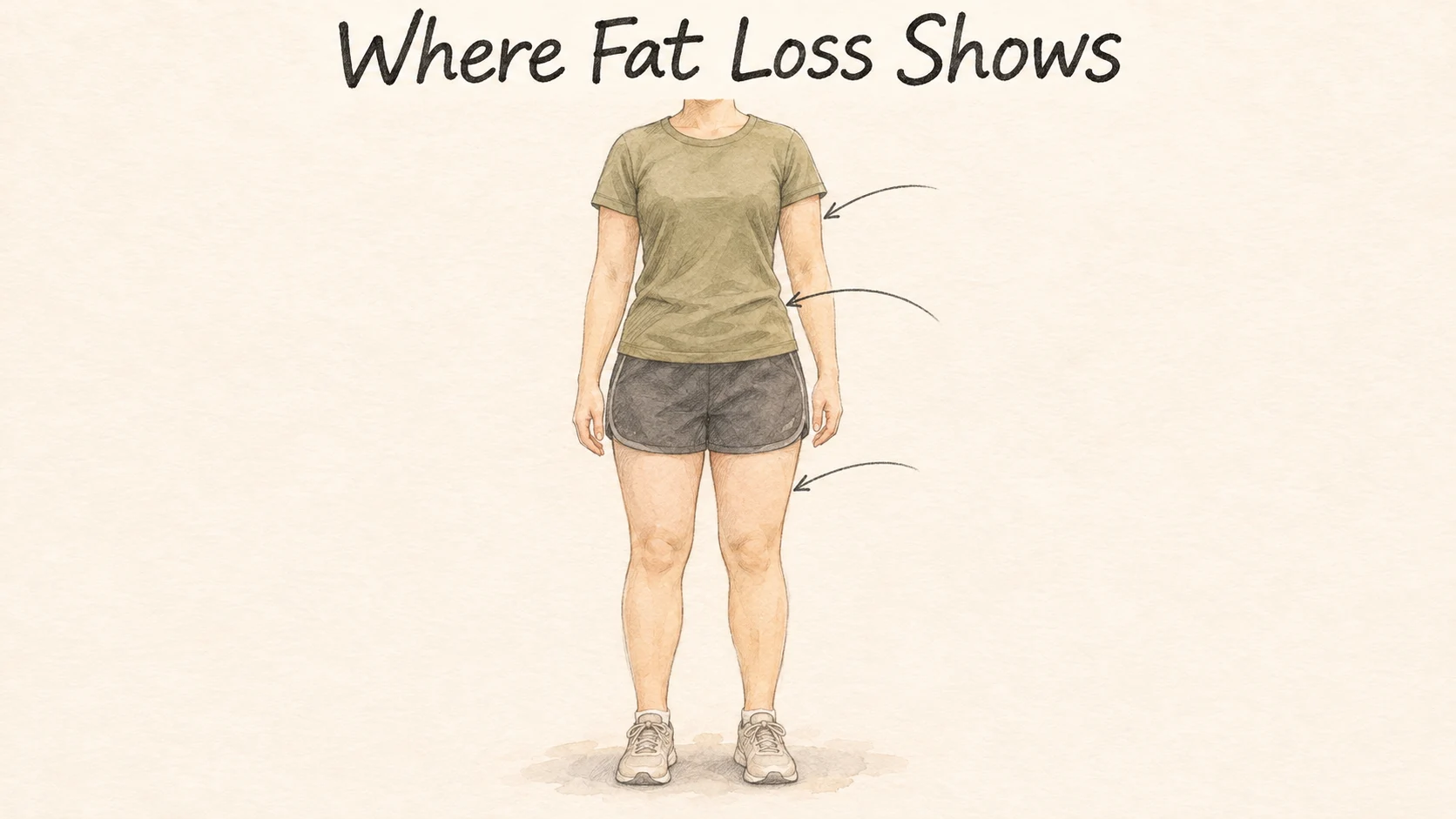
Your waistband feels looser, but the same trousers still fit the same way around your thighs. The two areas can genuinely change at different rates. How you compare them can also make one difference easier to notice than the other. People carry and lose fat in different patterns, and the areas on one person's body can change at different times. You can choose which muscles to train. How much fat changes nearby is harder to predict from the movement alone.
Start by separating three things you can observe. Clothing and a tape measure tell you about external size. An exercise test tells you what the muscle can do. Imaging can help researchers distinguish and measure different types of fat tissue. A study can give those three outcomes separate columns because they can move independently.
What sits inside one waist measurement?
Some of the soft tissue you can pinch around your abdomen is subcutaneous fat, just under the skin. Deeper inside, past the muscles of the abdominal wall, there are fat deposits around the organs. That's intra-abdominal fat, often called visceral fat. A tape measure wraps around all of it at once, along with muscles and the other contents of your abdomen. [1][2]
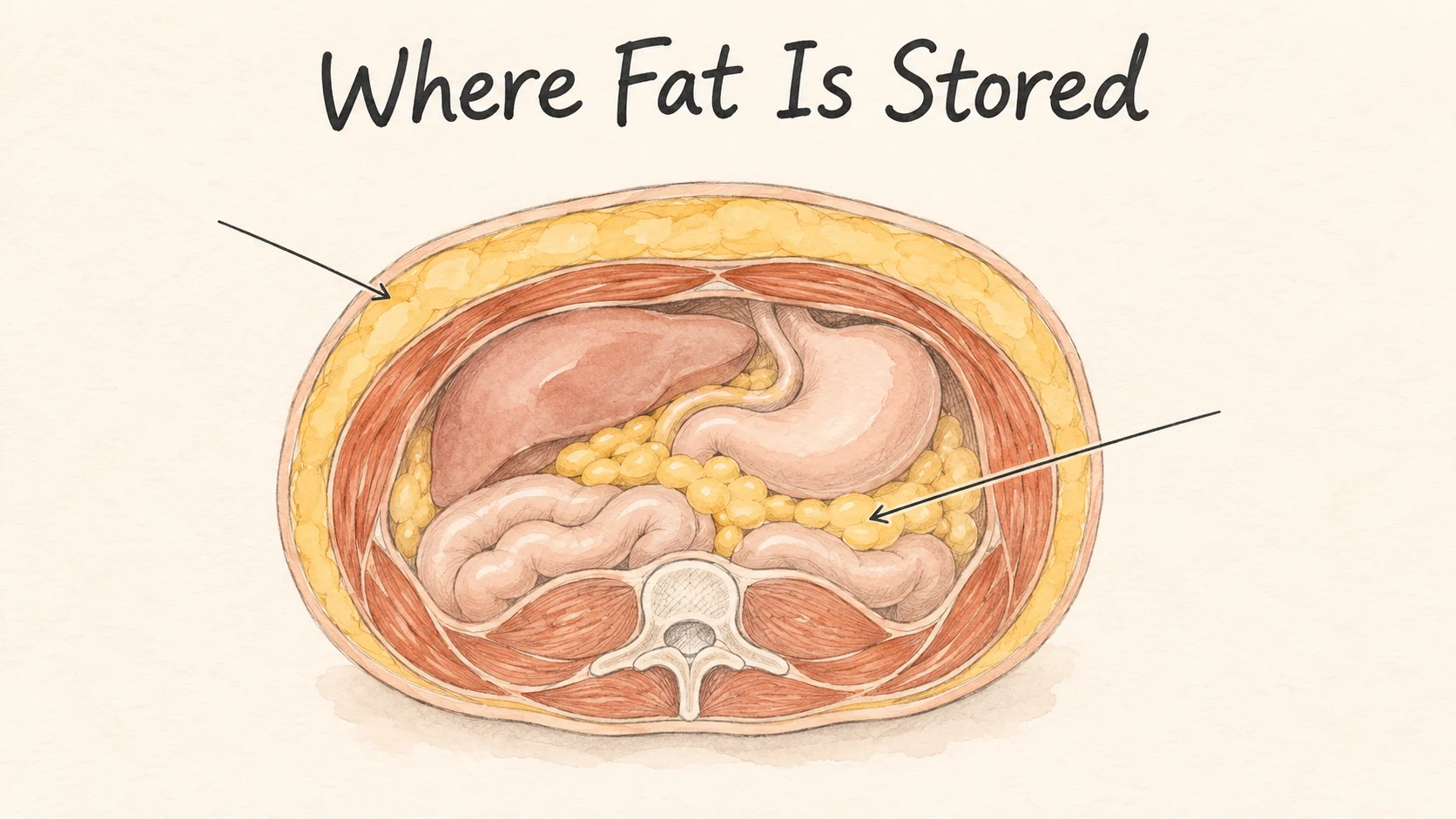
A Dutch trial randomly assigned 243 postmenopausal women with overweight to a diet group, a diet-plus-exercise group, or a control group. After 16 weeks, the researchers used MRI to measure the cross-sectional areas of abdominal subcutaneous fat and intra-abdominal fat separately. The diet group lost an average of 6.1% of body weight and the diet-plus-exercise group lost 6.9%. Both groups had less fat in both measured areas than the control group. [1]
In the diet group, compared with the control group the abdominal subcutaneous area fell by about 12.5%, and the intra-abdominal area by about 12.0%. Those are changes in measurements taken at particular levels in the abdomen. A circumference is an external length, and body weight reflects the whole person. If you measure your waist at home, a change of a centimeter tells you that the circumference changed under those conditions. It gives you very little information about how much of each specific tissue changed. [1]
The amount of fat a region starts with also affects how the same percentage looks. Imagine two areas that each lose 10%. If the first started with two kilograms of fat, it would lose 200 grams. If the second held half a kilogram, it would lose 50 grams. This is an arithmetic example. In daily life, you also notice change where clothing already fits closely. A small change around the waistband is easier to detect in the same pair of trousers than a change under loose fabric.
Deposits can also behave differently on the inside. In a small physiological study, a team compared the blood flow and markers of fat mobilization in subcutaneous tissue from the abdomen and buttocks. The buttock tissue had lower blood flow and lower activity by one measure of an enzyme involved in releasing stored fat. That is a short-term physiological measurement. Finding how a depot changes over months would require tracking the tissue over that period. [5]
Can more crunches change belly fat first?
To test that, researchers need a group that trains the abdominal muscles and measurements of both muscle endurance and local fat. In a 2011 randomized trial, 24 sedentary adults aged 18 to 40 took part. The training group did seven abdominal exercises five days a week for six weeks. The control group did no abdominal training. On the final curl-up test, the two groups averaged 47 repetitions and 32 repetitions, respectively. The investigators did not detect a clear reduction in measures such as abdominal circumference or abdominal skinfolds. [3]
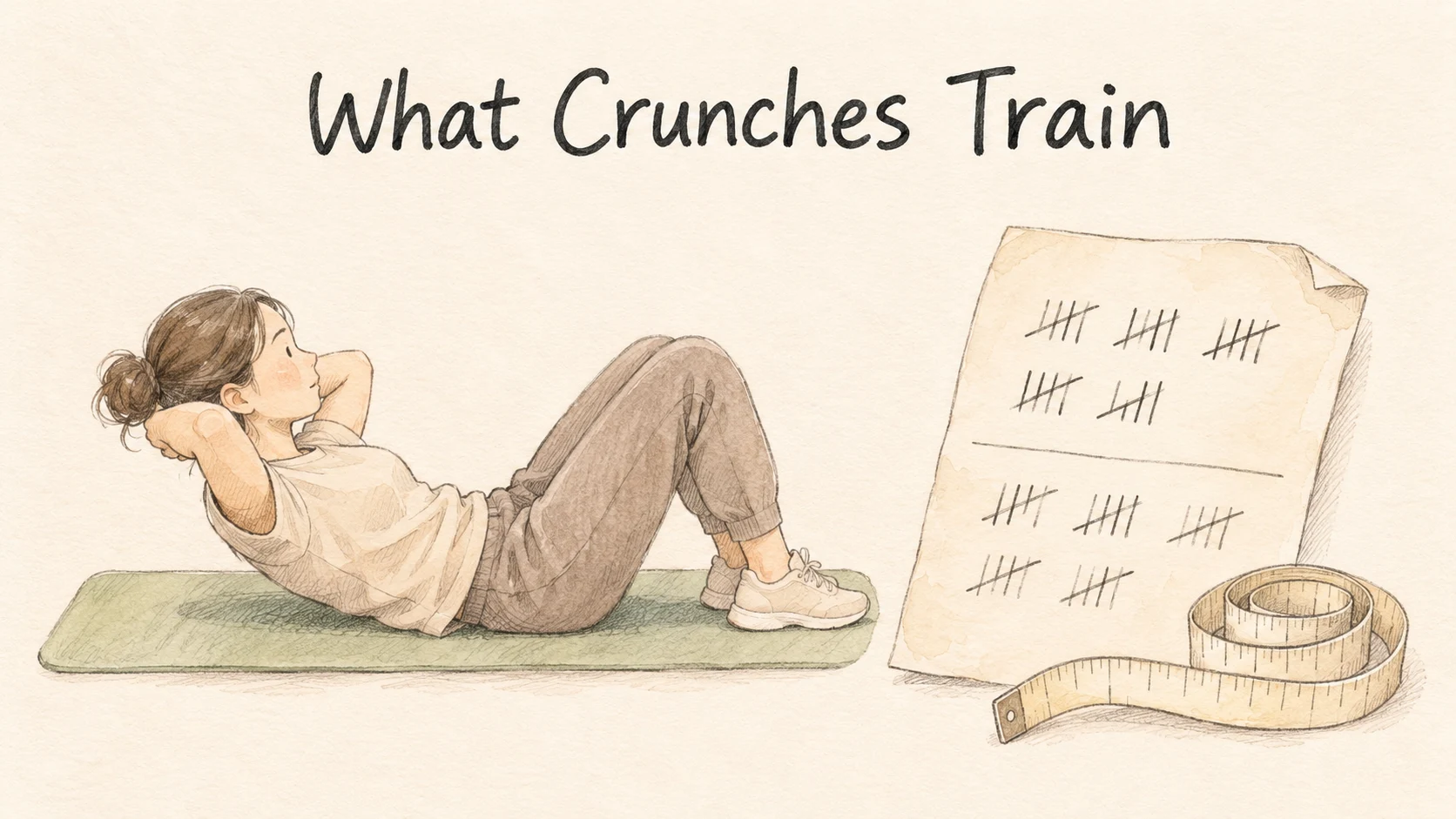
In the 2011 abdominal training trial, 47 and 32 were the groups' average scores at the end. The change in repetitions from each person's starting point is a separate comparison.
An acute exercise experiment helps show the distinction. Ten men alternated legs in a knee-extension exercise while researchers compared what happened in the fat tissue near the working and resting muscles. Near the working muscle, blood flow and the rate at which stored fats were broken down tended to be higher during the session. Released fatty acids can enter the circulation. That test says how tissue responded during exercise, while a longer imaging study asks how much fat a region contains after weeks of training. [6]
A small 2023 trial found a different result using a different routine. Sixteen adult men with overweight trained on treadmills for ten weeks. One group also performed intervals of weighted trunk rotation and crunches. The researchers measured fat with dual-energy X-ray absorptiometry, usually abbreviated DXA. On average, trunk fat fell more in the group that included the additional abdominal training. Both groups lost total body fat. [4]
The trunk is a larger region than the bit of your lower belly you can point to, and the training included much more than a few crunches at home. The result describes one specific routine in a small group. It leaves open how another person, another program, or a different body area would respond. If your aim is to get stronger or steadier in a movement, record that movement. If you want to learn what your waist or thigh is doing, measure that separately.
Compare your own measurements the same way each time
The number on a tape can change when you move the tape or hold your breath. The World Health Organization's waist measurement protocol uses the point halfway between the lowest palpable rib and the top of the hip bone. Keep the tape level and snug, without pushing into the skin, and take the reading at the end of a normal breath out. [2]
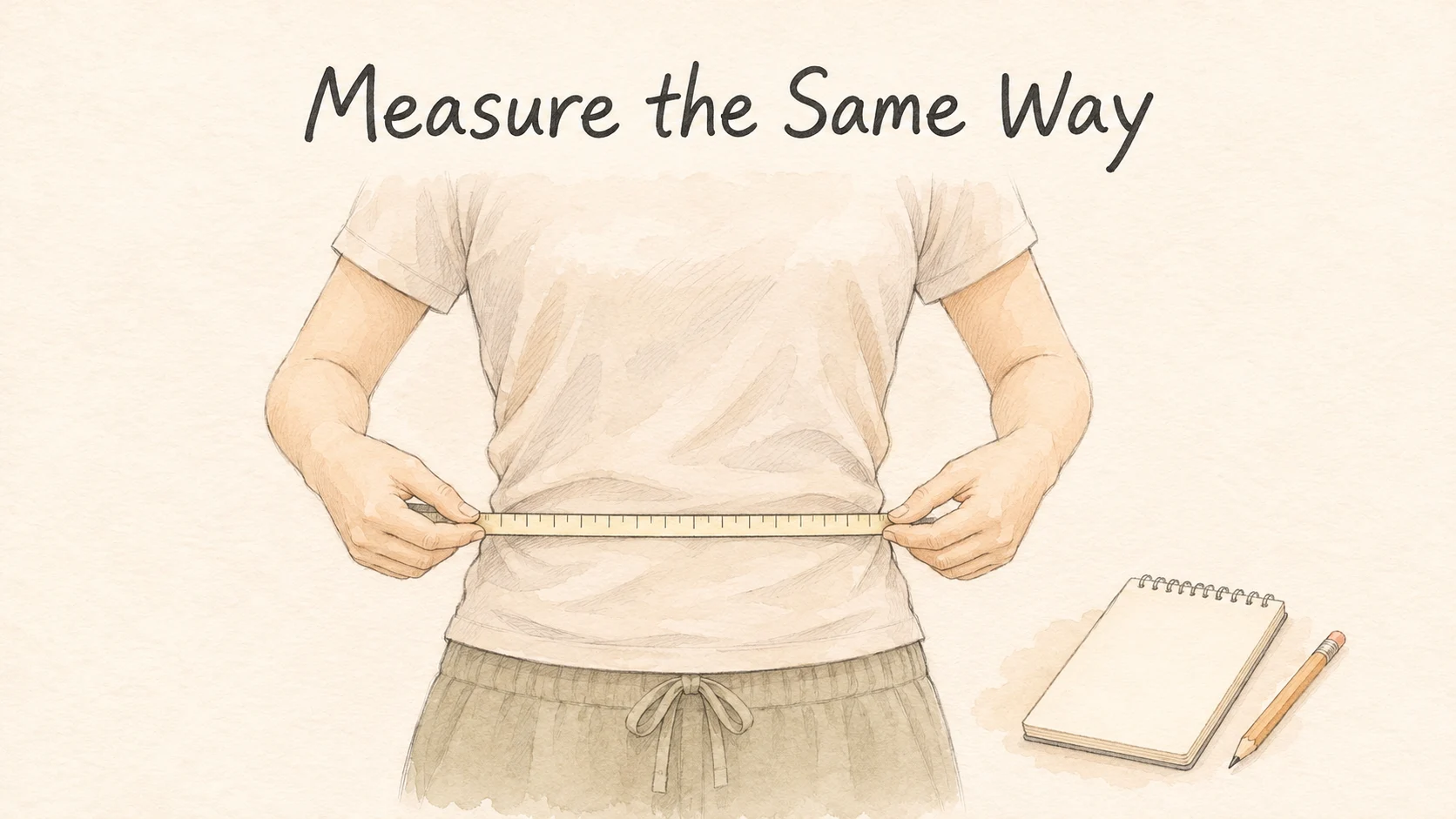
Say your waist reads 83 centimeters today and read 84 centimeters last time. It is hard to interpret that centimeter if you pulled the tape tighter one day or changed how you stood. For a comparison that is easier to read, choose a comfortable time, use similar clothing, and keep the position and tension similar. Compare a few readings taken at different times under the same conditions. When you measure another area, write down where the tape was on the first day so you have a place to return to.
Clothing can be a useful everyday observation too. Next time you pull on the same trousers, notice how the waistband, the hips, and the thighs fit. Compare that observation with your own measurements. On a separate line, write down what you could do in training if that's something you want to track. Each part of your body can change on its own timetable, and each measurement gives you one part of the picture.
References
[1] van Gemert WAM, et al. Effect of diet with or without exercise on abdominal fat in postmenopausal women. BMC Public Health. 2019;19:174.
[2] World Health Organization. WHO STEPS Surveillance: physical measurement procedures.
[3] Vispute SS, et al. The effect of abdominal exercise on abdominal fat. J Strength Cond Res. 2011;25:2559–2564.
[4] Brobakken MF, et al. Abdominal aerobic endurance exercise reveals spot reduction exists: A randomized controlled trial. Physiol Rep. 2023;11:e15853.
[5] Tan GD, et al. Upper and lower body adipose tissue function: A direct comparison of fat mobilization in humans. Obes Res. 2004;12:114–118.
[6] Stallknecht B, et al. Are blood flow and lipolysis in subcutaneous adipose tissue influenced by contractions in adjacent muscles in humans?. Am J Physiol Endocrinol Metab. 2007;292:E394–E399.