
Does Eating in Front of a Screen Really Make You Eat More?
Across 50 experiments, distraction did not clearly increase intake during the meal. The more consistent difference appeared at the next eating occasion.
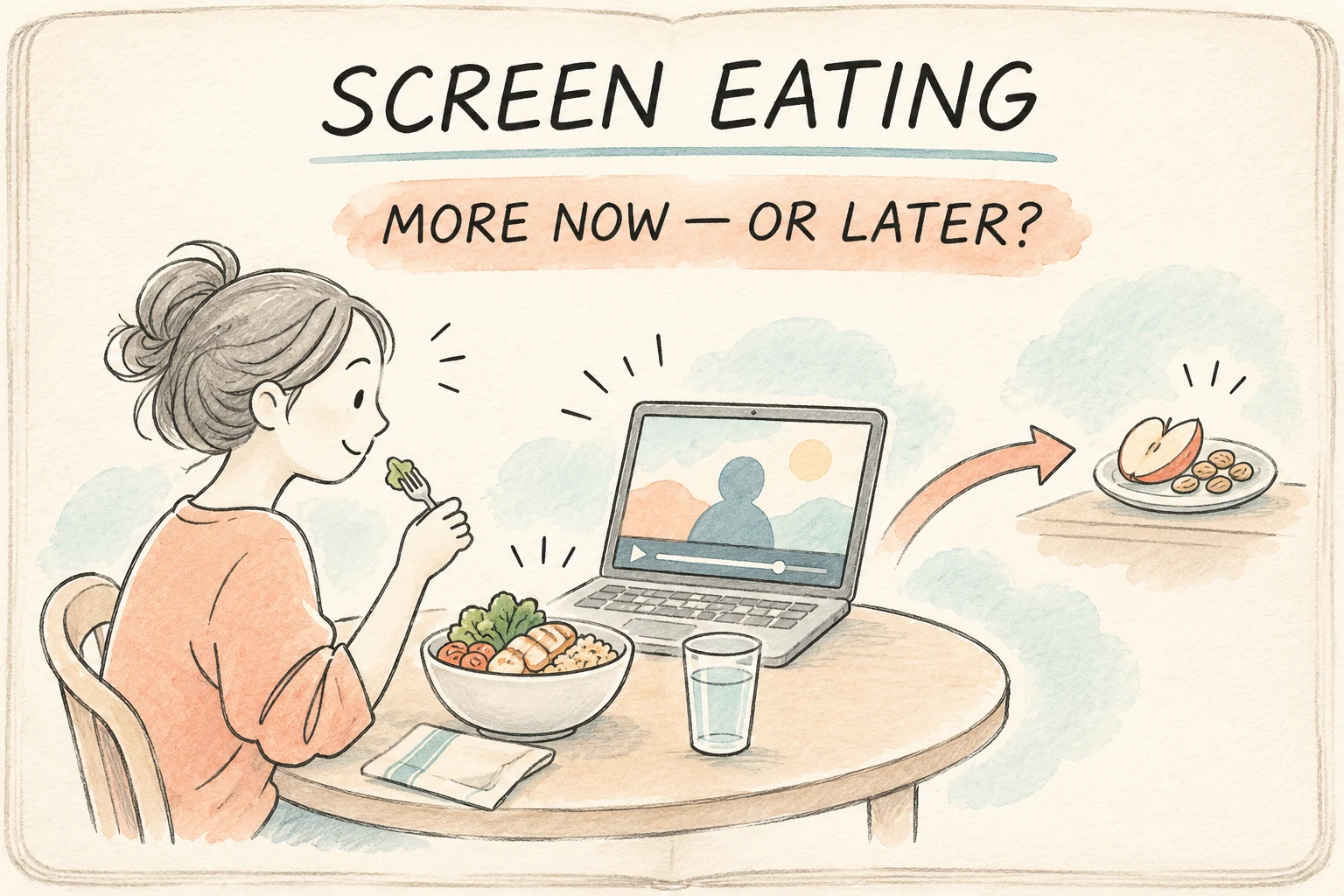
Dinner reaches the table and you start an episode almost automatically. Twenty minutes later, the bowl is empty. You can recount the plot, but the last few bites barely registered. Did the screen necessarily make you eat more?
Not necessarily. A 2026 meta-analysis found no clear increase in food intake during the meal when all forms of distraction were pooled. The more consistent difference appeared later: people ate more at the next eating occasion after a distracted meal. Watching television passively and performing a demanding task that requires constant decisions and button presses are not interchangeable forms of distraction [1].
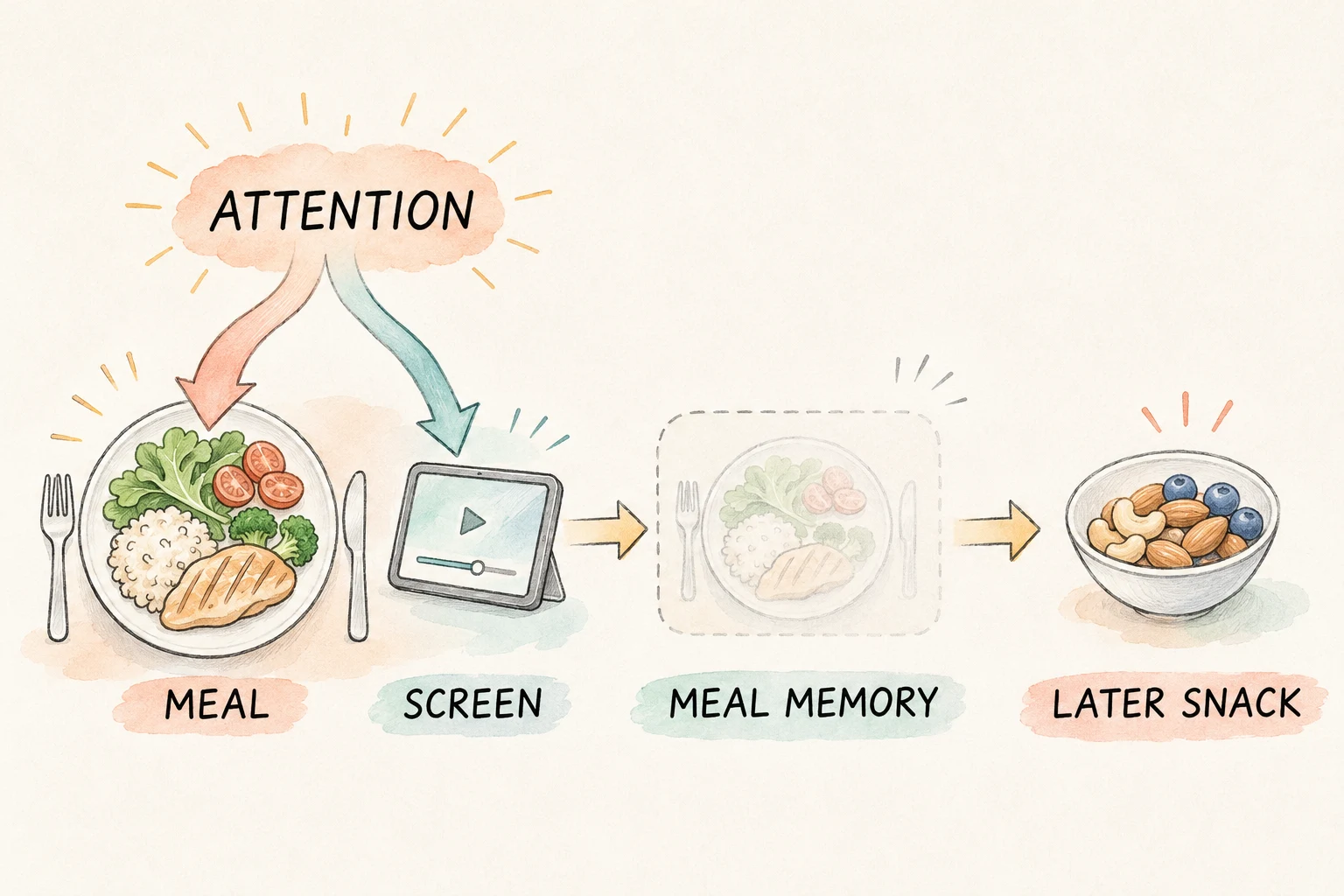
Distraction can change two parts of eating
Stopping a meal depends on more than signals from the stomach. You also see food disappear from the plate, notice that a flavor has become less interesting, and keep a rough sense of how much you have eaten. A video competes for some of the attention used to register those cues.
Researchers use meal memory to describe the contextual memory that a meal happened and roughly what it contained. You do not need to recall every bite. But when food appears again a few hours later, signals from the body are not working alone; memory of recent eating may also contribute to the decision to start or continue eating. A distracted meal may leave a weaker record. That does not mean memory is the sole controller of appetite, or that forgetting lunch guarantees a larger snack.
Researchers also separate satiation, the processes that bring the current meal to an end, from satiety, the period in which the meal suppresses further eating. Stomach stretch, taste, and the visible portion may matter strongly for stopping now. Hormonal signals and a memory of the meal can still matter later. This distinction helps explain how two conditions might produce similar dinner intake but different afternoon or evening snacking.
Distraction can also change the mechanics of eating. A task that keeps both hands busy may interfere with using utensils. Passive television leaves a hand free to reach repeatedly into a bowl. The first task can slow or reduce intake even while it weakens meal memory; the second may allow eating to continue almost automatically. Pooling them can hide that distinction.
Fifty experiments separated the current meal from the next one
The updated systematic review included 50 experiments in adults. Forty measured intake while participants were distracted, and ten served a fixed meal before measuring food intake at a later eating occasion. The distractions included television, music, reading, games, and computerized attention tasks. The search covered studies available through December 2024 [1].
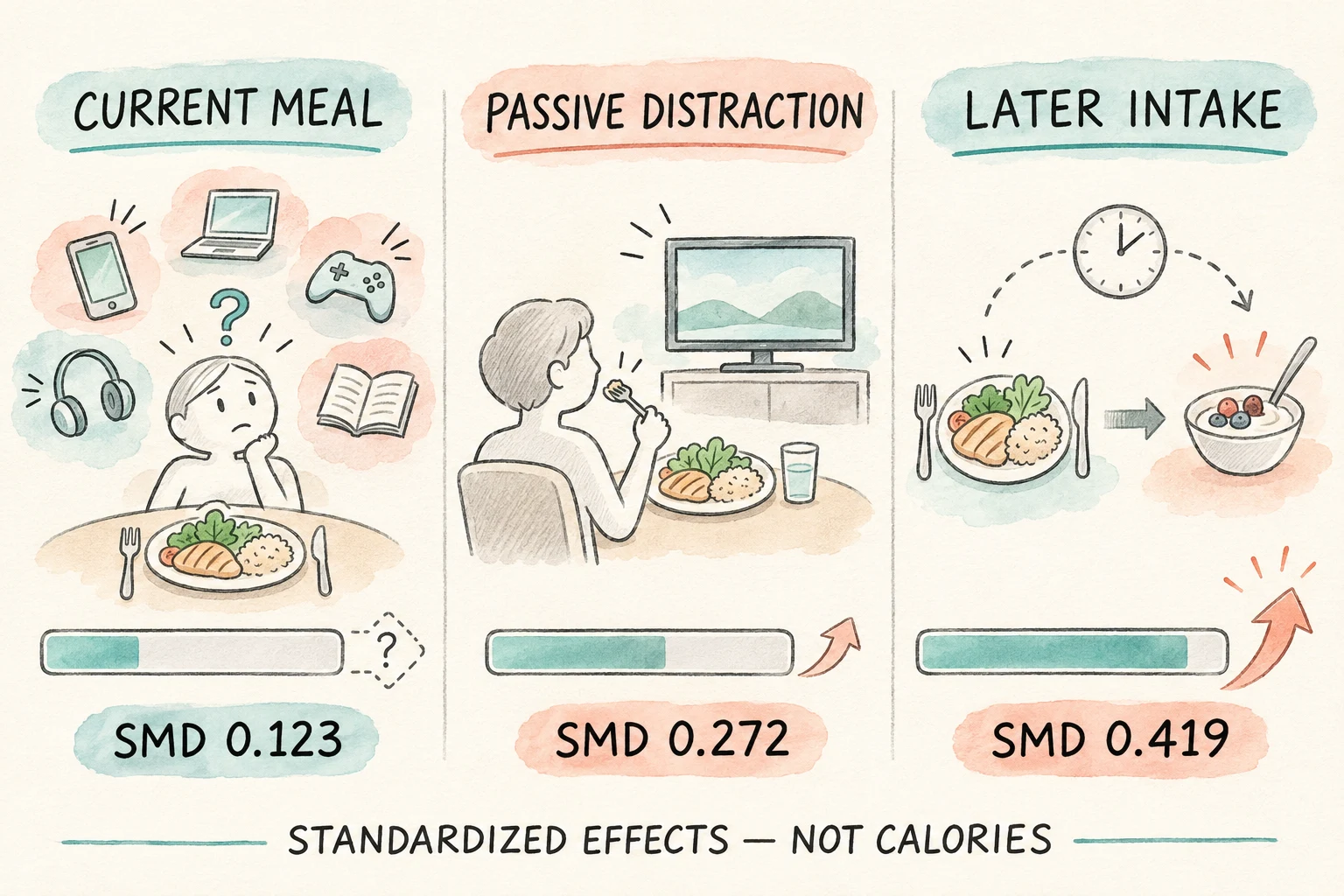
When every type of distraction was combined, the standardized mean difference for concurrent intake was 0.123, with a 95% confidence interval extending from below −0.01 to 0.25. It was not statistically significant. In practical terms, the review does not justify a rule such as “a screen adds a fixed number of calories to every meal.”
The type of distraction mattered. Passive distractions such as television or music were associated with greater intake during the meal, with a standardized mean difference of 0.272. Distractions involving physical actions did not clearly increase intake. The clearest pooled result concerned what happened next: after eating under distraction, intake at a later eating occasion was higher, with a standardized mean difference of 0.419 [1].
A standardized mean difference is not grams or calories. It puts studies using different foods and measurements onto a common scale. A value of 0.419 describes a small-to-moderate difference between group averages; it cannot predict how many cookies one person will eat. Most studies were short laboratory experiments with Western adults, and only ten measured later intake. They did not establish an effect on long-term body weight [1].
One demanding task led people to eat 13 grams less
An open-access crossover experiment enrolled 119 healthy young adults. Each participant attended twice, one week apart. On both visits, they received ten miniature spinach-and-cheese quiches and had 15 minutes to eat as much as they wanted. During one visit they ate quietly. During the other, numbers appeared on a screen once per second; participants pressed the space bar whenever three consecutive numbers were all odd or all even [2].
During the computerized task, participants ate an average of 13 grams less quiche, not more. Thirty minutes later, they were offered cookies and grapes for five minutes, and snack intake did not differ significantly. Yet distraction made their estimates of how many quiches they had received and eaten less accurate [2].
That result does not overturn the idea that distraction can affect eating. It sharpens it. Continuously scanning numbers and pressing a key can interfere with the actions needed to eat. Watching a show may not. The study also detected a carryover effect based on which condition came first, and its participants were mostly college students around age 20. The 13-gram result should not be generalized to every person or meal.
An earlier repeated-measures experiment illustrates why researchers also look beyond the current plate. Sixteen young women ate the same fixed lunch on two days, once with television and once without it. Later that afternoon, they ate more cookies after the television lunch and rated their memory of lunch as less vivid [3]. The sample was very small, so it is not a universal estimate. It does show the proposed sequence: distraction during a fixed meal, a weaker meal memory, and a difference that appears at the later snack rather than at lunch.
What is a useful screen-free experiment?
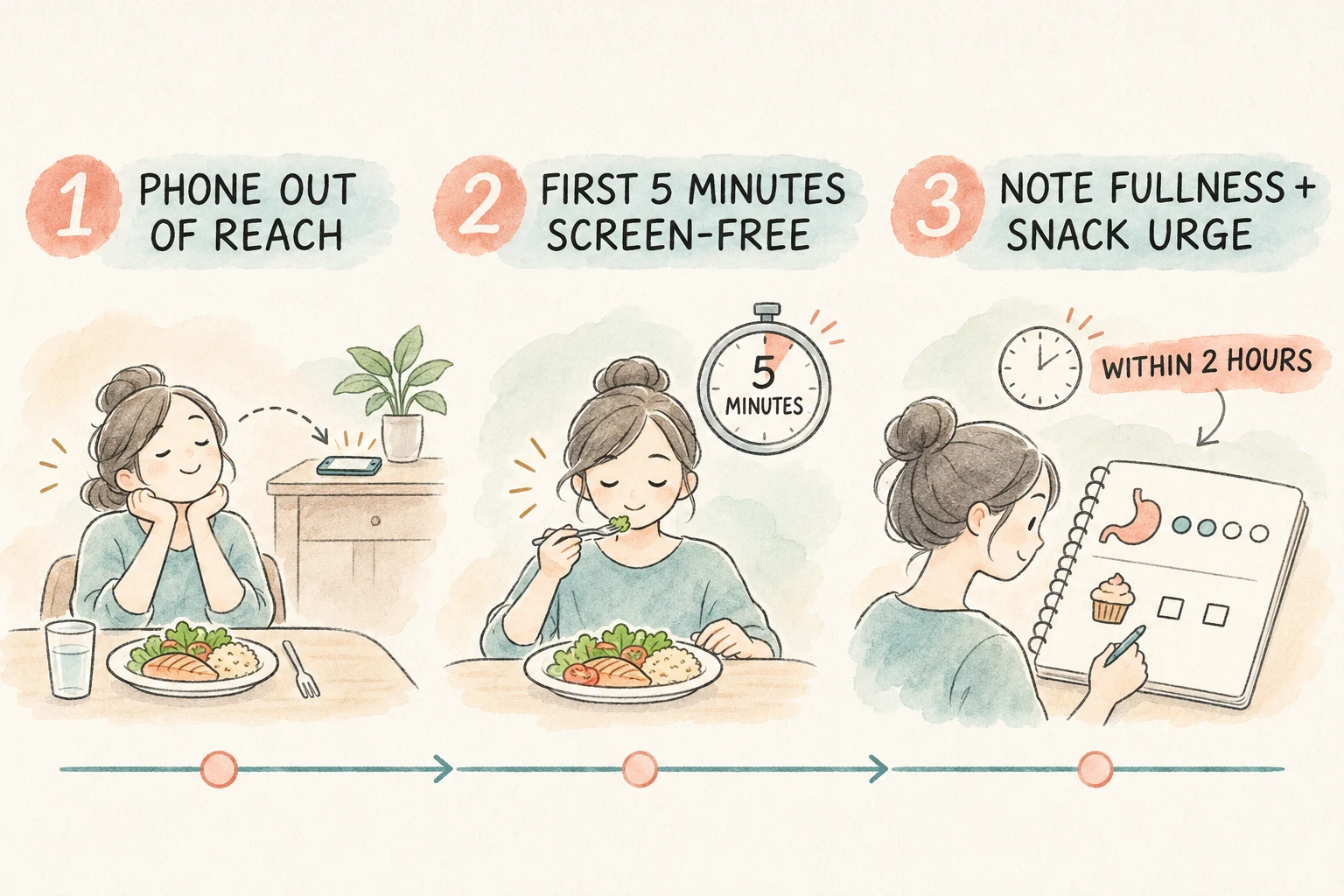
You do not need to turn every meal into a silent ritual. If you often look for a snack soon after dinner, compare two dinners that are similar in timing and portion. During one, use screens as usual. During the other, keep the first five minutes screen-free, then decide whether to turn the video on.
After each dinner, record three things: how full you feel, whether you can roughly name what you ate, and whether you want a snack within the next two hours. Keep the served portion normal. Do not deliberately eat less because you expect the screen-free meal to “work,” and do not treat a one-night difference as proof. Sleep, stress, the meal itself, and the starting portion can all change later appetite.
If a video provides welcome company while you eat alone, a smaller change may fit better: pause it until you put the utensils down, or practice with one meal rather than banning every screen. The evidence does not say that a phone on the table automatically causes weight gain. It supports a narrower conclusion: passive distraction may modestly increase intake during a meal, but the more consistent signal may emerge later, after the meal has left a weaker trace in memory.
References
[1] Gough T, et al. Eating while distracted: a systematic review and meta-analysis of the effect of distraction on concurrent and later energy intake in adults. Am J Clin Nutr. 2026;123(6):101315.
[2] Liguori CA, et al. Cognitive Distraction at Mealtime Decreases Amount Consumed in Healthy Young Adults: A Randomized Crossover Exploratory Study. J Nutr. 2020;150(5):1324–1329.
[3] Higgs S, Woodward M. Television watching during lunch increases afternoon snack intake of young women. Appetite. 2009;52(1):39–43.