
Why a Food Log Can Miss Part of What You Ate
Weighed records and next-day recall can miss items, quantities, and ingredients in different ways. Here's what researchers found and what a second look can recover.
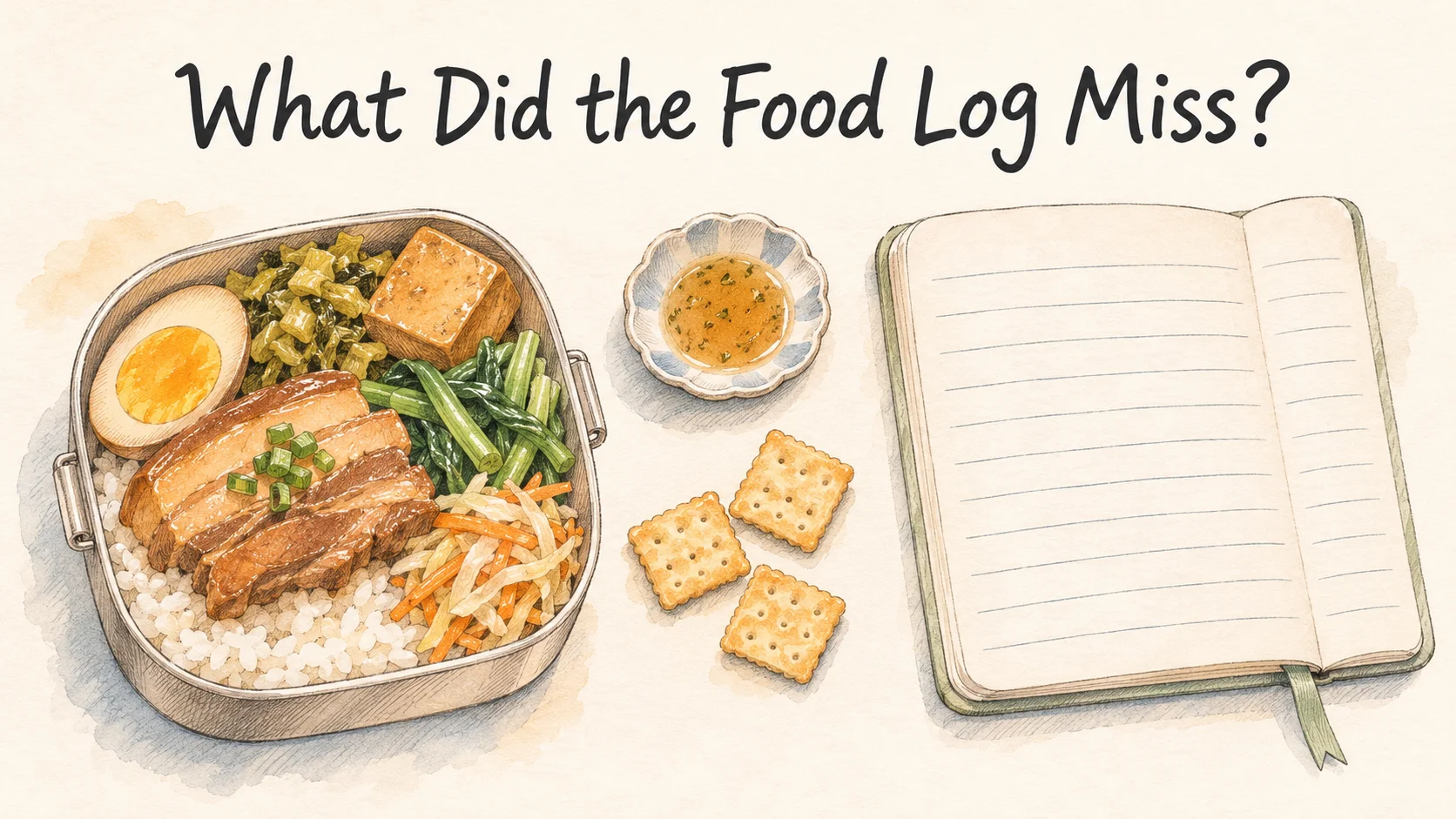
You look through your photos at night. The lunch bento is there, but the lid covers a little packet of sauce. The two crackers you tried at an afternoon meeting have no photo at all. A food log can miss an entire item, get the amount wrong, or list a food whose ingredients differ from what you ate. Researchers have measured all three by comparing people's records with food weighed independently [1][2].
You can still learn from a record with some gaps. To improve an entry, it helps to know what kind of detail is missing. A forgotten snack calls for a different question from a cup you remember drinking but cannot size from the photo.
How do researchers measure what people actually ate?
A 2018 analysis used data from 59 adults who lived in a Scottish nutrition research unit for 12 days. Each person had a kitchen space and access to familiar foods. They could choose what and how much to eat. Research staff weighed the food and drinks supplied to each kitchen. They also recovered and weighed leftovers, packaging, and waste. Subtracting what was left gave researchers a benchmark for what people ate and drank [1].
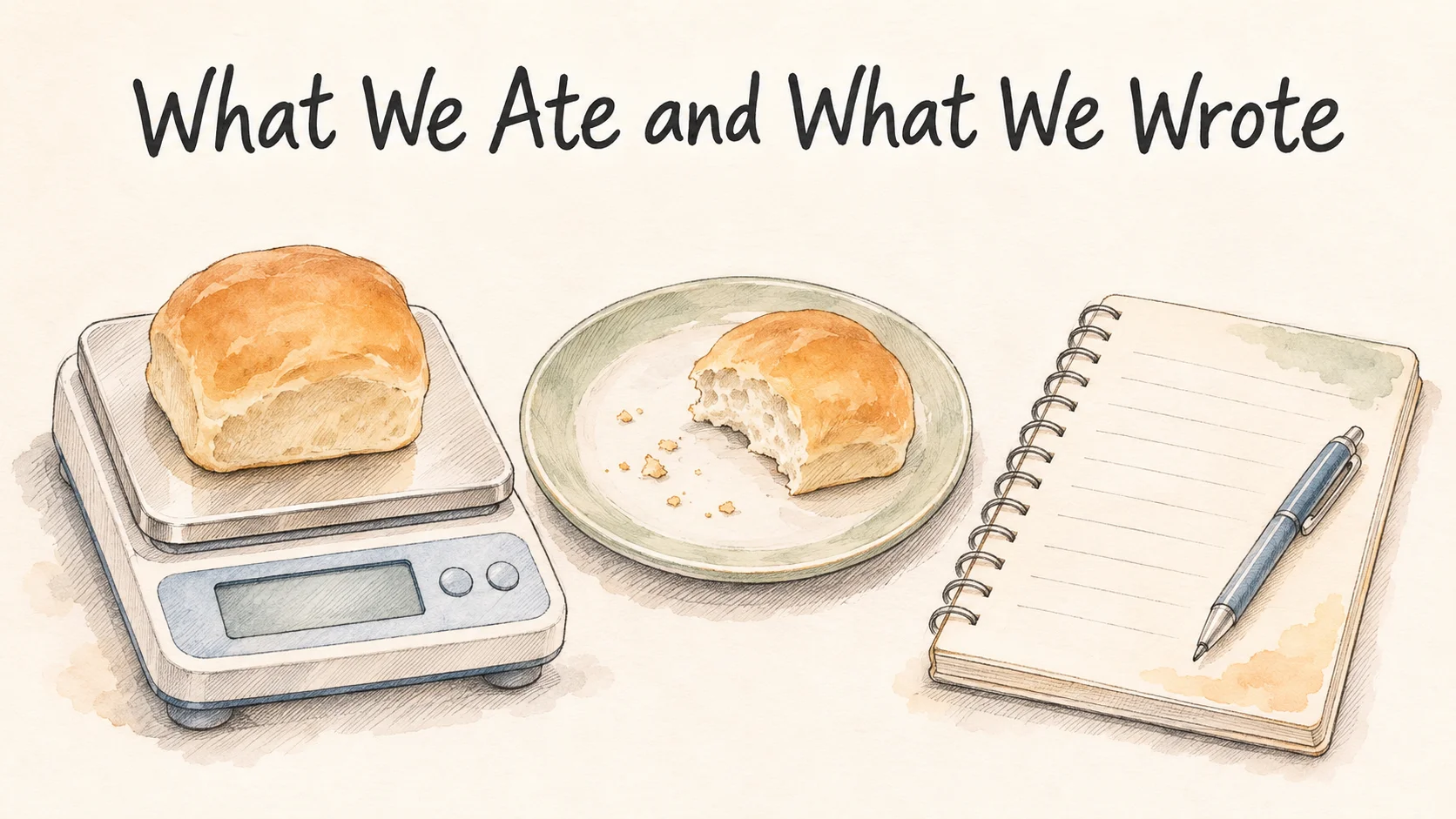
The analysis compared two three-day periods when participants also reported their own intake. They weighed items for a food record and the following day went through a 24-hour recall with a trained interviewer. The interviewer made several passes to gather a list, check times and amounts, and prompt for items that might have slipped their mind. Researchers could compare the record and the recall with the separately measured food for the same days [1].
The reference measurement averaged 3.6 kilograms of food and drinks per day. Participants' weighed records averaged 3.3 kilograms, and their next-day recalls averaged 3.0 kilograms [1].
Those figures include beverages, so the missing weight cannot be converted directly into missing calories. Three hundred grams of drinking water and the same weight of pastry differ greatly in energy. The team also calculated energy from the individual foods and drinks. On average, the weighed records were 5.1 percent below what people consumed and the next-day recalls were 10.1 percent below [1].
These are averages for a particular residential study. Participants had familiar food, could prepare meals themselves, and didn't eat out. At a café, you may know your order but have little information about how the filling or dressing was made. The group's average percentage will not tell you how much of your lunch went unrecorded.
The earlier report from the same project also compared days when people were asked to self-record with days when they were not. The staff measured intake either way. People actually ate about five percent less, on average, while keeping their own records [3]. This is a change in what they ate. Missing part of the food from a record is a separate change in what gets reported. A method can pick up one change and miss the other.
Forgetting the sauce and guessing the portion
Say an imaginary packet of sauce contains 80 calories. You use half of it. If the sauce never makes it into your entry, that's 40 calories missing. If you remember the sauce but log the whole packet, the entry is 40 calories too high. If you remember drinking half a cup of soy milk but select a different recipe, the estimate can be off even when the cup size is right.
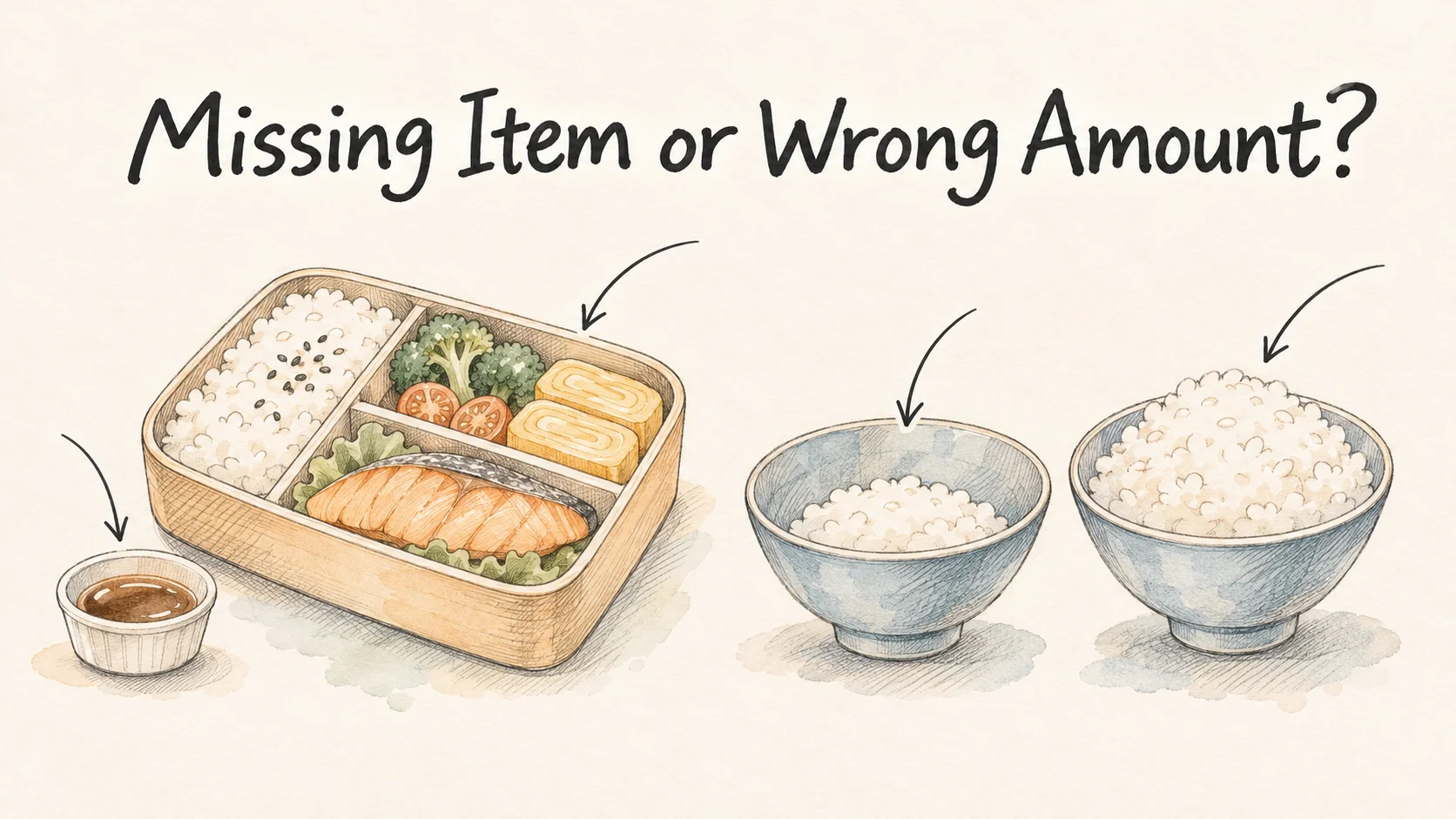
A small US study asked 12 men to choose what they wanted from the foods provided, then weighed what remained. Researchers compared next-day reports with the measurement and assigned discrepancies to four types. People forgot items, gave the wrong amount, described an item inaccurately, or reported something they had not eaten. Across food items in that experiment, omission and incorrect portion size each accounted for roughly a third of the statistical variation in reporting errors [2]. That's a share of the variation across errors, not a share of anyone's missing calories.
The amount can be wrong in either direction. A bowl you shared with a friend may look empty, even if you ate half. A second spoonful might be missing from a photo taken before the meal. Both are useful things to check, depending on what you want your record to show.
A total can look close even when individual items differ. Imagine that an entry overstates the rice by 40 calories but leaves out 40 calories of sauce. The two numerical errors cancel. The record still describes a different lunch from the one eaten. If you're looking for a source of sodium or protein, that difference matters even when the calorie total happens to match.
The Scottish team also found that some categories were more often underreported than others. Foods commonly considered healthy weren't reliably overreported, and items often described as unhealthy weren't consistently underreported [1]. Checking a record for small items and mixed dishes can help without making assumptions about what a person wants to include.
Make one second pass through the day
If you already keep a log and want it to describe your usual meals, start by making a quick note of the main items. Later, look back in time order. Think of the drink you picked up with breakfast, the little pot of dressing at lunch, the piece of fruit or cracker someone handed you in the afternoon, and what you tasted while making dinner. A photo can prompt a memory. A calendar entry or the place you were eating can do that, too.
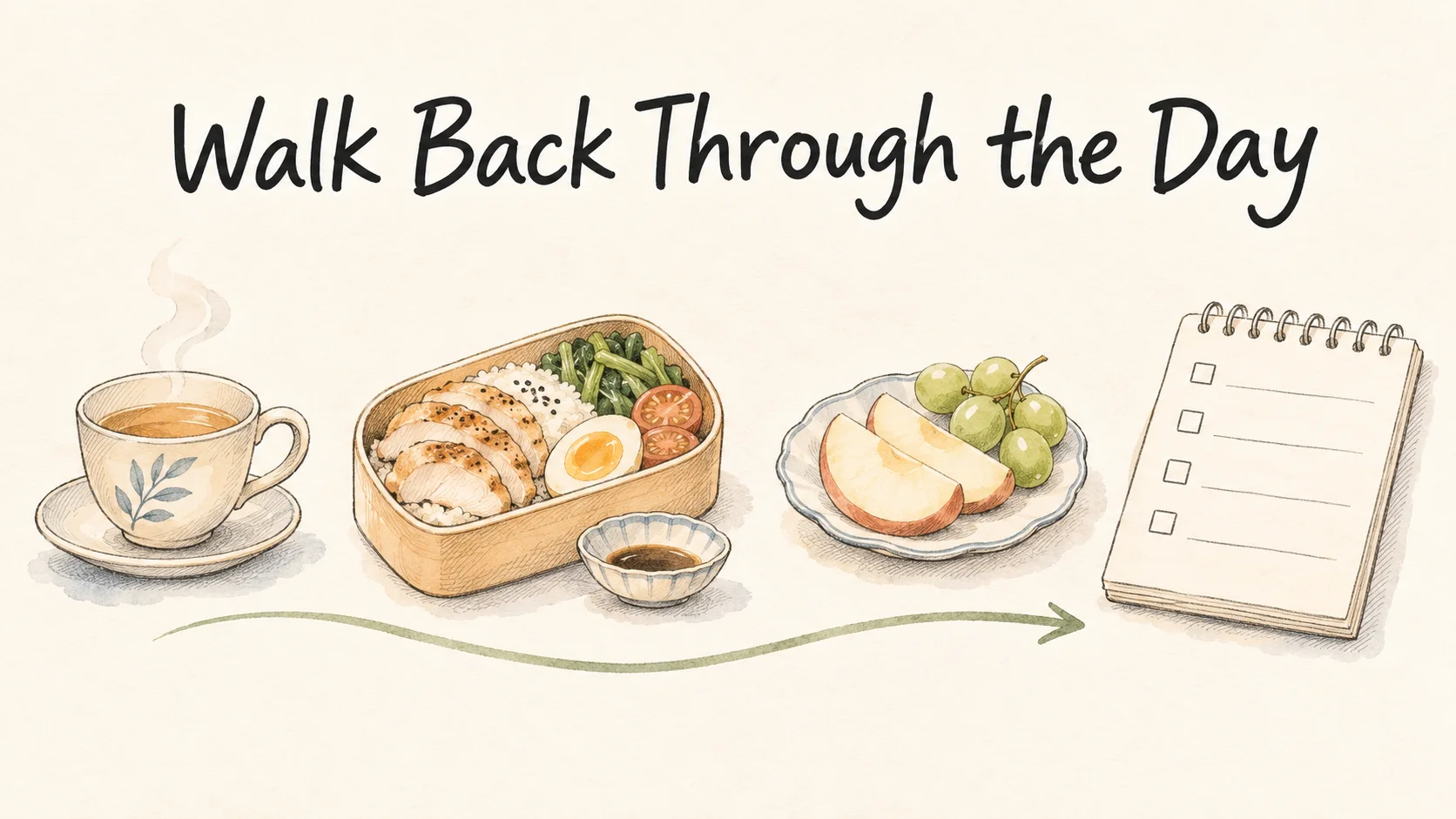
Add a detail if it answers the question you're asking. Suppose a photo shows a drink but hides the label. You might know it was about half the cup and be unsure of the recipe. Keep the half cup and leave the recipe open. If you remember that the sauce was mixed in and have no way to estimate the amount, you can still note that it was there. Later, you'll know which details came from memory, which were checked, and which are only estimates.
One way to make the second pass easier is to leave the package or a regular utensil in the first photo when that's convenient. The original photo is still useful when you can only estimate. A note about leftovers can tell you whether the photo shows what arrived or what you finished.
Back at the lunch photo, try remembering what happened between opening the box and clearing it away. Did you pour on a sauce, share the side, or leave some rice in the box? Recovering one actual detail tells you more about that meal than topping up your record with an average from a study.
Sources
[1] Garden L, Clark H, Whybrow S, Stubbs RJ. Is misreporting of dietary intake by weighed food records or 24-hour recalls food specific? Eur J Clin Nutr. 2018;72:1026–1034. Author manuscript.
[2] Rumpler WV, Kramer M, Rhodes DG, Moshfegh AJ, Paul DR. Identifying sources of reporting error using measured food intake. Eur J Clin Nutr. 2008;62(4):544–552.
[3] Stubbs RJ, et al. Measuring the difference between actual and reported food intakes in the context of energy balance under laboratory conditions. Br J Nutr. 2014;111(11):2032–2043.