
When a Bigger Serving Arrives, Do We Eat More?
Four servings of the same macaroni and cheese reveal how the amount offered differs from what we eat. An 11-day trial asks what happens when portions stay larger.
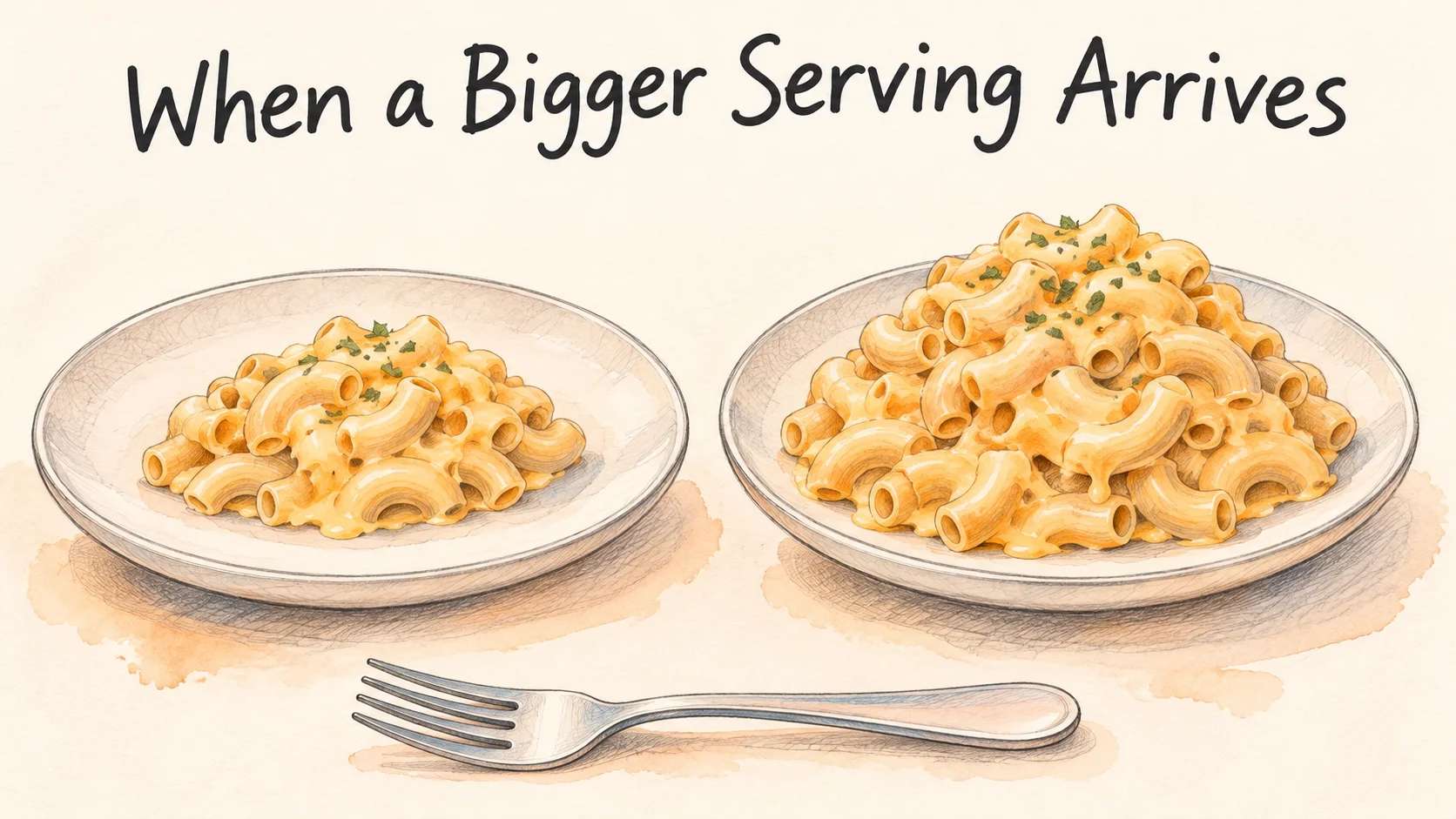
You get the same noodles from your usual lunch spot. This time, the plate arrives with a bigger pile. You eat until you're satisfied and leave a few bites. Even with food left on the plate, you might have eaten more than yesterday. In a controlled lunch experiment, doubling the amount of the same main dish offered led participants to eat about 30 percent more calories on average [1].
Say a small plate holds 300 grams of noodles and you finish it. A larger plate holds 450 grams. If you leave 100 grams on that plate, you still ate 350 grams. You left more food and ate 50 grams more. This is a hypothetical comparison that shows why researchers weigh what remains as well as what they serve.
How do you change the serving without changing lunch?
In 2002, a research team asked 51 young adults to eat lunch in a laboratory once a week for four weeks. The main dish was the same macaroni and cheese every time. The four amounts offered were 500, 625, 750, or 1,000 grams. Each person encountered all four amounts, so the researchers could compare the same person's lunch intake across portions. The experiment used these serving sizes to test a range, and people were free to stop eating when they wanted [1].
In one group, 27 people received their macaroni and cheese on a plate that the researchers had already filled. The other 24 served themselves from a dish placed on the table. For that group, the team had to account for two kinds of leftovers. Some food stayed in the serving dish. Some made it onto the plate without being eaten. Both stay out of the intake calculation [1].
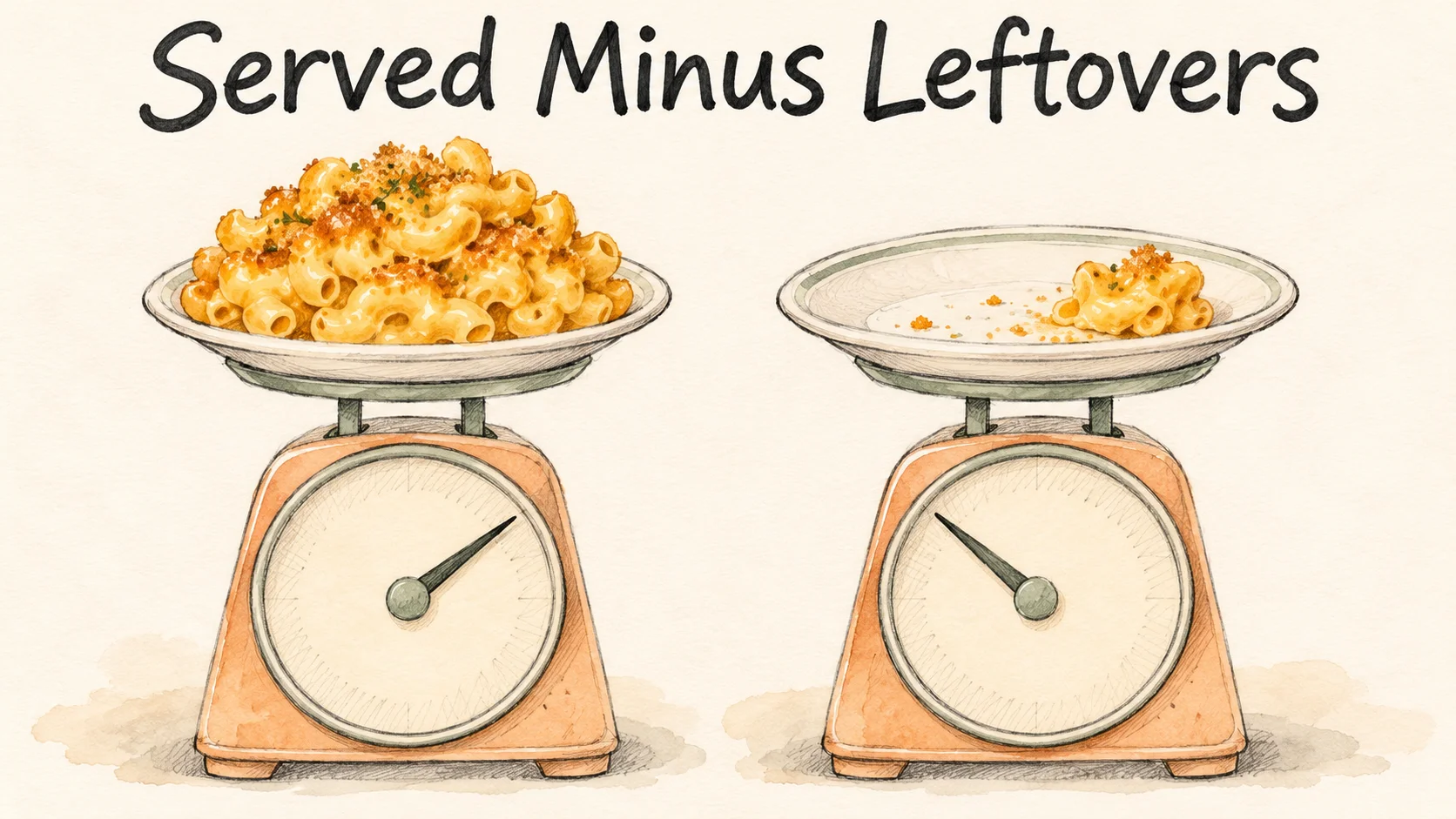
For an example, imagine a serving bowl starts with 500 grams. You put 350 on your plate, and 50 remains after lunch. You ate 300 grams. Uneaten food remains in two places, with 50 grams on the plate and 150 in the serving bowl.
A family meal works a little like the second setup. You can ask how much was in the shared bowl, how much you put on your plate, and how much you finished. Those amounts can all differ. In the study, the average increase in intake with the larger offering occurred when the researchers served the food and when participants served themselves. The amount already on a plate and the amount available at the table can both be worth noticing [1].
The researchers changed how much of the dish was offered. They did not make plate diameter the thing being tested. Serving the same food on smaller plates would need its own comparison.
Twice as much offered, about a third more eaten
When 1,000 grams of macaroni and cheese was available, participants ate about 30 percent more calories from it than when 500 grams was available. The average difference was about 162 calories [1].
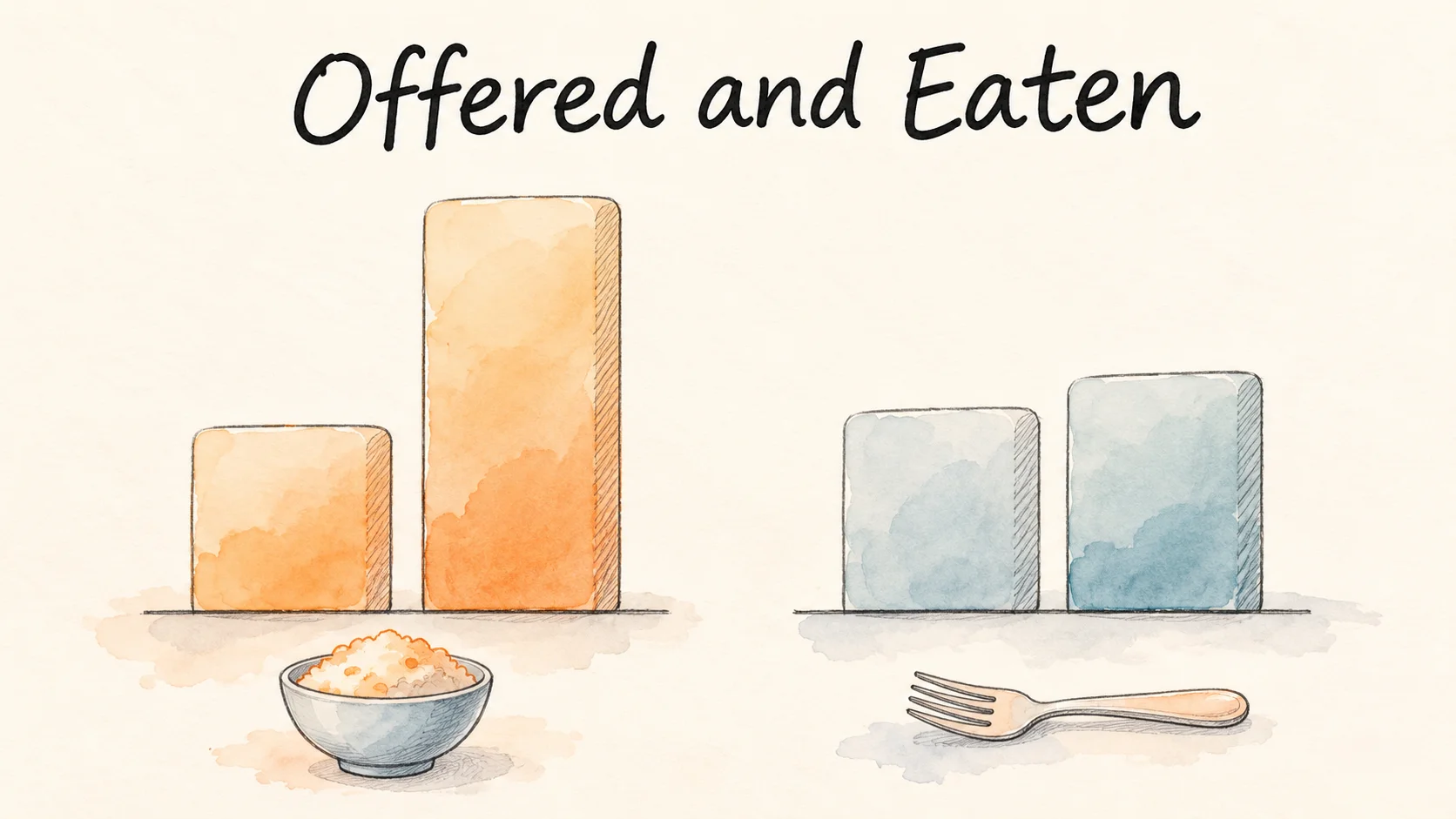
The two percentages refer to different measurements. To double the amount offered means going from 500 grams to 1,000. The 30 percent uses calories eaten in the small-portion condition as its base. If that lunch were about 540 calories, for example, 30 percent would be about 162. The 162 is the average difference between two study conditions. It doesn't give the difference you would see for a larger order of noodles in a restaurant.
The recipe was consistent, so the macaroni and cheese contained the same calories per gram in all four conditions. In a restaurant, a larger order might also come with more sauce, extra cheese, or a different side. Then there are changes in the kind and amount of food. The study used one recipe to get a clearer view of the amount alone [1].
The team also asked how hungry or full participants felt afterward. It did not find a significant difference between the serving conditions in those post-lunch ratings [1]. That was a separate measurement from the amount eaten. Someone who leaves food or gives the same fullness rating can still have eaten more at one lunch than another.
What happens when larger portions last more than one meal?
Another study gave 23 adults two sets of meals and snacks. Each set lasted 11 days. In one period, food and drinks containing calories were provided at the baseline size. In the other, the same menu was offered in portions 50 percent larger. The study team provided breakfast, lunch, dinner, and snacks, with most weekday meals eaten in the laboratory and weekend meals provided for home [2].
Participants ate 423 more calories a day on average in the larger-portion period. The difference did not clearly shrink during the 11 days. That number describes intake during a controlled stretch of meals. The study did not measure weight change between the start and end of the periods. Using 423 calories to predict what someone would gain in a year would require assuming the same larger portions and the same response every day for much longer than the study observed [2].
Intake also varied across foods. Main dishes and starches contributed more calories in the larger-portion period. The researchers didn't detect a clear change in calories from vegetable sides. This trial increased many things on the menu together. Adding one bowl of vegetables to a family meal would change a different part of the setting. To see whether a result applies to your lunch, check what the study changed at the whole table [2].
A lunch where only the rice serving is larger gives you one change to notice. A stretch with larger lunches, drinks, and afternoon snacks changes several things together. An experiment changes one of those combinations at a time.
Leave yourself the option to have more
If you're eating family-style at home, you can serve what you want to start with and leave the rest in a dish you can reach for again. If you're still hungry, help yourself to more. With takeout, you could put the amount you want now on a plate while the rest waits in its container. This makes the first serving visible and leaves room to adjust. When meals are shared, the leftovers on the table reflect what everyone ate.
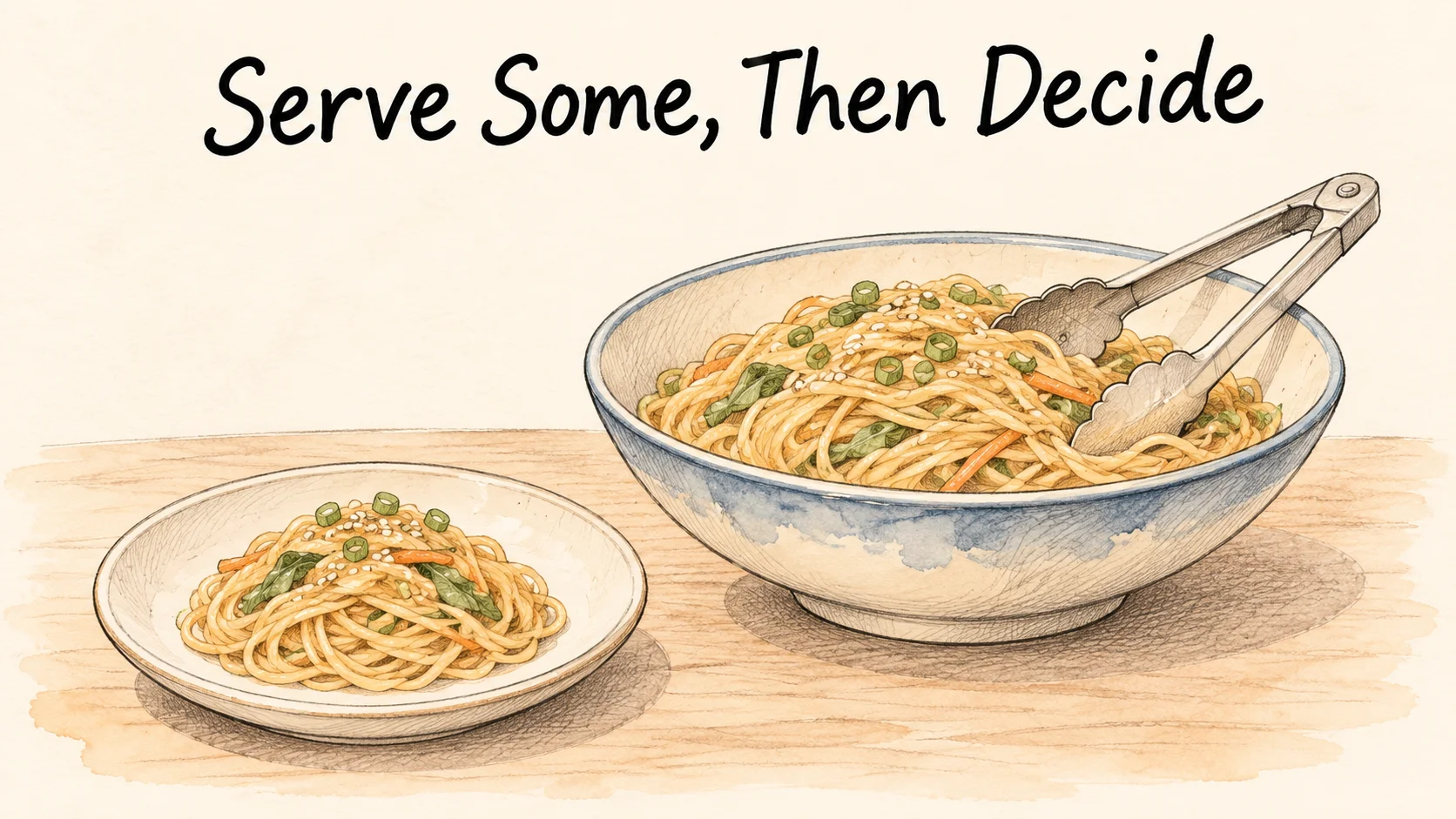
At your regular noodle shop, look at the ordinary and large portions you've actually bought. You may want the full large order for lunch or prefer to save a portion for later. If you want to see what fits, compare the same dish on ordinary days and notice both what remains and how you feel after eating. It's the amount that works for your lunch, including a second helping if you want one, that helps you make the next order.
Sources
[1] Rolls BJ, Morris EL, Roe LS. Portion size of food affects energy intake in normal-weight and overweight men and women. Am J Clin Nutr. 2002;76(6):1207–1213.
[2] Rolls BJ, Roe LS, Meengs JS. The effect of large portion sizes on energy intake is sustained for 11 days. Obesity. 2007;15(6):1535–1543.