
Why Does the Next Dish Look Good When You're Already Full?
Experiments with sandwiches and taste ratings show how the appeal of one food can fade during a meal while a different dish still looks inviting.

There is one bite of grilled meat left on your buffet plate. You don't particularly want more of it. A friend comes back from the counter with sliced watermelon, and suddenly a couple of bites sound appealing. A food can lose some of its appeal as you eat it, while a different flavor still seems inviting. Researchers saw a version of this when they served four short courses of sandwiches, either repeating the same filling or changing it from course to course [1][2].
Feeling satisfied and being curious about another taste can happen together. Researchers separated those reactions by asking people to rate several foods before and after making a meal out of just one.
One flavor can lose its appeal first
In a 1981 experiment, 32 people rated how pleasant eight foods tasted. At lunch, they ate one of the foods until they were satisfied. Two minutes and 20 minutes after the meal, they rated all eight tastes again. The pleasantness of the food they'd just eaten fell more than that of the foods they hadn't eaten [1]. Researchers call that relative change sensory-specific satiety. On the plate, it can feel like having had enough of one particular flavor.
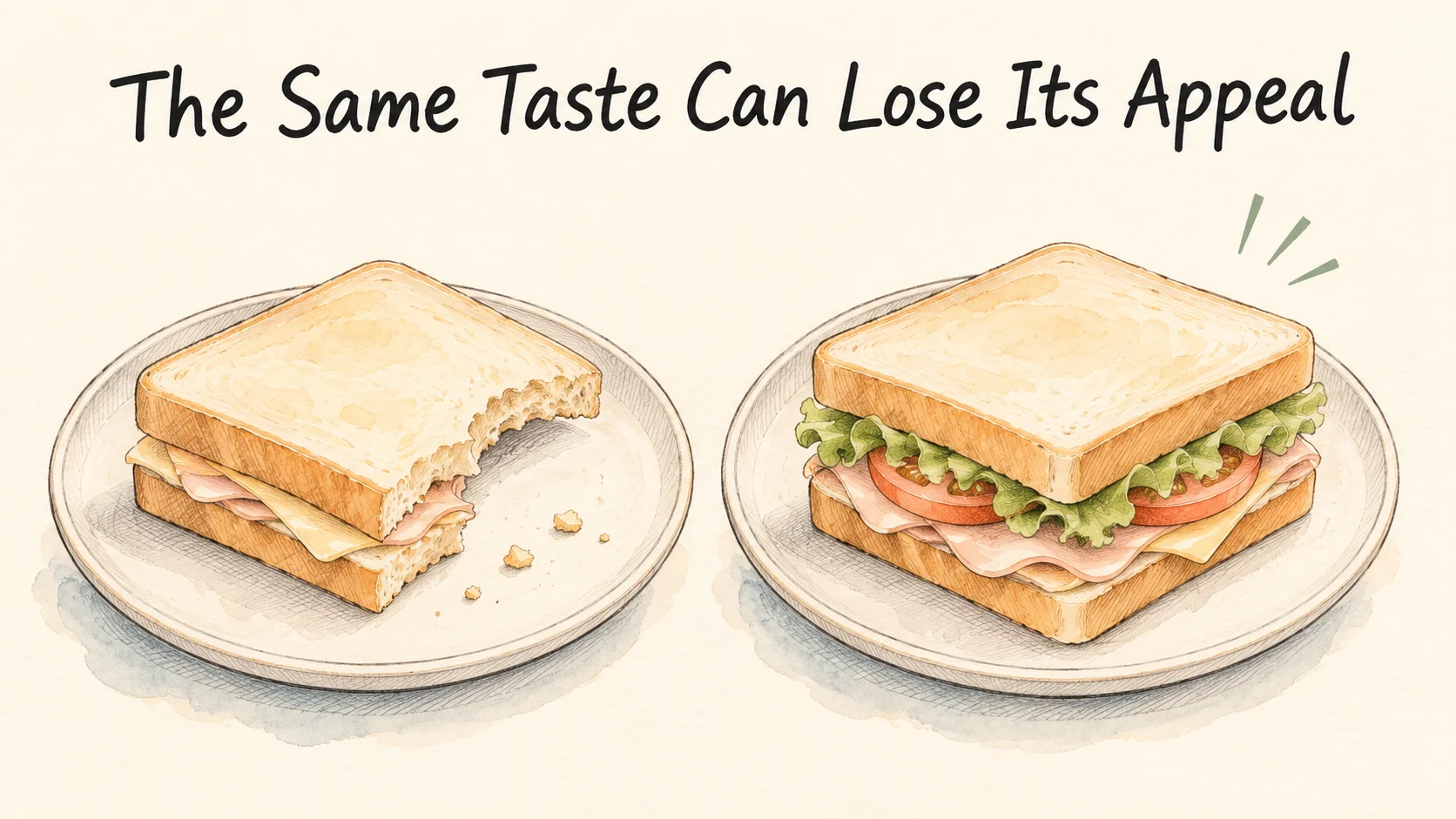
Think of the first bite of grilled meat on the buffet plate. A few bites later the recipe is the same, and it may still be warm. It just seems less appealing now. The study compared people's ratings of the tastes over a meal. It didn't ask whether they would like to order the same food again the following day. Losing interest during dinner can be a short-lived change.
The relative part matters too. You can be less interested in eating in general than you were at the start of the meal and still be more interested in the watermelon than in another piece of the food you just ate. Both reactions can show up together. The tasting experiment let the team compare changes in how people liked specific foods even after appetite had changed over the meal.
That first paper included another experiment with 24 people. They ate either sausage or cheese on crackers, rated the foods again two minutes later, and then unexpectedly received a second course. Some got the same food and some got the other one. Those who received a different food ate more calories in the second course. The ratings and the amount eaten gave the team two ways to observe what had changed [1].
The second sandwich course is where the meals diverged
A related experiment gave 36 female nursing students, aged 18 to 25, two lunches a week apart. Each lunch had four eight-minute courses. On one day, all four courses featured the same filling. On the other day, the courses featured four different fillings, chosen from ham, egg, cheese, and tomato. Each plate was removed before the next one arrived, and participants could eat as much of the current course as they wanted [2].
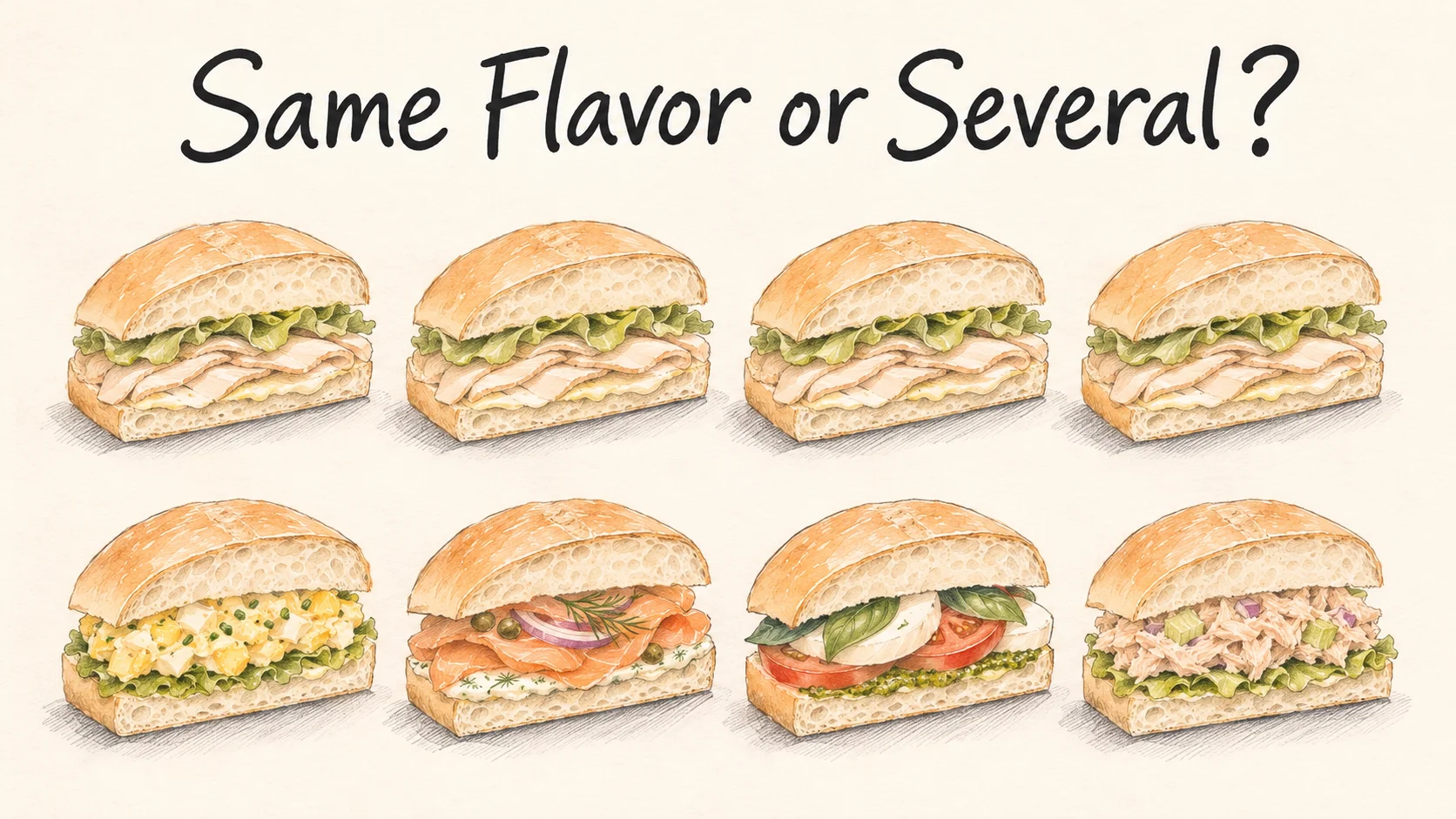
The amounts eaten didn't clearly differ in the first course, before the variation started. Students ate more in courses two, three, and four on the day the filling changed. Across the lunch, they ate about a third more by weight when they were offered four different fillings [2].
For an everyday illustration, suppose the meal with one repeated filling comes to 240 grams. A third more is another 80 grams, taking you to 320. Those are made-up weights to show what the fraction means. In the study, the team used the number of pieces eaten and the average weight for each type of sandwich. The ingredients in each sandwich were not weighed closely enough to calculate total energy intake. That result describes a difference in estimated food weight [2].
There was no menu of coming courses at the table. The researchers could watch how intake changed when the next sandwich arrived. A restaurant counter is different. You can see the fruit and dessert before you eat a bite, and those plans can already affect which foods you choose.
Perhaps people simply got their favorite filling on the more varied day. The researchers compared the same filling for the same person in the same later course and still found higher intake in the varied condition. They also divided the average amount eaten in the later courses by the amount each person ate in the first. By that measure, 30 of the 36 people ate relatively more on the varied day, while the other six went in the opposite direction. The group result leaves room for the two lunches to play out in different ways for different people [2].
Does any kind of variety do the same thing?
The same paper reported two experiments that each enrolled 24 participants. One compared hazelnut, blackcurrant, and orange yogurts, which differed in taste, texture, and color. Participants ate more when the flavors changed from course to course than when one flavor was repeated, even if the repeated flavor was their favorite. The other experiment used more similar strawberry, raspberry, and cherry yogurts. There, the researchers didn't detect an increase when the three flavors took turns [2].
The two yogurt experiments were separate comparisons. They show that going from one repeated flavor to three does not produce the same result with every set of flavors. How the foods differ is part of the comparison.
The number of options doesn't tell you how different they are to eat. Two dessert counters can each have six dishes. One might have six versions of the same kind of cake. Another might have warm pudding, fresh fruit, and a few crisp pastries. The names on the signs offer only part of what you'd experience from one bite to the next. The studies give examples of how sensory differences can matter within a meal.
Take a look around before your first plate
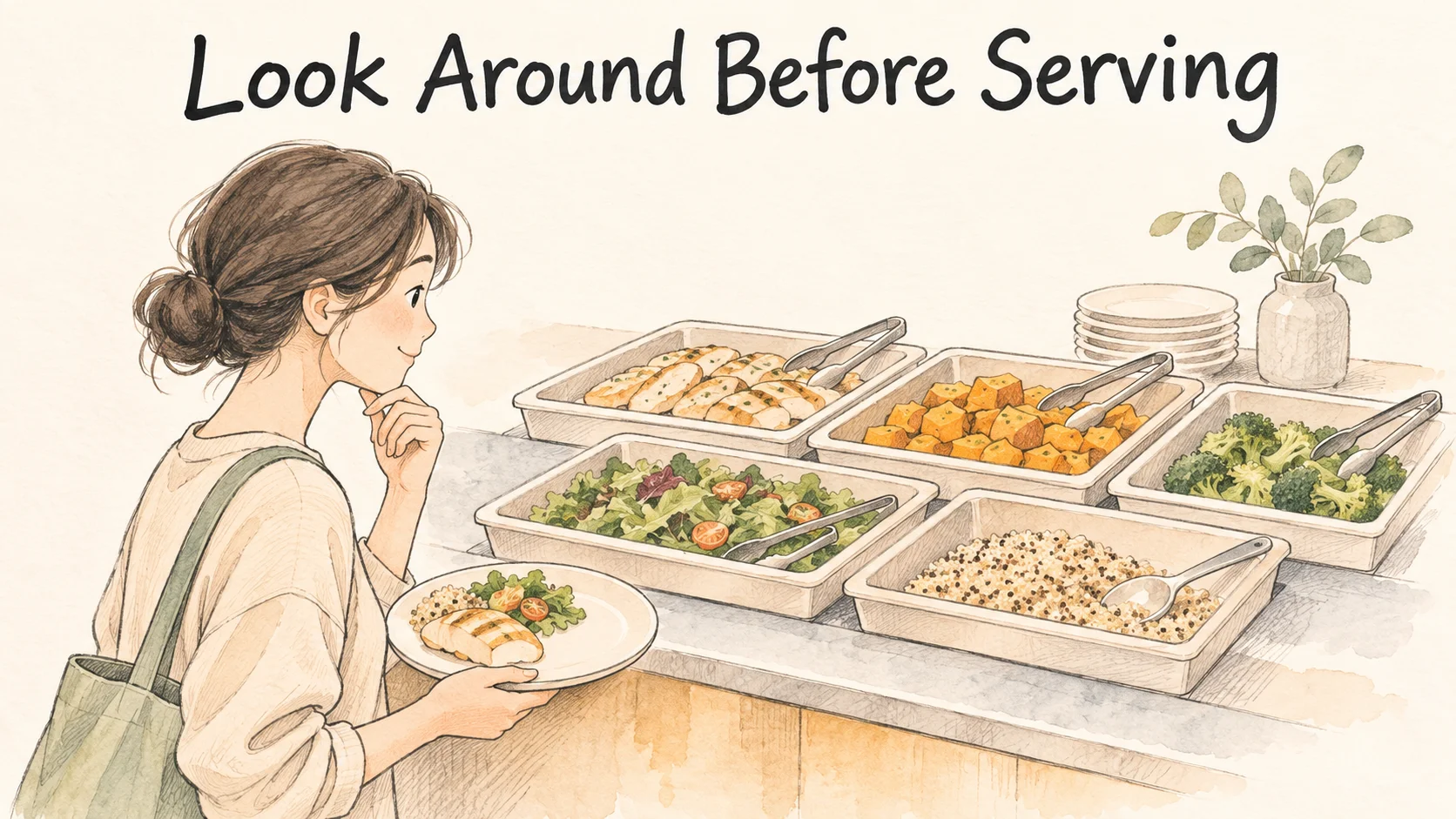
At a buffet, you can walk around the counter before you start to serve. Look for the dishes you'd want to try and put the ones that sound good now on your first plate. If a second helping still sounds good when you're done, you can go back. This is a way to make a choice with more information. The sandwich study did not compare plate sizes or test any particular order for taking food at a restaurant.
When you get back to that piece of grilled meat, think about whether you're generally satisfied or whether you've just had enough of that one flavor. You might still like the idea of tasting the watermelon, or decide you are done. Either way, you'll know a little more about what made the next dish interesting.
Sources
[1] Rolls BJ, Rolls ET, Rowe EA, Sweeney K. Sensory specific satiety in man. Physiol Behav. 1981;27(1):137–142.
[2] Rolls BJ, Rowe EA, Rolls ET, Kingston B, Megson A, Gunary R. Variety in a meal enhances food intake in man. Physiol Behav. 1981;26(2):215–221.