
Can a Warm Bath Before Bed Help You Fall Asleep Faster?
In a 23-person home experiment, a longer 40°C bath completed 1.5–2 hours before bed was followed by sleep onset about eight minutes sooner than a shower.
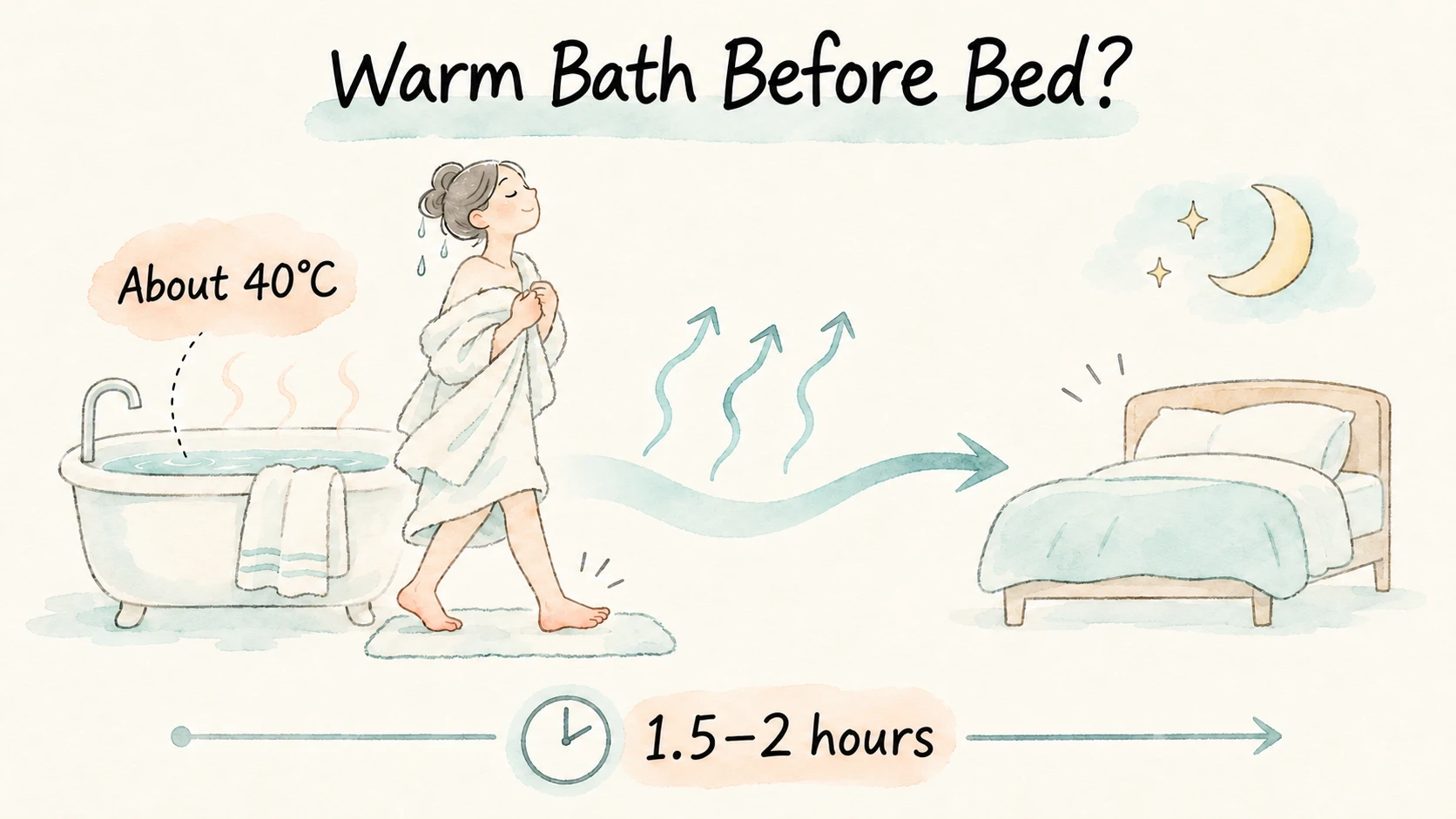
You plan to be asleep by 11:30 p.m. At 11:20, you step out of a very hot shower, climb into bed, and discover that you are still sweating. Wasn't hot water supposed to help you sleep?
It may help a little, but hotter and closer to bedtime are not necessarily better. The pattern most consistently supported by the research is a comfortably warm shower or bath lasting at least 10 minutes and ending one to two hours before bed. Warming the skin of your hands and feet, then leaving time for heat to escape, may be more useful than carrying that heat straight under the covers [1].
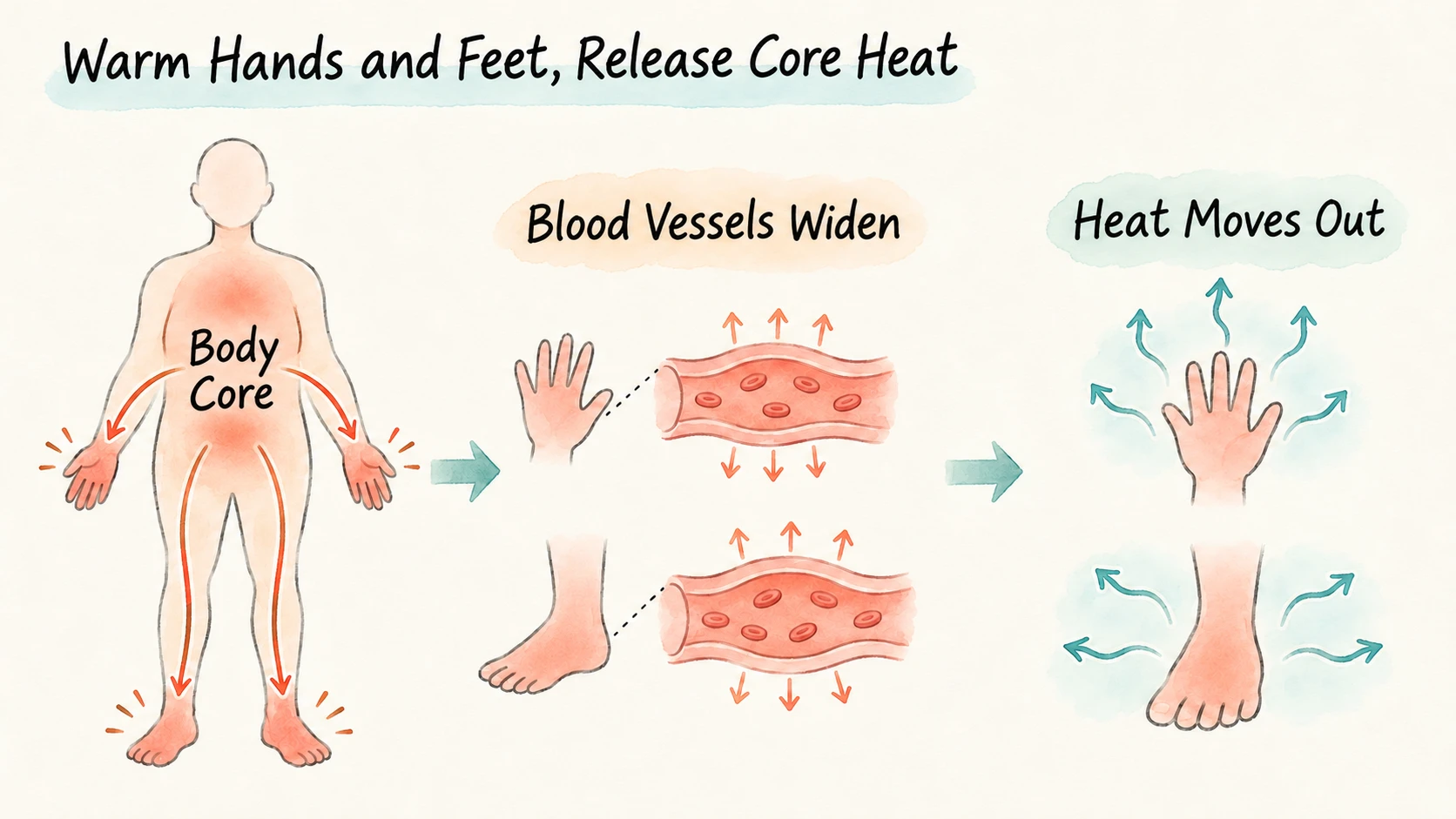
How can warming up help you cool down?
As sleep approaches, temperature inside the body normally begins to fall. The palms and soles contain blood vessels that can rapidly change skin blood flow. When those vessels widen and the extremities warm, blood carries heat from the core toward the surface, where it can be released into the environment [1, 2].
Researchers often describe this process with the distal-to-proximal skin temperature gradient. In plain language, they compare the temperature of an extremity, such as the top of the foot, with the temperature of the trunk. A warmer foot relative to the chest generally indicates more peripheral vasodilation. The body is not becoming cold all at once: heat first moves outward, then leaves through the skin. A bath supplies a controlled pulse of heat; the cooling period after you leave the bathroom is the part that lines up with sleep onset.
That is why a warm bath and an overheated bedroom are not equivalent. A stuffy room makes it harder for the skin to give heat to the surroundings. A bath taken earlier may warm the extremities while still leaving a cooler interval for heat loss. The water does not need to be scalding. The review covered water around 40–42.5°C (104–108.5°F), not temperatures that redden the skin or make you feel unwell [1].
Twenty-three adults tried three bathing routines at home
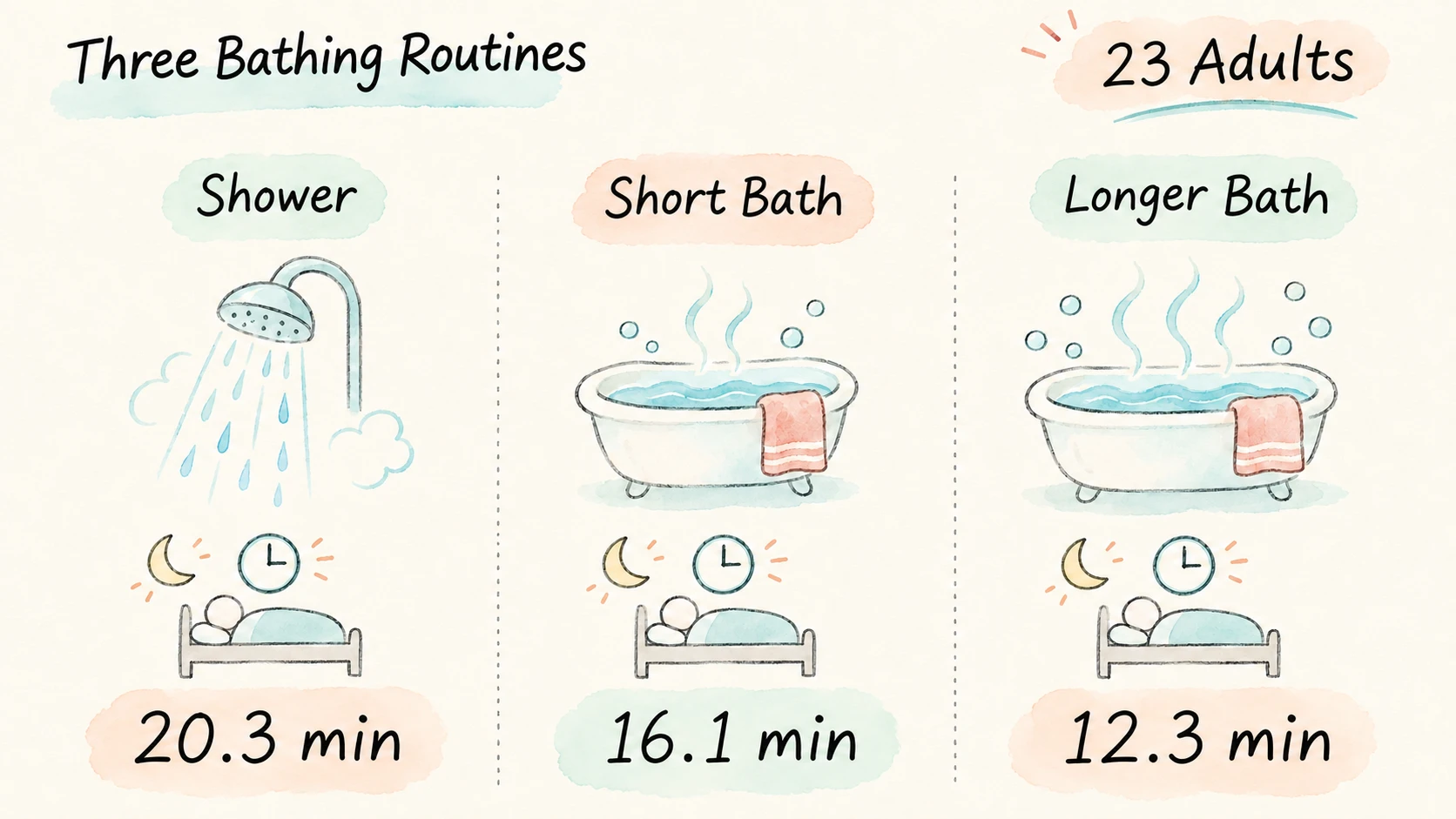
In a 2023 crossover experiment, 23 adults aged 23 to 54 with regular sleep schedules completed three conditions in their own homes, in randomized order: showering only, a short soak, and a longer soak. The water was about 40°C in every condition, and bathing began 1.5 to 2 hours before bedtime. The short baths averaged 5.2 minutes; the longer baths averaged 16.1 minutes. A waist-worn activity monitor estimated when each person fell asleep [2].
After showering, estimated sleep-onset latency—the time from going to bed to falling asleep—averaged 20.3 minutes. It averaged 16.1 minutes after the short bath and 12.3 minutes after the longer bath. The approximately eight-minute difference between the longer bath and shower conditions was statistically significant. The short-bath result sat between them, but this experiment alone cannot establish that a five-minute soak reliably works [2].
The longer bath raised sublingual temperature by an average of 0.91°C; from the end of the bath to bedtime, it then fell by 0.94°C. The corresponding post-shower decline was 0.66°C. Sublingual temperature is only a proxy for core temperature, not a direct rectal or esophageal measurement. Still, the longer bath also left the top of the foot warmer relative to the chest, which fits the proposed sequence of peripheral vasodilation followed by heat loss [2].
Two outcomes did not clearly change. Sleep efficiency—the proportion of time in bed estimated as asleep—and wake time after sleep onset were not significantly different across the three conditions. The study supports a narrower conclusion: a well-timed bath may help sleep begin sooner. It does not show that bathing adds hours of sleep, treats insomnia, or improves every stage of the night [2].
What do other studies say about the one-to-two-hour window?
A systematic review identified 17 studies, 13 of which contributed data to the meta-analysis. Taken together, they supported an association between water-based warming at 40–42.5°C, for at least 10 minutes and scheduled one to two hours before bed, and shorter sleep-onset latency, better sleep efficiency, and better self-rated sleep quality. But the evidence base was small. Studies differed in water exposure, timing, participants, and measurement methods [1].
A larger home study followed 1,094 Japanese adults with a mean age of 72 across 2,139 nights. When participants soaked for at least 10 minutes and finished 61–120 minutes before bed, median actigraphy-estimated sleep onset was 13.5 minutes. Finishing 121–180 minutes before bed corresponded to 12 minutes. On nights without a bath, the median was 18 minutes. The analysis adjusted for several differences, but bathing was not randomly assigned. Earlier bathers may have differed in other parts of their routine, so this remains an association rather than proof of cause [3].
There is also useful negative evidence. In a randomized crossover trial, 25 older adults used a 40°C footbath for 20 minutes. Their feet warmed, and core temperature rose, but polysomnography and self-rated sleep did not significantly improve. Warm feet alone do not guarantee faster sleep that night. The area heated, the population, and the person's baseline sleep may all matter [4].
Put the finding on tonight's timeline
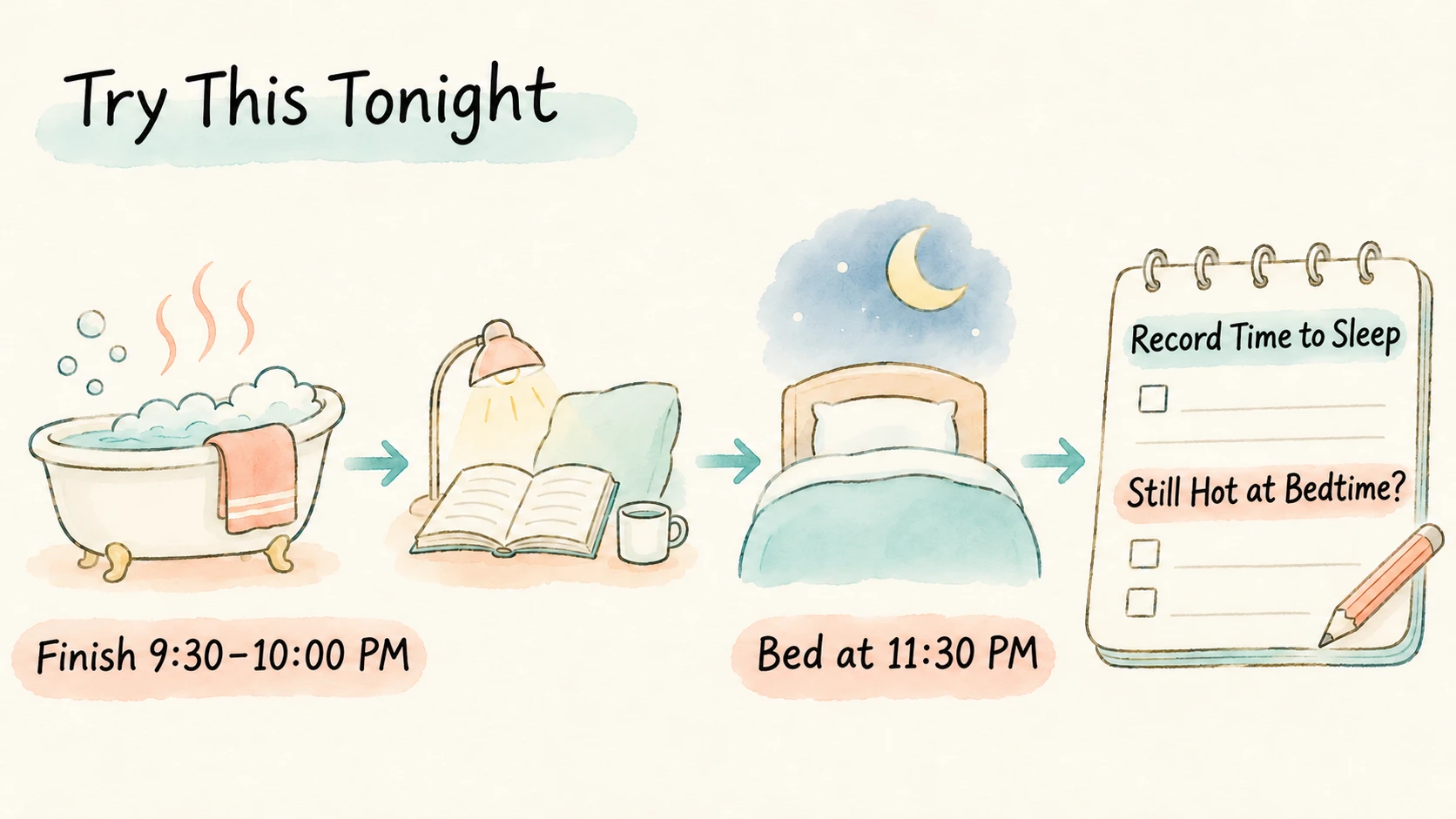
If you normally go to bed at 11:30 p.m., try finishing your bath around 9:30–10:00 p.m. Use comfortably warm water rather than chasing the highest tolerable temperature. To resemble the research, a soak of roughly 10–20 minutes is reasonable. Afterward, change into dry clothing and follow your normal wind-down routine in a room that does not feel stuffy.
For a simple home comparison, record just three numbers: when the bath ended, when you went to bed, and how long you think it took to fall asleep. Add one note: did you still feel hot when you got into bed? For example: bath ended at 9:50, bed at 11:30, asleep in about 15 minutes. Compare that with a shower-only night with a similar bedtime. A wearable's sleep onset is still an estimate, so a three-minute difference on one night is not a verdict. Look for a consistent direction across several nights.
Stop if you feel dizzy, develop palpitations, or notice painful skin heat, and cool down gradually. A very hot, prolonged bath is not a good solo experiment for someone prone to fainting, unsteady on their feet, drinking alcohol, or managing a cardiovascular condition that limits heat exposure. A warm bath can be a small sleep experiment. If difficulty sleeping keeps affecting daytime life, it deserves professional assessment—not ever-hotter water.
References
[1] Haghayegh S, et al. Before-bedtime passive body heating by warm shower or bath to improve sleep: A systematic review and meta-analysis. Sleep Med Rev. 2019;46:124–135.
[2] Maeda T, et al. Effects of bathing-induced changes in body temperature on sleep. J Physiol Anthropol. 2023;42:20.
[3] Tai Y, et al. Hot-water bathing before bedtime and shorter sleep onset latency are accompanied by a higher distal-proximal skin temperature gradient in older adults. J Clin Sleep Med. 2021;17(6):1257–1266.
[4] Liao WC, et al. Effect of a warm footbath before bedtime on body temperature and sleep in older adults with good and poor sleep: an experimental crossover trial. Int J Nurs Stud. 2013;50(12):1607–1616.