
You Lost 3 Kilograms. Did Short Sleep Change How Much Was Fat?
A change on the scale can hide differences in body composition. Three human studies show what short sleep changed in the lab and at home.
You've been eating less for two weeks, and the scale says you're about 3 kilograms lighter. Several nights that week, work kept you up past midnight. If the weight came off anyway, did those short nights make a difference?
They can change what comes off. In a small University of Chicago experiment, the same people followed the same calorie restriction twice and lost about 3 kilograms each time. When they had more time to sleep, they lost 1.4 kilograms of fat on average. When they had less time to sleep, they lost 0.6 kilograms of fat [1].
What goes into the number on the scale?
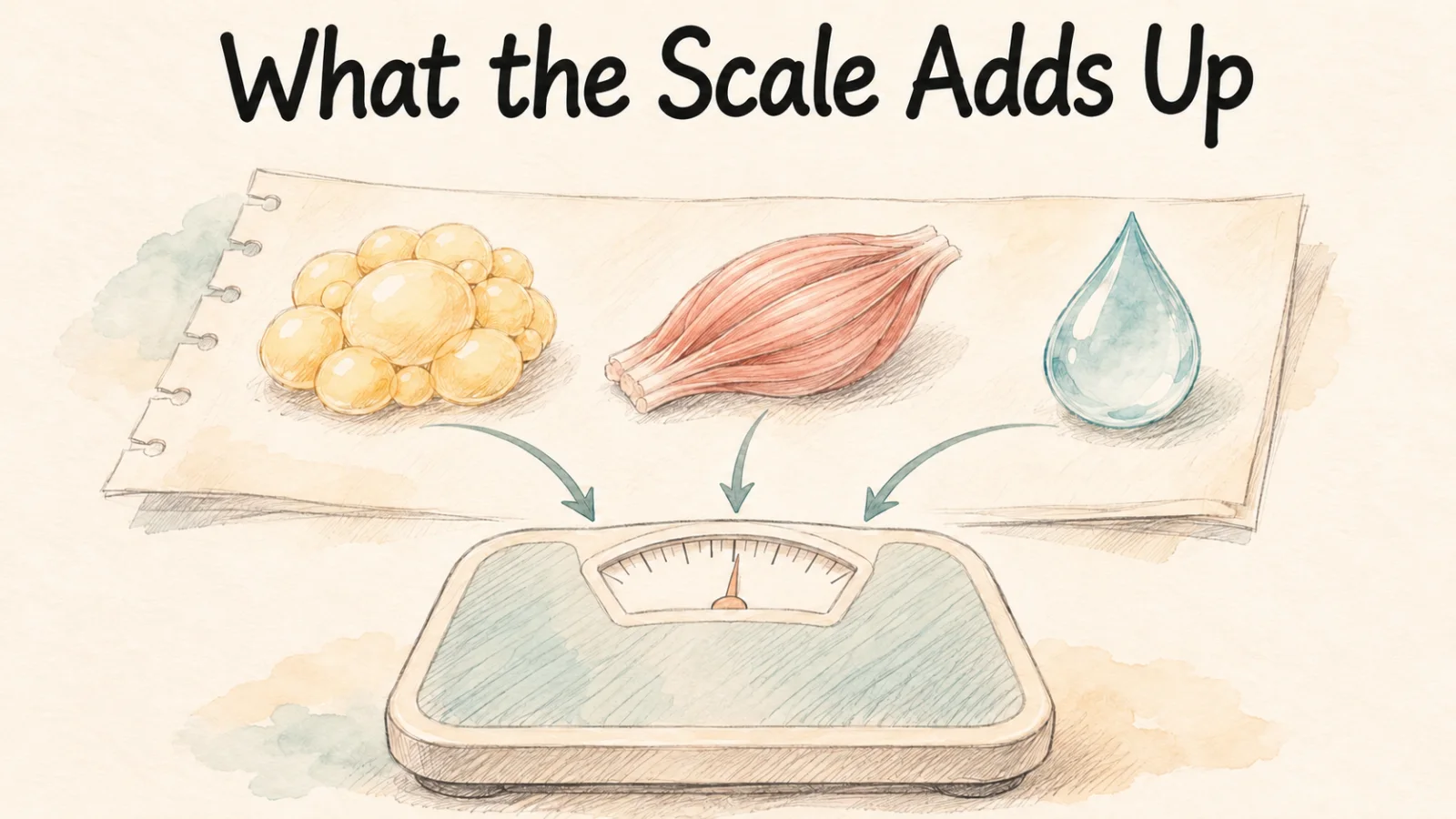
Put two bags of groceries on a scale. One is mostly potatoes. The other is mostly apples. Both can weigh 3 kilograms, and the scale will give you the same answer. To find out how many potatoes you bought, you have to weigh those separately.
Bathroom scales give you that same kind of number: the combined weight of fat, muscle, water, bones, and everything else. Body composition studies often report fat mass and fat-free mass. The second term covers all the weight left after accounting for fat, so muscle and water both count. If a study reports 2 kilograms less fat-free mass, you'd need another measurement to tell how much of that change came from muscle [1].
Same diet, same weight loss, different amounts of fat
In 2010, University of Chicago researchers brought 10 adults with overweight into a sleep lab. They were 41 years old on average. Each person completed two 14-day periods on the same calorie restriction. In one period, they had 8.5 hours in bed each night. In the other, they had 5.5. Researchers assigned the order randomly, so they could compare each person with themselves under both schedules [1].
Those were hours available for sleep. Time in bed includes the minutes you spend taking the pillow apart and flipping it over, plus any time you lie awake after the lights go out. The researchers measured actual sleep separately. Participants averaged 7 hours and 25 minutes of sleep on the longer schedule and 5 hours and 14 minutes on the shorter one. The actual difference was about 2 hours and 11 minutes a night [1].
| Average change after 14 days | 8.5 hours in bed | 5.5 hours in bed |
|---|---|---|
| Fat lost | 1.4 kg | 0.6 kg |
| Fat-free mass lost | 1.5 kg | 2.4 kg |
| Share of weight lost as fat | 56% | 25% |
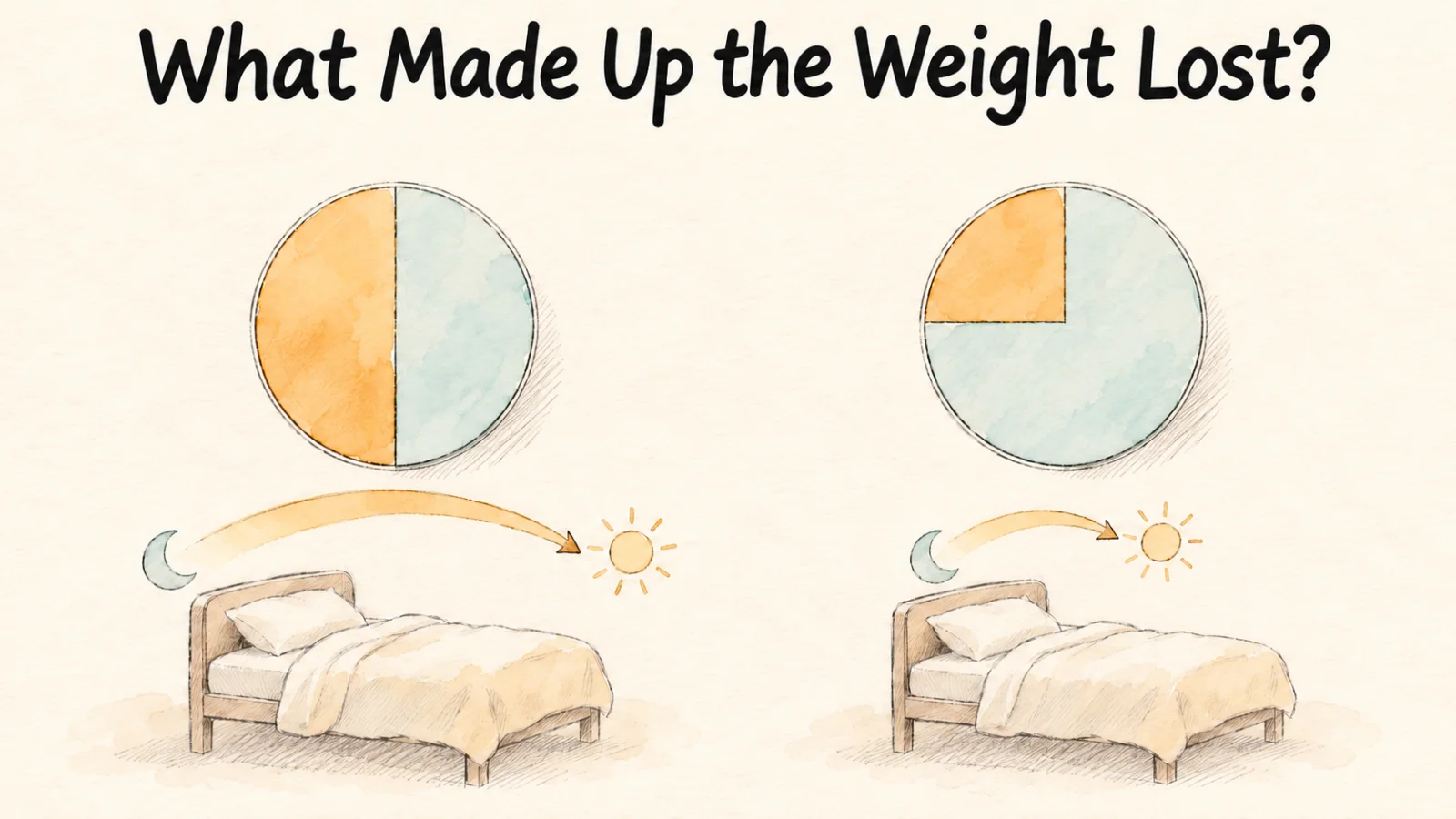
The orange area represents fat. The longer sleep opportunity is on the left. The figures in the table give the study averages.
The last row takes a second look. The researchers calculated the share of weight lost as fat for each person and then averaged those shares. From 56% to 25% is a gap of 31 percentage points. Relative to the original 56%, the share fell by about 55%. The rows above it average the kilograms lost. Those are two different ways of summarizing the same set of participants [1].
What the study can tell you. This was a two-week comparison in 10 people under controlled conditions. It measured a difference in body composition during calorie restriction. It didn't measure how much skeletal muscle each person lost or follow them for several months [1].
At home, does eating stay the same?
People in the first study reported feeling hungrier on the shorter sleep schedule. The lab had already set their meals, so there was no way to find out whether they would have eaten more when left to their own devices. A later University of Chicago study looked at what happened when people lived and ate as usual at home [1][2].
Published in 2022, the trial analyzed 80 adults with overweight who usually slept less than 6.5 hours a night. Half received personalized guidance to make more time for sleep. The other half carried on with their usual sleep schedule. Both groups chose what to eat and how much to exercise [2].
After two weeks, the group given sleep guidance slept about 1.2 hours longer per night than the comparison group. Compared with its own starting point, that group took in an estimated 156 fewer calories per day. The group that kept its usual schedule took in about 115 more calories per day. The researchers reported the difference between those changes as about 270 calories. Think of two lines moving away from their starting points and 270 as the gap between the movements [2].
To estimate intake without asking people to write down every bite, the team measured energy expenditure with doubly labeled water, then combined it with changes in body weight and composition. The change in total energy expenditure did not differ significantly between groups. The trial describes a two-week period in people who usually slept short hours. It leaves open how long the difference would last [2].
If short sleep raises weight, how much of the gain is fat?
A Columbia University team combined two randomized crossover trials in 2026. The analysis involved 95 adults at elevated cardiometabolic risk who usually slept at least seven hours. They completed a six-week period with adequate sleep and another with restricted sleep. During the shorter schedule, they slept about 78 minutes less per night and weighed 0.45 kilograms more on average. That's roughly the weight of 450 milliliters of water. MRI measurements showed nearly the same proportion of whole-body volume made up of fat tissue in both conditions [3].
The lab study at the beginning put people on a calorie-restricted diet and measured what made up the weight they lost. The Columbia trials changed people's sleep without asking them to lose weight. Each result makes sense alongside the instructions the researchers gave and the measurements they took.
Try a seven-day observation
If you're already tracking your eating or weight, spend a week noting roughly when you went to bed and got up. Add the time of dinner, any late-night snack, and your first meal the next day if you remember them. If you already weigh yourself, use the same scale at a similar time of day for a more consistent comparison.
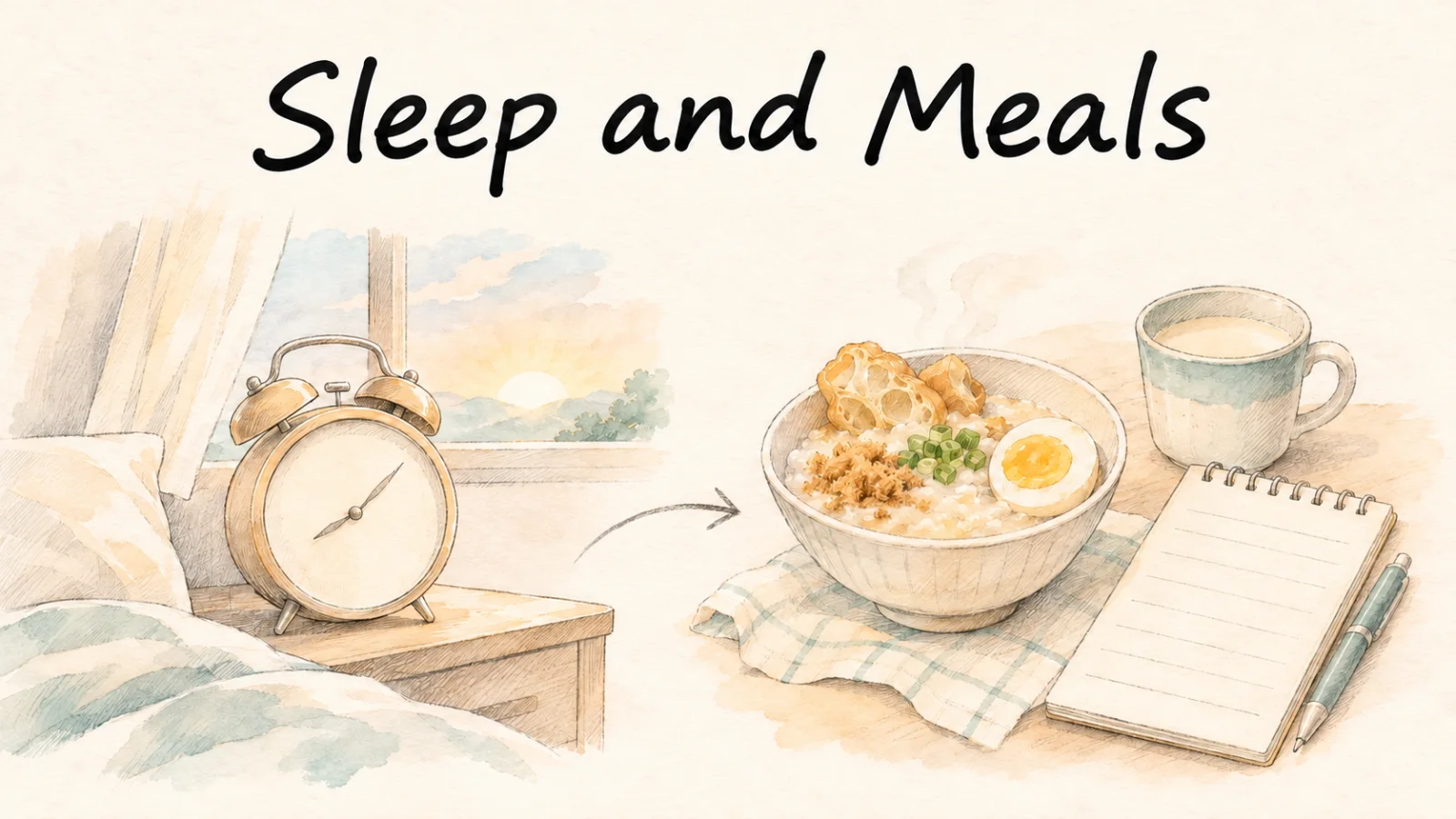
At the end of the week, look for one pattern. Maybe the days you stay up late also happen to be the days you work late and eat after dinner. See whether you spot the same pattern across several days, or whether an earlier finish changes when you feel like eating. The week gives you a glimpse of how your schedule works. Measuring a change in fat mass would take a different kind of data.
Back to those 3 kilograms. The scale tells you how much your weight changed. The sleep experiments answer the questions the scale leaves open: what made up the weight you lost, and how changing sleep affected the amount people ate.
References
[1] Nedeltcheva AV, et al. Insufficient sleep undermines dietary efforts to reduce adiposity. Ann Intern Med. 2010;153(7):435–441.
[2] Tasali E, et al. Effect of sleep extension on objectively assessed energy intake among adults with overweight in real-life settings. JAMA Intern Med. 2022;182(4):365–374.
[3] Zuraikat FM, et al. Insufficient sleep and its effect on body weight and composition: a pooled analysis of randomized trials. Ann Intern Med. 2026;179(8):1085–1093.