
What Shifts When You Sleep Later on the Weekend?
Two nights can both last eight hours and still sit at different times. See how sleep midpoint is calculated and what social jet lag measures.
There is no alarm on Saturday. You wake up to a bright room and do the math. You went to sleep two hours later and got up two hours later than usual, so you still slept eight hours. Did anything about your sleep schedule change?
The amount of sleep stayed the same, and the window in which you slept moved. Researchers can describe that shift by comparing the middle of your sleep on a workday with the middle on a day off. They call the gap between the two times social jet lag. The measurement comes from your schedule and can change even when you spend the whole week in one place [1].
What time is halfway through your night?
Start with a workday. If you fall asleep at 11 p.m. and wake at 7 a.m., that's eight hours. Four hours after 11 p.m. is 3 a.m., the midpoint. On a day off, suppose you fall asleep at 1 a.m. and wake at 9 a.m. Halfway through those eight hours is 5 a.m. In this example, the two sleep midpoints differ by two hours.
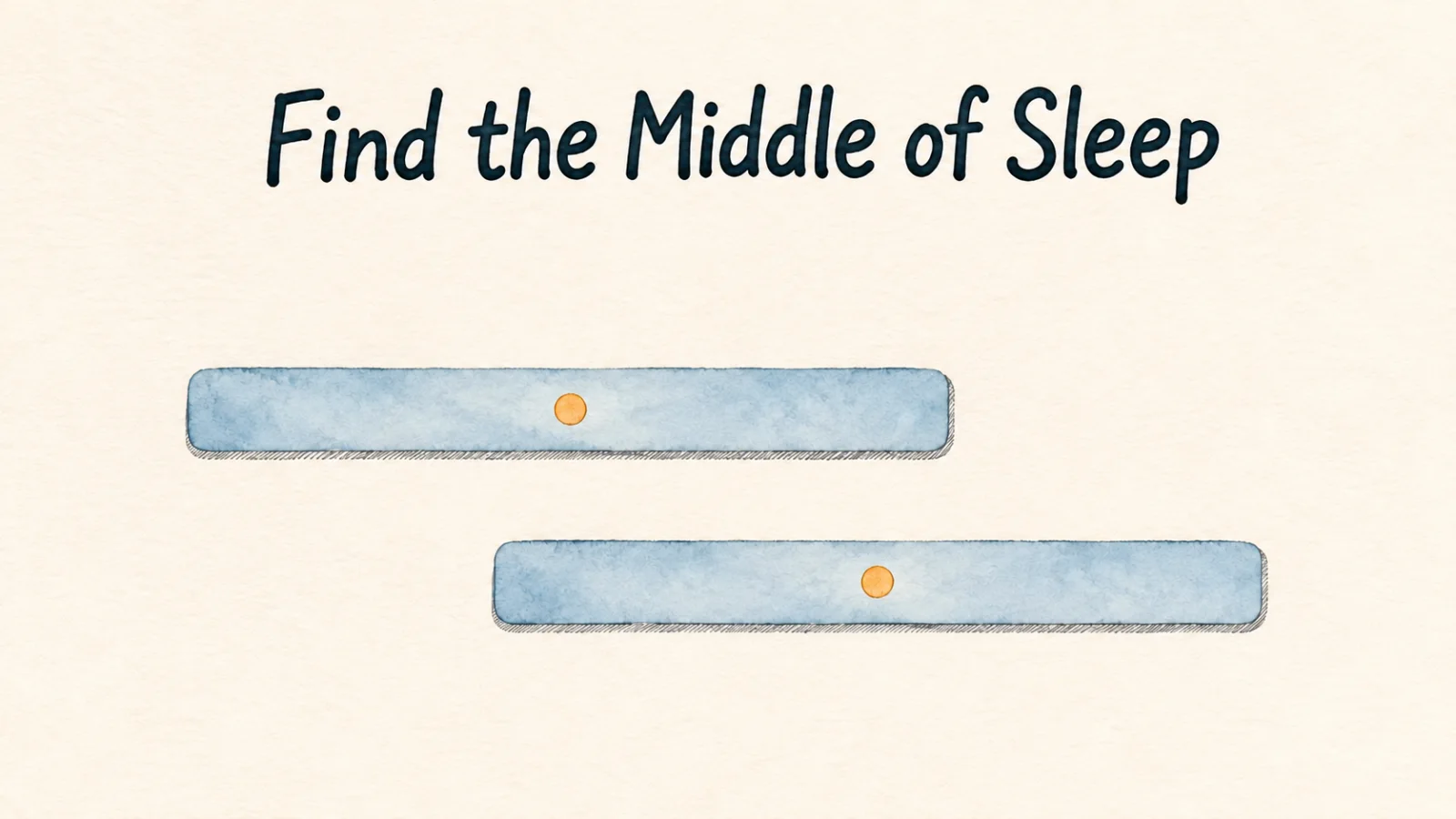
Here's a different weekend. You still fall asleep at 11 p.m., but with no alarm you sleep until 9 a.m. This time you sleep for ten hours. The middle is at 4 a.m., an hour later than on a workday. Both weekends ended with the same 9 a.m. wake-up. In one, the entire sleep window shifted two hours. In the other, staying asleep longer moved the midpoint by an hour.
The term sounds like something a tracker would need to measure while you sleep. You can calculate it afterward. Use the time you think you fell asleep and the time you finally woke. Someone who gets into bed at 11 p.m. and reads until 11:30 p.m. has spent thirty minutes in bed before the sleep period starts. If you use the earlier time, the midpoint shifts a little earlier too.
The midpoint can also stay put when duration changes. Suppose your usual sleep runs from 11 p.m. to 7 a.m., and on one day off you sleep from 10 p.m. to 8 a.m. You added one hour to both ends. The middle of the night is still 3 a.m. If you measured only the midpoint, those nights would look identical, even though one gave you two more hours of sleep.
A workday is a day when your schedule sets the clock
In 2006, researchers collected sleep timing information from 501 volunteers using the Munich ChronoType Questionnaire. The questionnaire separates workdays from days off. The group also asked people about sleep quality, aspects of well-being and some daily habits. What they were looking for was a way to describe how much sleep timing shifts between days with different obligations [1].
The sleep times in a questionnaire can show when people sleep under those two sets of conditions. They are an indirect clue about the internal clock. A lab can answer another question by collecting saliva under controlled dim light and checking when melatonin begins to rise. That's one way to estimate the timing of the body's clock, whether or not someone stayed up late the night before [3].
“Workday” can mean Tuesday for one person and Saturday for another. If you work Saturdays and have Tuesdays off, comparing every Saturday with every weekday blurs the very distinction you're trying to make. The same applies if you have to get up early on a day off to drive someone to an appointment. Write down why you got up so that you can make sense of the time later.
Is the average a target to aim for?
A study in the Dunedin birth cohort in New Zealand compared data from 815 people who were not shift workers, assessed at age 38. The group's average social jet lag was 0.88 hours, or about 53 minutes. Some people had a midpoint that moved farther and some had little difference between their two types of days. The average tells you where the group's results landed taken together [2].
In the study, larger differences between sleep midpoints were associated with some higher measurements related to body weight and waist size. The participants weren't assigned different weekend schedules. Both their sleep questionnaire answers and their body measurements came from the same age assessment. Job patterns, family plans and other circumstances might have helped shape both. The result gives researchers a relationship to investigate. It doesn't tell us what would happen to someone's waist size if that person shifted their weekend wake time [2].
53 minutes is a result for this group. It describes the size of the average shift in these schedules. The study provides a way to ask about your own week, without assigning you an ideal midpoint or a threshold to stay under [2].
The Dunedin analysis excluded shift workers. Night shifts can put a main sleep period in the daytime, and some people use several sleep periods around changing shifts. The average reported for non-shift workers describes a different schedule. If your hours change with a roster, note the actual schedule rather than assuming every calendar weekday has a similar pattern [2].
Keep both times when you write down your sleep
If you'd like to see your own pattern, keep a note for a week or two. Write down when you think you fall asleep and when you last wake up. Add whether you used an alarm or had something that meant you needed to be up. Then set your workdays and days off side by side. Look at the sleep duration and the midpoint separately.
For example, say you fall asleep at midnight on Thursday and wake at 7 a.m. On Sunday, you sleep from 1 to 9 a.m. Thursday's sleep lasted seven hours and had a midpoint of 3:30 a.m. Sunday's lasted eight hours and had a midpoint of 5 a.m. The weekend night gave you one more hour of sleep and shifted the middle by an hour and a half. Those are two things you might have meant when you said your weekend sleep was “different.”
You can do the arithmetic with two typical days first, then add a few more days before drawing a conclusion. A workday that begins extra early and a late party on one weekend can make for a dramatic pair. The record from an ordinary stretch of days will give you a better sense of which change keeps coming up.
When you don't need an alarm next weekend, note both ends of the night. Maybe you slept longer. Maybe you slept the same amount and moved the window. Having both times gives you a clearer picture of what the weekday alarm normally changes.
References
[1] Wittmann M, Dinich J, Merrow M, Roenneberg T. Social jetlag: misalignment of biological and social time. Chronobiol Int. 2006;23(1–2):497–509.
[2] Parsons MJ, et al. Social jetlag, obesity and metabolic disorder: investigation in a cohort study. Int J Obes. 2015;39(5):842–848.
[3] Wright KP Jr, et al. Entrainment of the human circadian clock to the natural light-dark cycle. Curr Biol. 2013;23(16):1554–1558.