
Can a Night of Sleep Make Yesterday's Practice Feel Smoother?
Sleep can help stabilize a newly learned movement sequence, but that does not mean every skill improves 20% overnight. Here is what finger-tapping experiments actually measured.
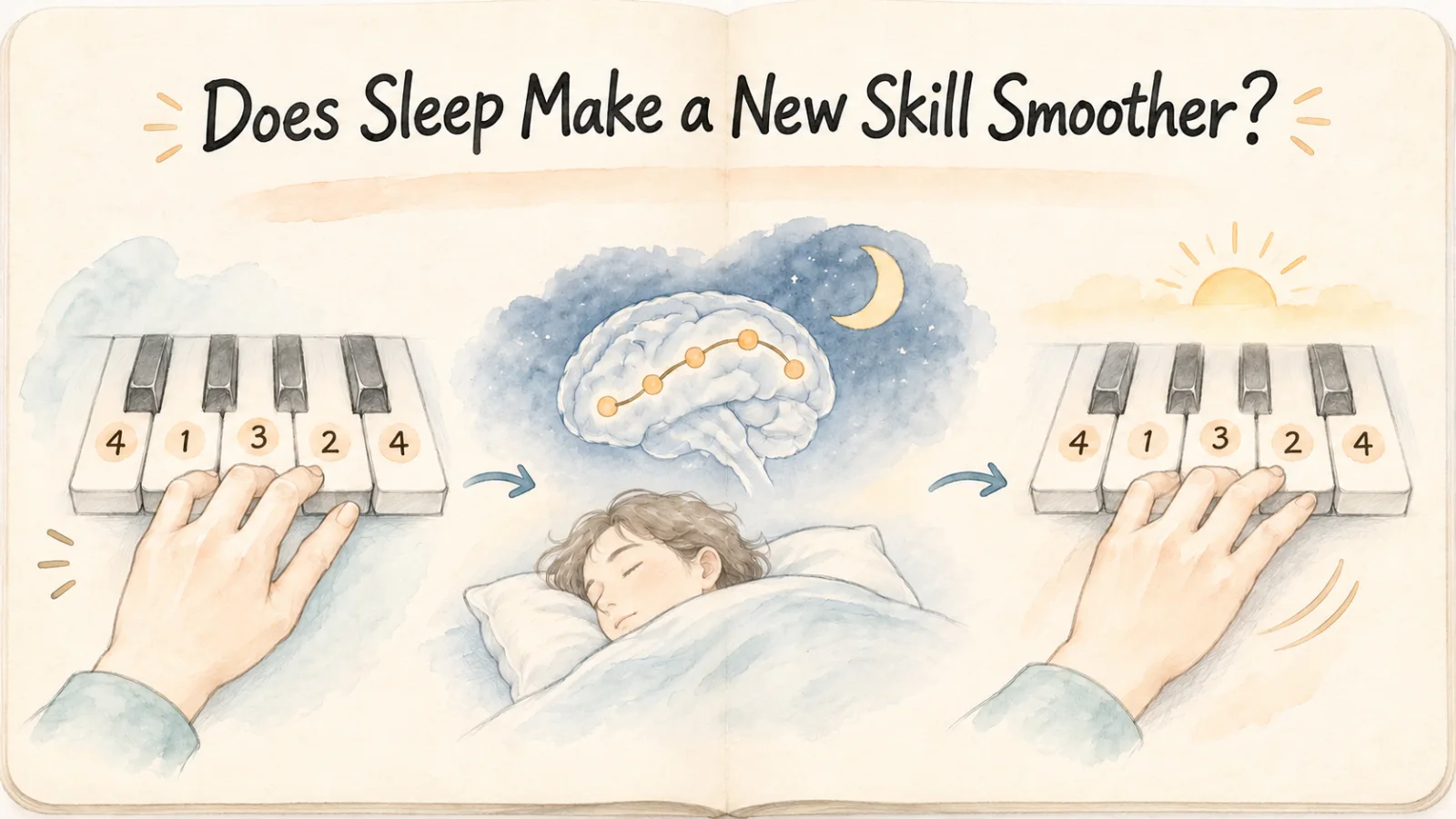
You practice a short piano passage at night. The last few attempts still snag at the same transition. The next morning, before you have practiced again, your fingers seem to find it more easily. Did sleep continue the lesson, or are you just fresher?
Sleep can help a newly learned, simple movement sequence remain stable, and some experiments have measured better performance after sleep. The famous figure of roughly 20%, however, came from young adults tapping five numbers with their nondominant hand. It does not mean a tennis serve, a song, or a rehabilitation exercise will improve by 20% while you sleep [1].
The laboratory skill was five key presses
A 2002 study enrolled 62 right-handed adults ages 18 to 25 and assigned them to five groups. Their task was deliberately narrow. Using four fingers of the left hand, they repeatedly typed 4-1-3-2-4 for 30 seconds. They completed 12 trials, resting 30 seconds between trials. The computer counted both correctly completed sequences and errors [1].
That distinction matters. Finishing more sequences by pressing carelessly would not count as cleaner skill. During the first training session, participants already improved substantially: across the 12 trials, their average number of sequences completed in 30 seconds rose by 8.42. The question was what happened during the next 12 hours, when some participants slept and others remained awake [1].
One group of 15 people trained at 10 p.m. and returned at 10 a.m. after a night of sleep. Their speed on correct sequences had increased 20.5%, or 4.50 sequences on average, without more errors. Over the next 12 hours awake, it rose only another 2.0%. In another group, morning training followed by 12 waking hours produced only a 3.9% change; clear improvement appeared after the following night of sleep [1].
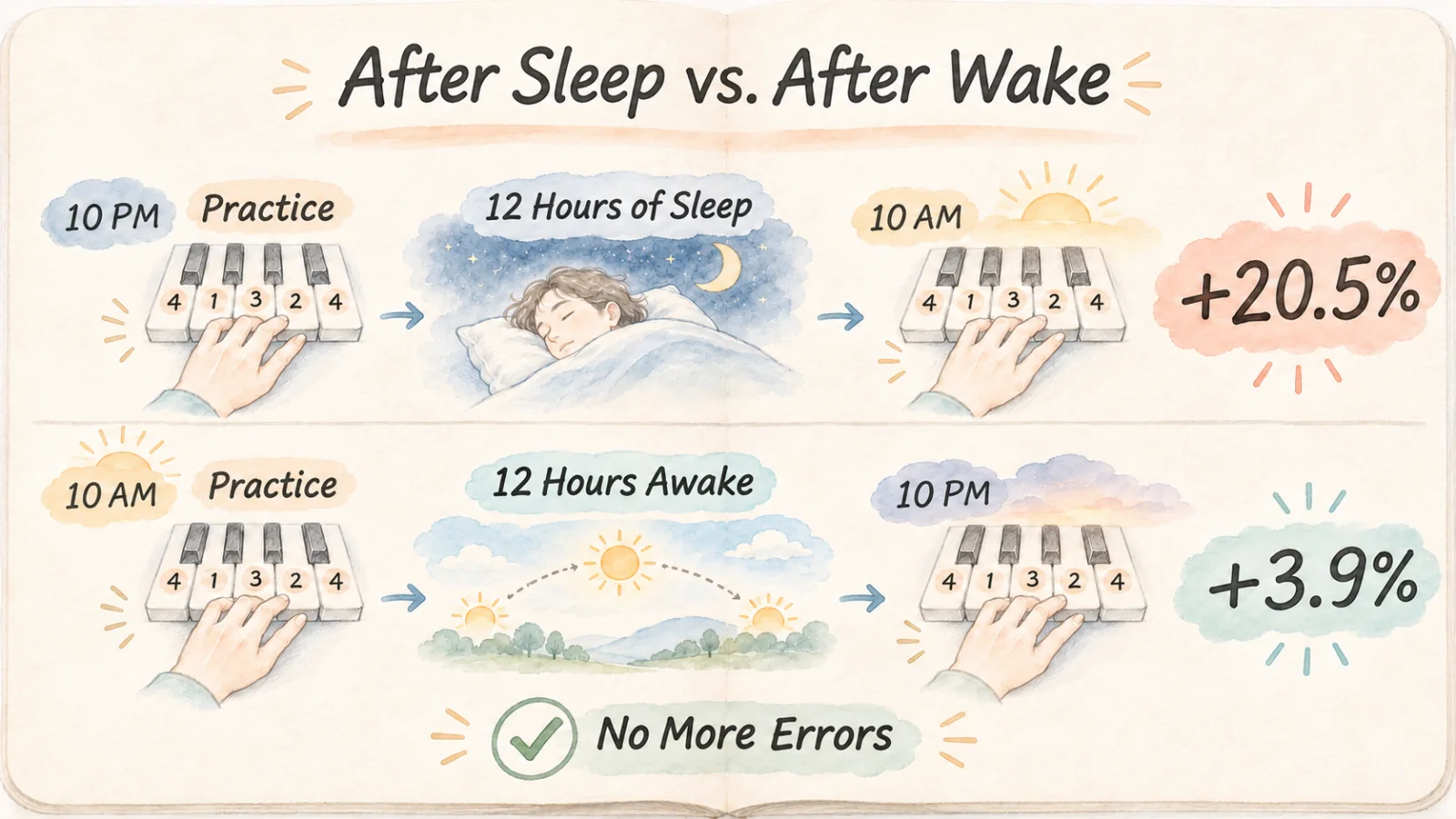
The 20.5% is a group average on one keyboard task. It compares speed at two test points. It does not convert eight hours of sleep into a certain number of practice hours, and the study did not test a complex skill in a studio, clinic, or playing field [1].
Did sleep add performance or preserve an early gain?
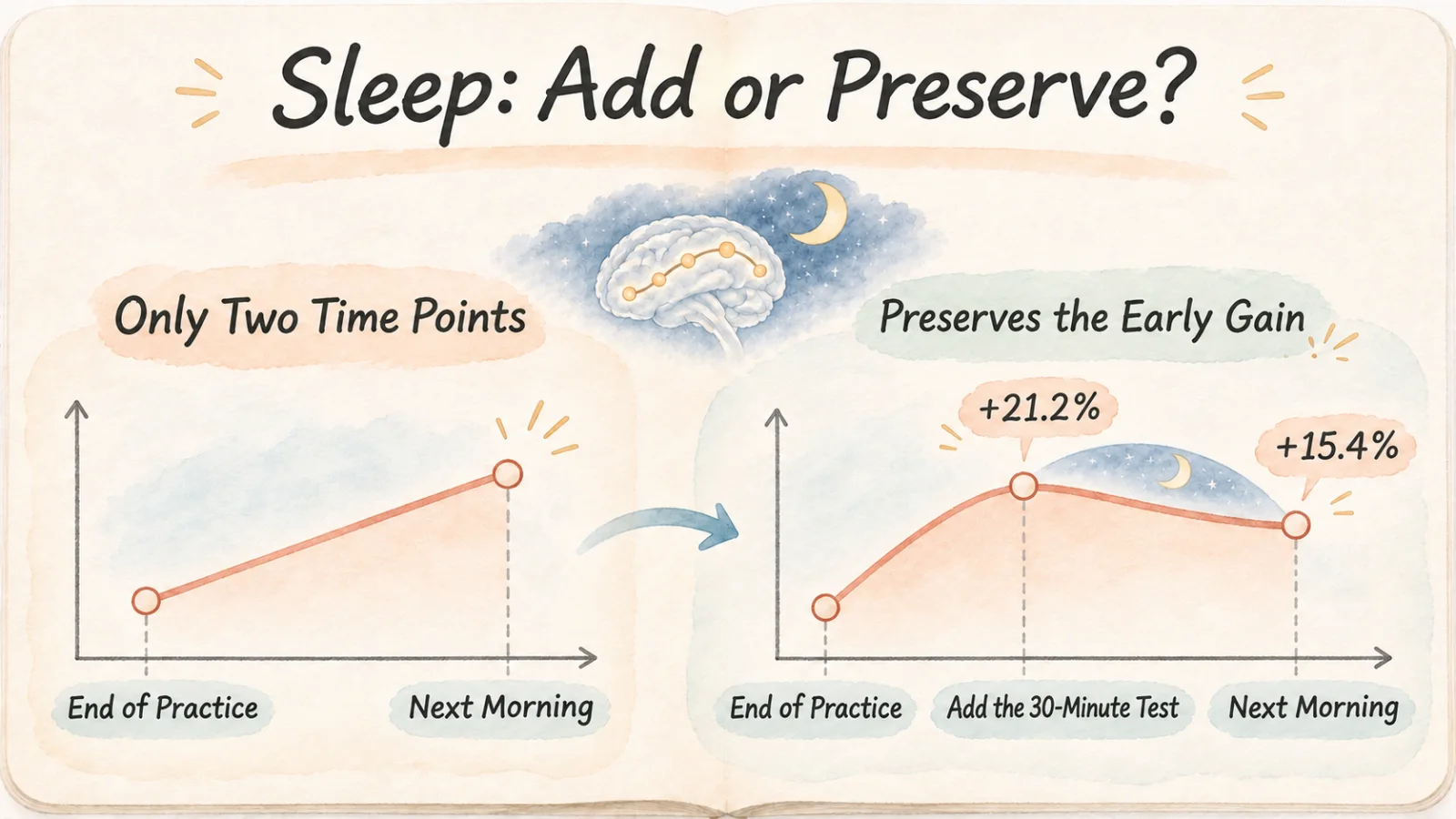
Comparing the end of practice with the next morning leaves out an important moment. The final trials can be affected by fatigue. After 30 minutes of quiet rest, performance may rebound before anyone has gone to sleep. If researchers do not measure that early boost, it gets included in the apparent overnight gain.
A 2015 study added that missing test. Its main experiment included 31 adults. Each person completed both a short wake condition and a sleep condition, using different sequences. When participants were tested 30 minutes after training, their performance was already 21.2% above the end-of-training level. In the corresponding condition measured after a night of sleep, performance was 15.4% higher than the end of training. Those results were not significantly different. Post-sleep performance had not exceeded the high point already visible before sleep [2].
When participants stayed awake for four hours after training, performance was only 6.3% above the training endpoint. After the comparable four-hour interval followed by sleep, it was 15.2% higher. The authors interpreted this pattern as stabilization or restoration: an early boost faded during wakefulness, while sleep preserved or brought back that level. Sleep did not necessarily build another layer of skill on top of the best pre-sleep performance [2].
The way researchers choose a baseline changes the size of the effect, too. In a separate experiment, 15 people took a 90-minute nap and 15 stayed quietly awake. Using the last three practice trials as the baseline made the post-nap improvement look close to 15%. Using each person's best three practice trials reduced the estimate to roughly 5%, although it still remained greater than the wake condition [3]. “Sleep contributes” and “sleep always adds 15% or 20%” are very different claims.
What carries over to a court, instrument, or clinic?
The finger-tapping task is an explicit, repetitive sequence. Real skills combine several demands: force, balance, visual decisions, timing, feedback, and changing surroundings. The original researchers suggested that sports, musical performance, and motor rehabilitation could benefit from post-practice sleep. That is a plausible application to investigate, not a result directly measured in their keyboard experiment [1].
The 2002 study also found that overnight improvement correlated with the share of stage 2 non-REM sleep, especially late in the night. A correlation cannot show that this sleep stage caused the improvement. The study did not selectively add stage 2 sleep and then demonstrate a larger gain. There is no reason to chase a particular “stage 2” score on a consumer watch; its estimates are not the laboratory brain-wave recordings used here [1].
The safest practical conclusion is modest. Practice supplies the movement. A normal period of sleep may help the nervous system consolidate what was practiced. Sleep cannot correct a sequence you repeatedly practiced the wrong way, and the experiments do not tell us that staying in bed longer than usual creates extra skill.
Make one overnight comparison
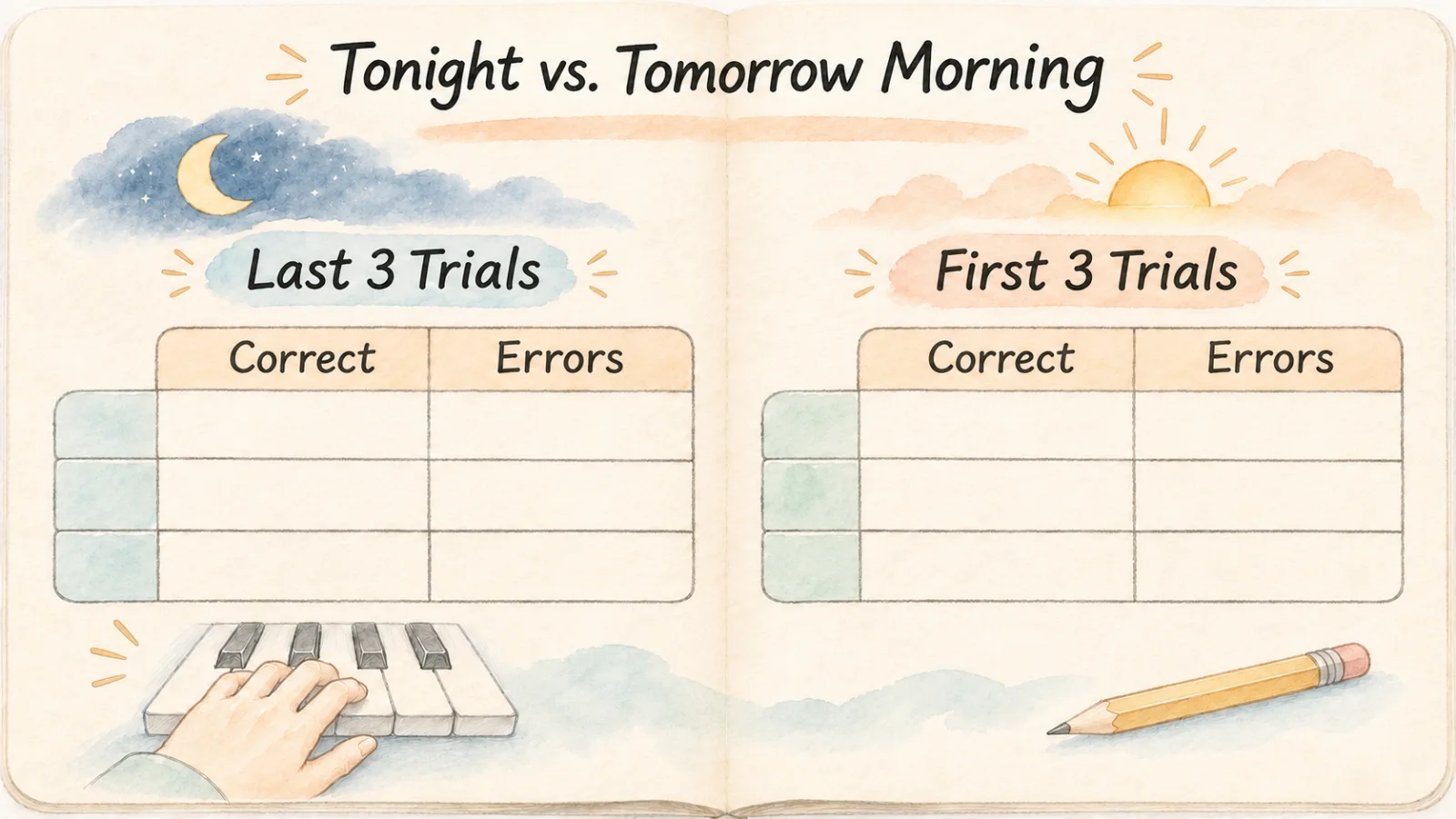
Choose a short sequence you can repeat and score: five piano notes, a fixed dribbling pattern, or a rehabilitation movement that your clinician has already said is safe. In the evening, complete 10 to 12 trials of equal duration. For the final three, record both correct completions and errors. Stop before your form breaks down, and do not deprive yourself of sleep for the sake of a comparison.
The next day, at a similar time and with the same equipment, perform three test trials before adding more practice. If speed rises while errors also rise, “better” is the wrong label. If the numbers remain similar, sleep may have helped preserve the previous level. One night cannot establish a cause; repeating the same comparison three to five times gives you a better view of overnight variation and ordinary good or bad days.
Sleep does not replace practice. A better metaphor is the save button after practice: sometimes the file opens more smoothly the next day, and sometimes the achievement is simply that the new pattern was not lost. Your sleeping brain is not secretly doing another piano lesson. It is still processing the lesson you gave it while awake.
References
[1] Walker MP, et al. Practice with sleep makes perfect: sleep-dependent motor skill learning. Neuron. 2002;35(1):205–211.
[2] Nettersheim A, et al. The role of sleep in motor sequence consolidation: stabilization rather than enhancement. J Neurosci. 2015;35(17):6696–6702.
[3] Hoedlmoser K, et al. Re-examining sleep's effect on motor skills: how to access performance on the finger tapping task? Sleep Sci. 2015;8(1):4–8.